
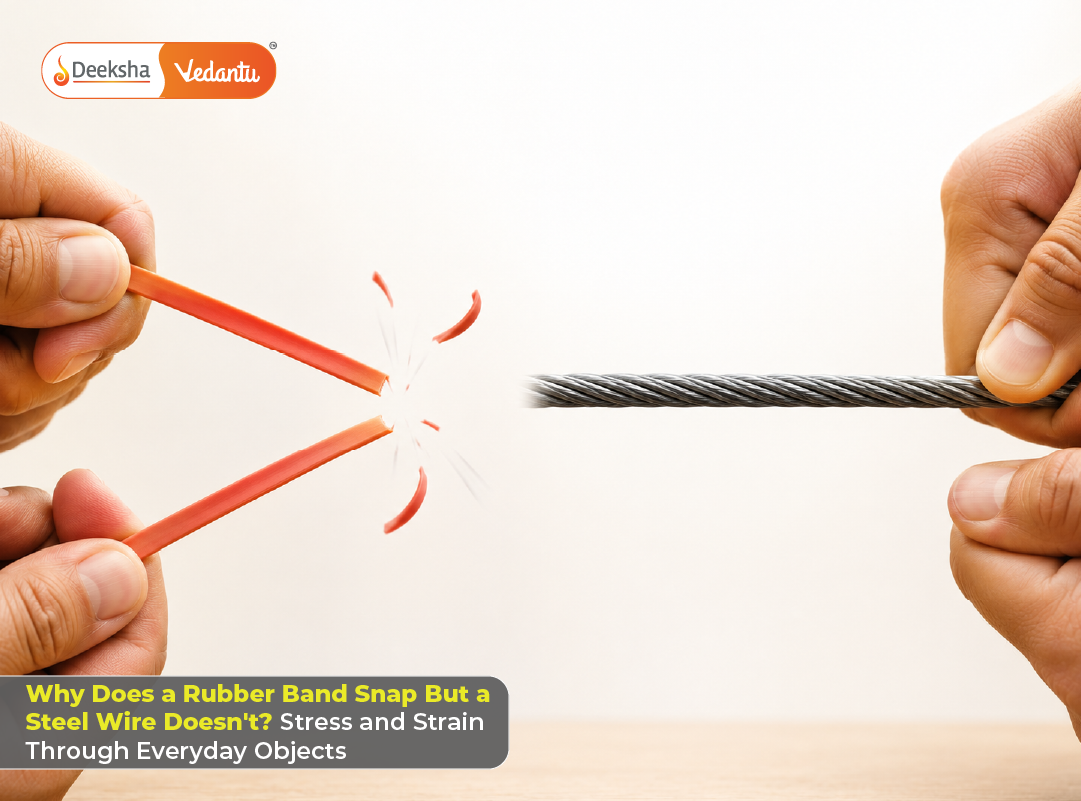


Stretch a rubber band far enough and it snaps almost instantly. Pull on a steel wire with everything you’ve got, and it barely stretches at all – yet steel is the material engineers trust with bridges and skyscrapers, not rubber. This feels backward at first: shouldn’t the material that stretches more easily be the “stronger,” more forgiving one? It isn’t, and understanding exactly why unlocks the entire chapter on Mechanical Properties of Solids without needing a single formula first.
The Rubber Band’s Deceptive Flexibility
Stretch a rubber band a little, and it snaps back perfectly when released – no lasting change. Stretch it further, and it still recovers. But push past a certain point, and two things start happening simultaneously: it becomes noticeably harder to stretch further, and eventually, it just breaks, often without much warning.
What’s actually happening inside the rubber is that its long polymer chains are uncoiling and straightening as you pull. Early on, this uncoiling is easy and fully reversible – the chains slide back into their coiled shape the instant you let go. But once the chains are nearly fully straightened, there’s nowhere left for them to go. Any additional force has to act directly against the chemical bonds themselves, rather than against the geometry of coiled chains, and those bonds fail suddenly rather than gradually.
This everyday experience is a live demonstration of a stress-strain relationship, just without the vocabulary yet. Stress is how much force you’re applying, adjusted for the object’s cross-sectional area. Strain is how much the object has deformed, relative to its original length. The rubber band shows you strain climbing rapidly for relatively little added stress – precisely because it’s so easy to deform, right up until it isn’t.
The Steel Wire That Barely Seems to Move
Now try the opposite experiment mentally: pull on a steel wire with the same effort you used on the rubber band. It barely stretches – the change is often too small to see with the naked eye, even though you’re applying real, significant force.
This isn’t because steel is “resisting” you in some vague sense – it’s because steel’s atomic structure is a tightly packed crystalline lattice, not loosely coiled chains. Deforming that lattice, even slightly, requires genuinely displacing atoms against strong metallic bonds, which takes far more stress to produce even a small amount of strain. This is exactly the relationship Hooke’s Law describes: for many materials, within a certain range, stress is directly proportional to strain – stress = (a constant) × strain, where that constant, called Young’s modulus, is simply a measure of how stiff the material is.
Steel has an enormous Young’s modulus compared to rubber – meaning it takes vastly more stress to produce the same amount of strain. That’s the entire reason steel “seems unmovable” under a force that visibly deforms rubber: it’s not immovable, it’s just proportionally far stiffer, a relationship worked through in full detail on the Hooke’s Law page.
Why the Diving Board Doesn’t Snap Like the Rubber Band
Here’s a case that looks similar to the rubber band at first glance but ends completely differently: a diving board flexes dramatically when someone jumps on it, sometimes bending several inches downward – yet it doesn’t snap the way an overstretched rubber band does, and it springs back to its original shape every single time.
The diving board is operating entirely within what’s called its elastic limit – the range of stress within which a material returns fully to its original shape once the force is removed. The rubber band, by contrast, was pushed beyond its elastic limit in the snapping scenario, into a region where the deformation becomes permanent or catastrophic rather than reversible. Every material has this same elastic limit, it’s just positioned at a very different stress level depending on the material – fiberglass diving boards are specifically engineered to flex enormously while staying comfortably within their elastic range, which is precisely why repeated jumping doesn’t wear them out the way repeated overstretching wears out a rubber band.
Reading a Stress-Strain Graph Like a Story, Not a Chart
If you plotted the rubber band’s entire journey – from gentle stretch, to increasing resistance, to final snap – on a graph with stress on one axis and strain on the other, you’d get a curve that tells this exact story in geometric form. The steel wire’s graph would look completely different: a much steeper, straighter initial line (reflecting its high Young’s modulus and small strain for a given stress), followed eventually by its own version of yielding and breaking, just at a dramatically higher stress level than rubber ever reaches.
This is why the stress-strain curve isn’t really a chart to memorize – it’s a record of exactly the physical journey you can feel with your own hands: an initial straight-line region where Hooke’s Law holds perfectly, a curved region where the material starts deforming more than proportionally, and finally a fracture point where it gives way entirely. The complete anatomy of this curve, including the specific named points along it (yield point, ultimate tensile strength, fracture point), is covered on the stress-strain curve page.
Why Bridge Cables Use Steel, Not Rubber – Even Though Rubber Stretches “More Gently”
It might seem like rubber’s gradual, forgiving stretch would make it the safer engineering choice – surely a material that gives a warning by stretching is better than one that barely moves at all? The opposite is true, and this is the entire practical payoff of understanding stress and strain properly.
A bridge cable needs to support enormous, sustained loads without measurably changing shape – any significant strain under normal loads would mean the bridge itself is constantly flexing, which creates fatigue and eventual failure over time, even without ever approaching a snapping point. Steel’s tiny strain under large stress is exactly the property engineers want: predictable, minimal deformation across an enormous range of everyday loads, with a well-understood elastic limit far above anything the structure will realistically encounter. Rubber’s large strain for modest stress, which felt “gentle” in your hands, would be a structural liability at bridge scale – precisely because it deforms so easily that maintaining a stable shape under load becomes difficult. This same stiffness-versus-flexibility trade-off, expressed through different elastic moduli for different types of deformation (stretching, compression, shearing), is explored fully on the elastic moduli page.
Where This Fits Into Your Broader Preparation
Once this intuition feels solid, the natural next step is understanding how these same principles apply beyond simple stretching – to compression, shearing, and volume changes under pressure, covered on the mechanical properties of solids overview page. For the specific real-world engineering scenarios where elastic behavior determines material choice – bridges, springs, and structural beams – the applications of elastic behaviour page extends exactly the bridge-cable reasoning above into a fuller set of design examples.
Testing this understanding against real exam conditions through JEE Main previous year question papers is the fastest way to see how JEE actually frames stress-strain questions, and for a broader map of where this chapter fits within your full Physics syllabus, this physics formula sheet with concepts and quick revisions is a useful companion reference. Deeksha’s JEE coaching programs are structured around exactly this kind of intuition-first approach, building the physical feel for a concept before the formula is ever introduced.
Frequently Asked Questions
Why does rubber have a much lower Young’s modulus than steel?
Rubber’s long, loosely coiled polymer chains uncoil easily under stress, producing large strain for relatively small stress. Steel’s tightly packed crystalline lattice resists deformation far more strongly, producing much smaller strain for the same stress.
Does every material eventually snap if you apply enough stress, even steel?
Yes – every material has a fracture point beyond its elastic limit. Steel’s fracture point simply sits at a dramatically higher stress level than rubber’s, which is why steel handles everyday loads without visibly deforming.
Why doesn’t a diving board wear out the way an overstretched rubber band does?
As long as the diving board’s flex stays within its elastic limit, it returns fully to its original shape every time, with no cumulative damage – the rubber band only fails when pushed beyond that same kind of limit into permanent or fracture-level deformation.
Stress and strain were never abstract quantities waiting to be memorized – they’re the precise language for something you’ve felt directly: a rubber band’s easy give, a steel wire’s stubborn resistance, a diving board’s forgiving flex. Once you’ve noticed that story playing out in your own hands, the formulas are just naming what you already understood.











Get Social