
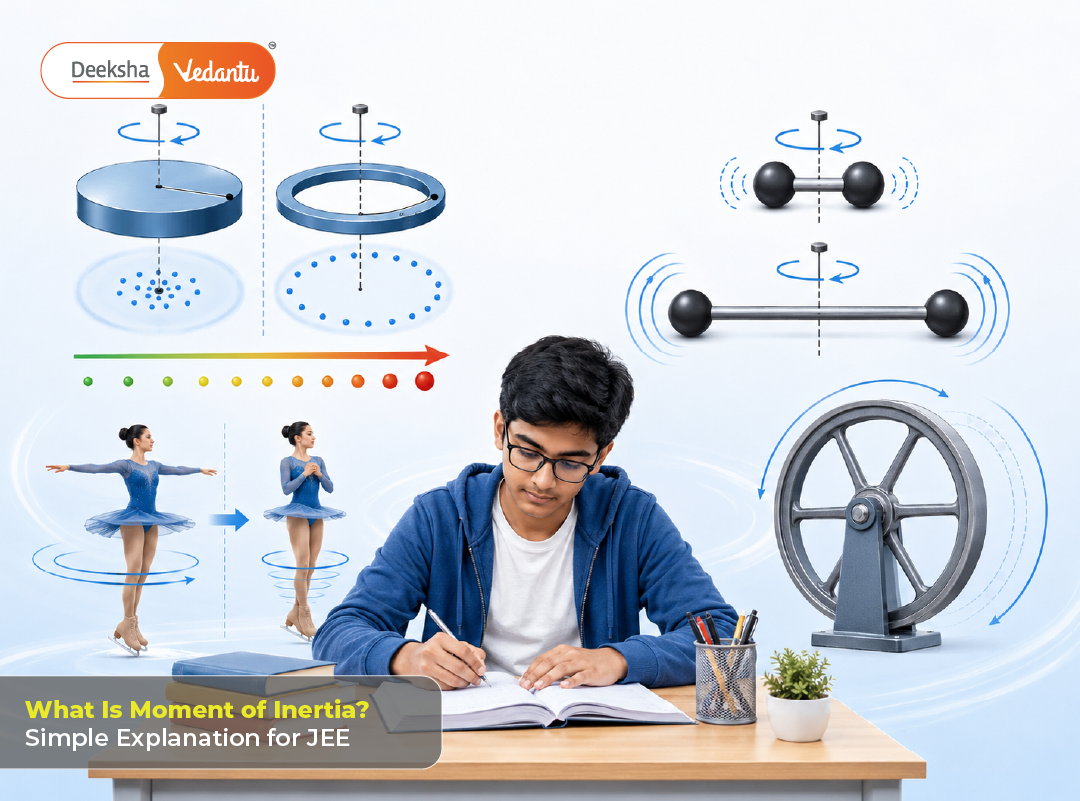


Ask most students what moment of inertia “is,” and you’ll get the formula recited back – I = mr², or some version of it – without a single sentence about what that number actually represents. That’s the problem. Moment of inertia isn’t a formula you memorize; it’s a feeling you’ve already had, dozens of times, without naming it. Let’s find that feeling first, then let the formula follow naturally from it.
The Door That Won’t Budge From the Wrong Spot
Try pushing a door open near its hinge, right next to where it’s attached to the wall. It barely moves, even with real effort. Now push the same door near its outer edge, far from the hinge, with the exact same force. It swings open easily.
Same door, same force, same mass – completely different result. What changed is where the force was applied relative to the axis of rotation (the hinge). This is the first clue toward moment of inertia: rotational resistance isn’t just about how much mass an object has, it’s about how far that mass sits from the axis it’s rotating around.
Spinning a Pen vs. Spinning a Rod of the Same Mass
Imagine two objects with identical mass: a short, fat pen, and a long, thin rod. Try spinning both around their centers with the same twisting effort. The pen spins up quickly. The rod resists far more, even though it weighs exactly the same.
The difference isn’t mass – it’s distribution. The rod’s mass is spread far from the center (the axis of rotation), while the pen’s mass is clustered close to it. This is the second clue: moment of inertia depends on how mass is arranged relative to the axis, not just how much of it exists.
Put these two clues together, and you’ve essentially derived the concept yourself: moment of inertia is a measure of how much an object resists a change in its rotational motion, and it depends on both the mass and how far that mass is distributed from the axis of rotation.
The Figure Skater’s Spin (Where the Formula Becomes Undeniable)
Watch a figure skater spinning with arms outstretched, then pulling their arms in tight to their body. The moment their arms come in, they spin dramatically faster – without any extra push from the ice.
This is moment of inertia changing in real time. With arms out, the skater’s mass is distributed far from their spinning axis (their body’s centerline), giving them a large moment of inertia and slower rotation. Pulling arms in brings that same mass much closer to the axis, sharply reducing moment of inertia – and since angular momentum (which depends on moment of inertia times angular velocity) is conserved in the absence of external torque, angular velocity has to increase to compensate. The skater isn’t working harder to spin faster; they’re exploiting exactly the relationship you just built intuitively from the pen-and-rod example.
Now the Formula Makes Sense
For a single point mass m, rotating at distance r from an axis:
I = mr²
Notice this matches everything we’ve built so far: more mass (m) means more resistance, consistent with the pen-and-rod comparison. And crucially, the distance term is squared – meaning distance from the axis matters even more than mass does. Double the distance, and moment of inertia quadruples, not just doubles. This is exactly why the rod resisted spinning so much more than the pen despite equal mass – most of the rod’s mass sits at a much greater average distance from the center.
For a real object made of many particles rather than a single point, moment of inertia is the sum of every tiny piece of mass multiplied by its squared distance from the axis:
I = Σmᵢrᵢ²
This is why different shapes have different standard formulas – a solid disc, a hollow ring, and a solid sphere all distribute their mass differently relative to their rotation axis, even at the same total mass and radius.
Why a Hollow Cylinder Rolls Slower Than a Solid One
Race a solid cylinder and a hollow cylinder (same mass, same radius) down an identical ramp. The solid one reaches the bottom first, every time.
The solid cylinder has most of its mass distributed closer to the central axis, giving it a smaller moment of inertia (I = ½mr² for a solid cylinder). The hollow cylinder has all its mass pushed out to the rim, as far from the axis as possible, giving it a larger moment of inertia (I = mr² for a thin hollow cylinder). More moment of inertia means more resistance to changes in rotational motion – so as both cylinders convert gravitational potential energy into a mix of linear and rotational kinetic energy while rolling down, the hollow cylinder “spends” more of that energy just getting its rotation going, leaving less to convert into forward speed. That’s the entire race, decided before it even starts, purely by how mass is distributed.
Standard Moment of Inertia Values Worth Knowing
| Shape (about central axis) | Moment of Inertia |
| Solid sphere | (2/5)mr² |
| Hollow sphere (thin shell) | (2/3)mr² |
| Solid cylinder/disc | (1/2)mr² |
| Hollow cylinder (thin) | mr² |
| Thin rod (about center, perpendicular) | (1/12)mL² |
| Thin rod (about one end, perpendicular) | (1/3)mL² |
Notice the pattern across every single row: shapes with mass concentrated near the axis (solid sphere, solid disc) have smaller coefficients, while shapes with mass pushed toward the outer edge (hollow shell, hollow cylinder) have larger ones. You don’t need to memorize these as unconnected facts – you need to recognize that each coefficient is just a numerical signature of how far, on average, that shape’s mass sits from its axis.
Where Moment of Inertia Shows Up Next in Your Preparation
Once this intuition feels solid, it connects directly into torque and rotational dynamics – the relationship between torque, moment of inertia, and angular acceleration mirrors F = ma almost exactly, and is covered in full on the torque and angular momentum page. The figure skater example above is a direct real-world case of the angular momentum in rotation about a fixed axis principle, worth revisiting now that you’ve seen it in action.
For the full mathematical treatment, including the parallel and perpendicular axis theorems that let you calculate moment of inertia about axes other than the center, the dedicated moment of inertia page is the natural next step from here. This concept sits within the broader system of particles and rotational motion unit, and pairs directly with kinematics of rotational motion about a fixed axis for problems involving angular acceleration.
For a broader map of where rotational mechanics sits within your full JEE Physics syllabus, this physics formula sheet with concepts and quick revisions is a useful reference, and Deeksha’s JEE coaching programs are structured to build exactly this kind of intuition-first understanding before formulas are introduced.
Frequently Asked Questions
Is moment of inertia the same thing as mass?
No – mass measures resistance to linear acceleration, while moment of inertia measures resistance to angular (rotational) acceleration, and it depends on both mass and how that mass is distributed relative to the axis of rotation.
Why does a figure skater spin faster when pulling their arms in, without any extra effort?
Because angular momentum is conserved when no external torque acts – pulling arms in reduces moment of inertia, so angular velocity must increase to keep the product of the two constant.
Does moment of inertia change if you rotate the same object about a different axis?
Yes – moment of inertia is always defined relative to a specific axis. The same rod, for instance, has a different moment of inertia when rotated about its center compared to being rotated about one end, since the mass distribution relative to the axis changes.
Moment of inertia was never really a formula waiting to be memorized – it’s the precise version of something you’ve already felt every time you’ve pushed a door, spun a pen, or watched a figure skater pull their arms in. Once that intuition is genuinely in place, the formulas stop being abstract symbols and start being exactly what you’d expect them to say.











Get Social