
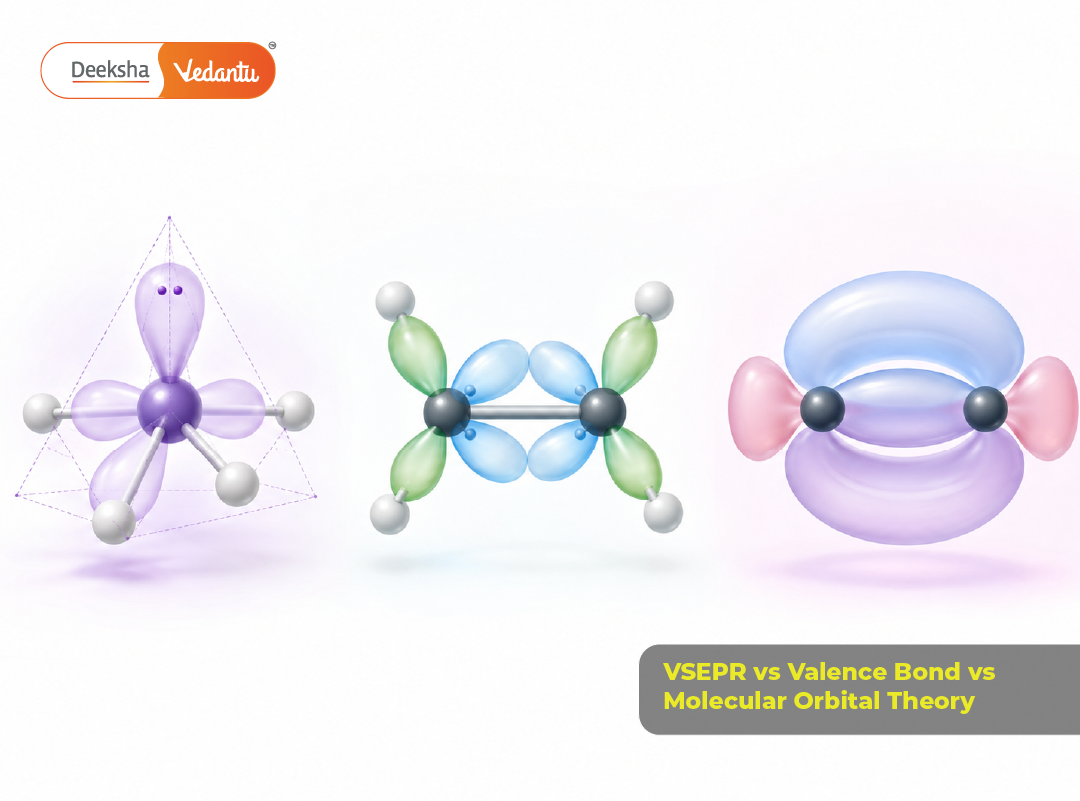


Ask a student to compare VSEPR, Valence Bond Theory, and Molecular Orbital Theory, and you’ll usually get three separate definitions recited back, with no real sense of why chemistry needs three different theories to explain bonding at all. Here’s a better way to see it: pick a single molecule, run it through all three lenses, and watch each theory answer a slightly different question – until one specific real-world fact forces you to bring in the third theory, because the first two simply can’t account for it.
Our test molecule for this entire journey is oxygen, O₂. It looks unremarkable on paper. It’s about to break two of the three theories.
Lens One: VSEPR Asks “What Shape Is This Molecule?”
VSEPR theory – Valence Shell Electron Pair Repulsion – starts from a simple, almost mechanical idea: electron pairs around a central atom, whether they’re in bonds or sitting alone as lone pairs, repel each other and arrange themselves as far apart as geometrically possible. Count the electron pairs, apply the repulsion logic, and you get the molecule’s shape.
For O₂, VSEPR’s answer is almost too simple to be interesting: with only two atoms involved, there’s no central atom with multiple substituents to arrange, so the molecule is necessarily linear – the only possible geometry for two connected atoms. Compare this to ammonia (NH₃), where VSEPR genuinely earns its keep: three bonding pairs and one lone pair around the central nitrogen repel each other into a pyramidal shape, with the lone pair pushing the bonding pairs slightly closer together than a perfect tetrahedral angle would allow.
What VSEPR is good at: predicting molecular shape quickly, using nothing more than a Lewis structure and a counting rule.
What VSEPR can’t tell you: anything about why the bond forms in the first place, how strong it is, or what’s actually happening at the orbital level. VSEPR describes geometry from the outside – it has no mechanism for explaining bonding itself.
Lens Two: Valence Bond Theory Asks “Why Does the Bond Actually Form?”
Valence Bond Theory (VBT) goes a level deeper than VSEPR by describing bond formation as the overlap of atomic orbitals – when two atoms approach each other, their orbitals overlap, and electrons pair up within that overlapping region, creating a bond. VBT also introduces hybridization: the idea that an atom’s orbitals can mix and reshape themselves (sp, sp², sp³, and beyond) to achieve the geometry that best minimizes repulsion and maximizes bond strength – essentially giving a mechanistic, orbital-level explanation for what VSEPR only described geometrically.
Applied to oxygen, VBT tells a specific story: each oxygen atom has two unpaired electrons in its 2p orbitals. According to VBT, these atoms should form a double bond by overlapping two sets of p orbitals – one head-on overlap forming a sigma bond, one sideways overlap forming a pi bond – with all electrons neatly paired up in the process, since bonding is described as pairing electrons within overlapping orbitals.
What VBT is good at: explaining bond strength, bond order, and how hybridization produces specific molecular geometries – genuinely more powerful than VSEPR for predicting energetic and structural properties.
Where VBT quietly breaks: according to this fully-paired-electron picture, O₂ should be diamagnetic – meaning it should be weakly repelled by a magnetic field, since all its electrons are paired and paired electron spins cancel each other’s magnetic effect. Here’s the inconvenient experimental fact: liquid oxygen is famously, visibly attracted to a magnet. It’s paramagnetic, not diamagnetic. VBT’s own bonding picture predicts a molecule that shouldn’t behave this way at all, and it has no internal mechanism to explain the discrepancy.
Lens Three: Molecular Orbital Theory Solves the Puzzle VBT Couldn’t
Molecular Orbital Theory (MOT) takes a fundamentally different starting assumption than VBT. Instead of treating bonding electrons as belonging to overlapping atomic orbitals localized between two specific atoms, MOT says atomic orbitals combine to form entirely new molecular orbitals that span the whole molecule – some of these combinations are bonding orbitals (lower energy, stabilizing), and some are antibonding orbitals (higher energy, destabilizing), and electrons fill these new molecular orbitals following the same rules (Aufbau principle, Hund’s rule) used for filling atomic orbitals.
Run oxygen through this lens, and something changes immediately. When you fill O₂’s molecular orbitals in order of increasing energy, you reach two orbitals of exactly equal energy (degenerate π* antibonding orbitals) with only two electrons left to place. Following Hund’s rule – electrons occupy degenerate orbitals singly before pairing up – these final two electrons go into separate orbitals, each unpaired, each spinning in the same direction.
This is the answer VBT couldn’t reach: MOT correctly predicts two unpaired electrons in O₂’s molecular orbital configuration, which is exactly what makes oxygen paramagnetic. The same theory also correctly calculates O₂’s bond order as 2 (matching the double bond VBT predicted, so VBT wasn’t wrong about bond strength – just wrong about electron pairing), reconciling both theories’ correct predictions while resolving the one VBT genuinely got wrong.
What MOT is good at: explaining magnetic properties, bond order in molecules where VBT’s simple pairing picture breaks down, and phenomena like resonance and delocalization far more naturally than VBT’s localized-bond picture.
What MOT costs you: it’s considerably more mathematically involved than either VSEPR or VBT, and for straightforward molecules where paramagnetism isn’t a factor, it’s often more machinery than the question actually needs.
Three Lenses, Side by Side
| Theory | Core Question It Answers | What It Correctly Predicts for O₂ | Where It Falls Short |
| VSEPR | What shape is the molecule? | Linear geometry (trivial for a diatomic) | No explanation of bonding or magnetism |
| Valence Bond Theory | Why and how strongly does the bond form? | Double bond, correct bond order | Predicts wrongly that O₂ is diamagnetic |
| Molecular Orbital Theory | How are electrons actually distributed across the whole molecule? | Correct paramagnetism, correct bond order | More complex, often unnecessary for simple shape questions |
Why JEE Expects You to Know All Three, Not Just One
Notice that none of these three theories is simply “more advanced” than the others in a way that makes the earlier ones obsolete – each answers a genuinely different question, and JEE tests you on recognizing which theory a given question is actually asking about. A shape question wants VSEPR. A bond formation or hybridization question wants VBT. A magnetic property or bond order anomaly question – especially involving O₂, NO, or similar molecules – wants MOT, and reaching for VBT there will actively lead you to the wrong answer.
To build the full picture behind each lens covered here, the dedicated VSEPR theory, valence bond theory, and molecular orbital theory pages each go considerably deeper than this comparative overview allows. The hybridization mechanism referenced under VBT is developed further on the hybridization page, and the specific molecular orbital diagrams for diatomic molecules like O₂ – the exact calculation behind the paramagnetism result above – are worked through in detail on the homonuclear diatomic molecules page.
This entire comparison sits within the broader chemical bonding and molecular structure unit, which is worth revisiting for the foundational Kossel-Lewis approach and bond parameters that all three theories ultimately build on top of. For structured guidance connecting these three theories the way JEE actually tests them – as complementary tools, not competing answers – Deeksha’s JEE coaching programs are designed around exactly this kind of comparative, question-driven understanding.
Frequently Asked Questions
Do I need to memorize molecular orbital diagrams for every molecule, or just a few?
Focus on the common homonuclear diatomics JEE tests repeatedly – O₂, N₂, and occasionally F₂ or C₂ – since these cover the paramagnetism and bond order patterns most likely to appear, rather than trying to memorize an exhaustive list.
If MOT is more accurate than VBT, why does JEE still test VBT and hybridization separately?
Because VBT and hybridization remain the faster, more intuitive tool for predicting geometry and bond strength in the vast majority of molecules where paramagnetism isn’t in question – MOT is reserved for the specific cases where VBT’s simpler picture actually breaks down.
Is VSEPR ever “wrong” the way VBT was wrong about O₂?
VSEPR is rarely wrong about shape itself, since it’s a comparatively modest, geometry-only claim – its limitation isn’t incorrect predictions, it’s that it simply doesn’t address bonding, energy, or magnetism at all, so it can’t be “wrong” about questions it was never built to answer.
VSEPR, VBT, and MOT were never meant to compete for the title of “correct” bonding theory – they’re three different lenses, each built to answer a different question, and oxygen’s quiet magnetic pull toward a lab magnet is the exact moment history needed the third one. Know which question a JEE problem is actually asking, and choosing the right lens stops being a guess.











Get Social