
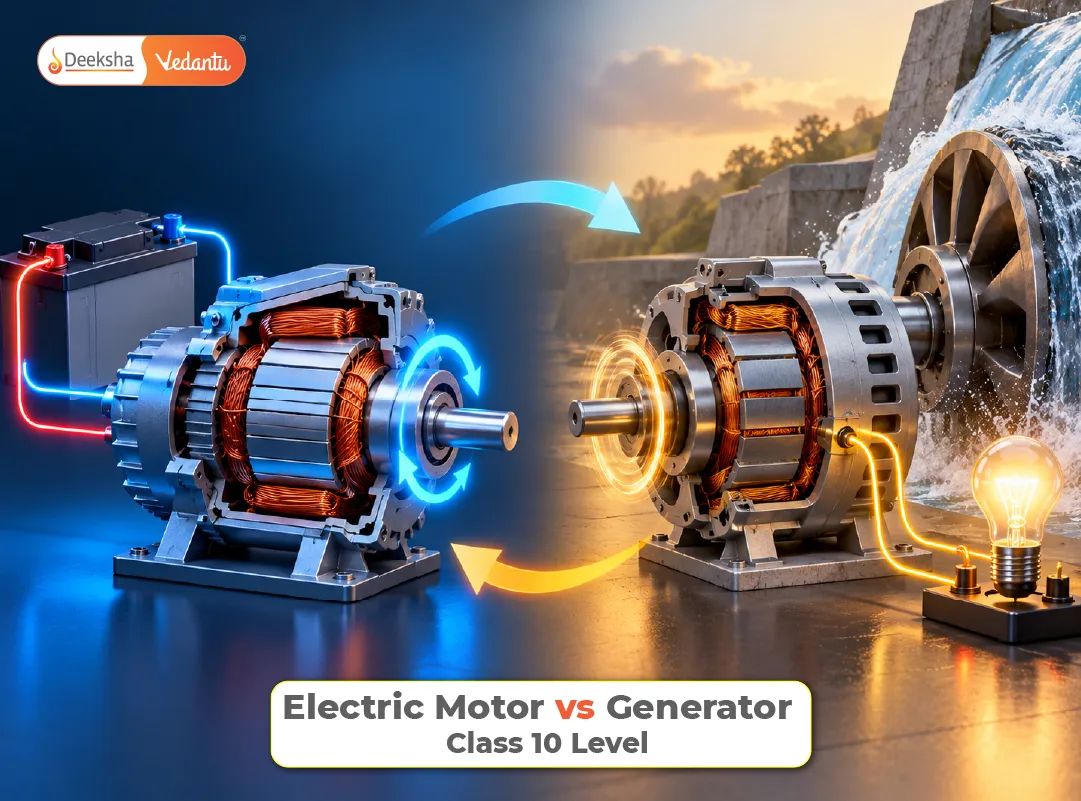


Open a ceiling fan and an electric generator and you will find almost the same hardware: a coil of wire, a magnet and a shaft. Yet one machine turns electricity into motion and the other turns motion into electricity. Students confuse them because the parts look alike, even though the jobs are exactly opposite.
This guide separates the electric motor from the generator by what goes in, what comes out, and which hand rule to use. It then gives you a quick way to decide in an exam, and shows where each machine sits in the Class 10, Class 12 and entrance-exam syllabus.
One Frame, Opposite Jobs
Both machines have a coil, called the armature, placed in a magnetic field. What changes is what you supply and what you collect. In a motor you supply electric current and collect motion. In a generator you supply motion and collect electric current.
| Feature | Electric motor | Electric generator |
| Energy conversion | Electrical to mechanical | Mechanical to electrical |
| Principle | A current-carrying conductor in a magnetic field experiences a force | A changing magnetic flux through a coil induces a current (electromagnetic induction) |
| Input | Electric current from a source | Rotation of the coil, for example by water, steam or wind |
| Output | Rotation of the shaft | Electric current in the circuit |
| Rule used | Fleming’s left-hand rule | Fleming’s right-hand rule |
| Special part | Split-ring commutator | Slip rings (AC) or split rings (DC) |
| Everyday examples | Fan, mixer, washing machine, electric car | Power station alternator, bicycle dynamo, diesel generator |
The two principles are linked in magnetic effects of electric current: electricity can create a magnetic effect, and a changing magnetic effect can create electricity.
How a Motor Turns Current into Motion
The force on a current-carrying coil
When a current flows through a wire in a magnetic field, the wire feels a force on the current-carrying conductor. In a motor, the coil sits between the poles of a magnet. On one side of the coil the current flows one way, and on the other side it flows the opposite way, so the two sides are pushed in opposite directions. Together these forces make the coil rotate.
Why the split-ring commutator is needed
After half a turn, the side of the coil that was being pushed up would be pushed down, and the coil would stop and swing back. The split-ring commutator prevents this. It reverses the direction of the current in the coil every half rotation, so the forces keep turning the coil the same way. Carbon brushes press against the split rings and carry current in from the battery.
Fleming’s left-hand rule
To find the direction of the force, stretch the thumb, forefinger and middle finger of your left hand at right angles to each other.
- Forefinger: direction of the magnetic field.
- Middle finger: direction of the current.
- Thumb: direction of the force, and hence of the motion.
See more on Fleming’s left-hand and right-hand rules.
How a Generator Turns Motion into Current
Electromagnetic induction in a rotating coil
In a generator, an outside source such as falling water, steam or wind turns the coil in a magnetic field. As the coil rotates, the magnetic flux linked with it keeps changing, and by Faraday’s law a current is induced in the coil. The faster the coil turns, or the stronger the magnet, the larger the induced voltage.
Slip rings and split rings
- AC generator: the ends of the coil are connected to two slip rings, and the brushes touch these rings. The current reverses direction every half rotation, so the generator produces alternating current.
- DC generator: the ends are connected to a split-ring commutator, which keeps the current in the outer circuit flowing in one direction, so the output is direct current.
Fleming’s right-hand rule
To find the direction of the induced current, stretch the thumb, forefinger and middle finger of your right hand at right angles to each other.
- Forefinger: direction of the magnetic field.
- Thumb: direction of the motion of the conductor.
- Middle finger: direction of the induced current.
If you want to compare the two kinds of current in detail, read about the difference between AC and DC.
Left Hand or Right Hand? A Quick Way to Decide
One question settles it
Ask yourself: what am I given, and what must I find?
- If the current is given and you must find the force or motion, it is a motor, so use the left hand.
- If the motion is given and you must find the induced current, it is a generator, so use the right hand.
In short: motor means you give current and get motion, and generator means you give motion and get current.
For more practice, try the Class 10 magnetic effects MCQs with answers.
Motors and Generators in the Syllabus
Both machines sit in Class 10 Science, Chapter 12: Magnetic Effects of Electric Current (NCERT numbering for 2026-27; the Karnataka SSLC textbook numbers the same chapter 13). The chapter covers the force on a current-carrying conductor, the electric motor, electromagnetic induction, the electric generator and domestic electric circuits. Published reduced-syllabus lists have, in some years, marked parts of this chapter, such as the generator, direct current and domestic circuits, as deleted or for internal assessment, so confirm the current portions with your board’s syllabus. For a full revision, see these Class 10 notes on the magnetic effects of electric current. The same chapter leads straight into home wiring, which is why how fuses and MCBs protect your home is a natural next read.
The ideas return in Class 12 as Moving Charges and Magnetism, Electromagnetic Induction and Alternating Current, now with formulas for the force on a conductor, induced emf and the AC generator. The NEET UG 2026 and JEE Main syllabi list electromagnetic induction, Faraday’s law, Lenz’s law, and the AC generator and transformer, and KCET covers electromagnetic induction and alternating current from the II PUC syllabus. This guide to electromagnetic induction for NEET shows how it is tested.
For JEE Advanced and for exam years after 2026, check the latest official syllabus. State Board and ICSE syllabi cover the same ideas under their own chapter titles.
Frequently Asked Questions
Q1. What is the main difference between an electric motor and a generator?
An electric motor converts electrical energy into mechanical energy, using the force on a current-carrying conductor in a magnetic field. A generator converts mechanical energy into electrical energy, using electromagnetic induction.
Q2. Which Fleming’s rule is used for a motor and which for a generator?
Fleming’s left-hand rule is used for a motor, to find the direction of the force on the conductor. Fleming’s right-hand rule is used for a generator, to find the direction of the induced current.
Q3. What is the role of the split-ring commutator in an electric motor?
It reverses the direction of the current in the coil every half rotation, so the forces on the coil keep turning it in the same direction instead of letting it swing back.
Q4. What is the difference between an AC generator and a DC generator?
An AC generator uses two slip rings and produces alternating current that reverses direction every half rotation. A DC generator uses a split-ring commutator so that the current in the outer circuit flows in one direction only.
Q5. Can the same machine work as both a motor and a generator?
In principle, yes. A DC machine used as a motor turns electrical energy into motion, and if you turn its shaft with an outside force, it acts as a generator. Electric vehicles use this idea in regenerative braking, where the motor recovers some energy while the vehicle slows down.
Same Parts, Opposite Jobs
Motors and generators are two sides of one idea. Give a coil current inside a magnetic field and it moves. Move a coil inside a magnetic field and it gives current. Once you hold that picture, the left-hand and right-hand rules stop being a memory test and become a question you can answer from the situation.






Get Social