
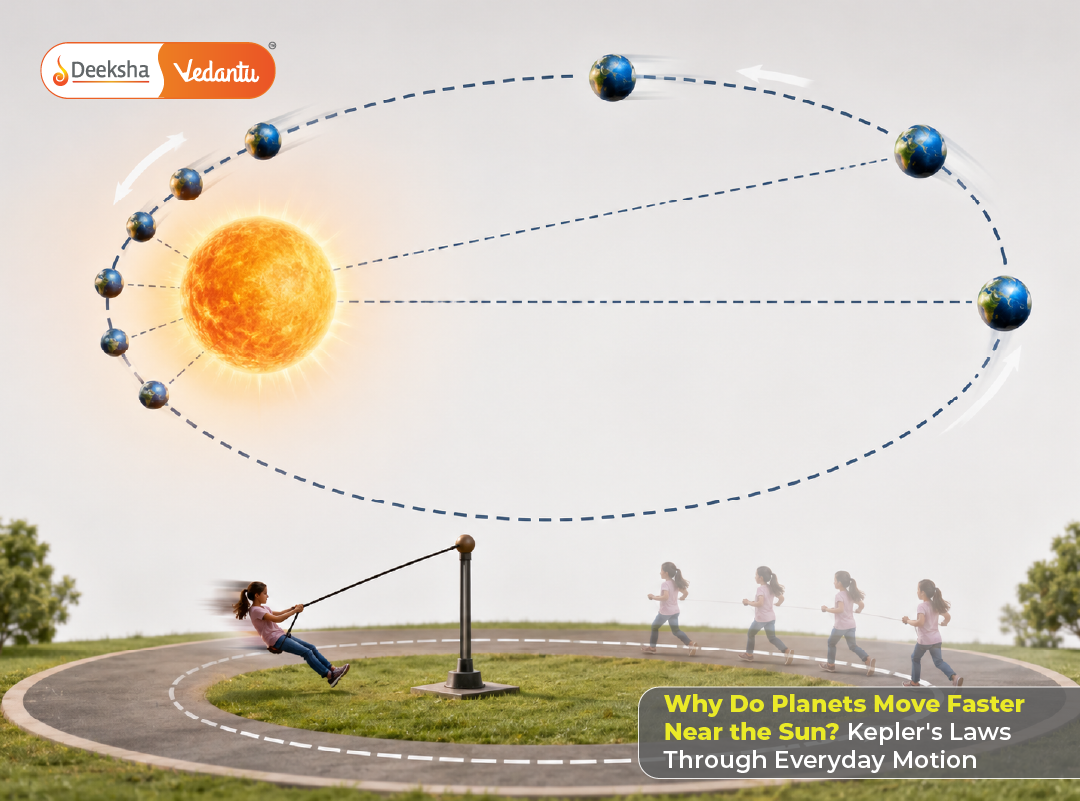


Here’s a genuinely strange fact most students memorize without ever really absorbing: planets don’t move at constant speed around the sun. They speed up as they get closer, and slow down as they drift further away. Kepler figured this out centuries before anyone understood why it happened – he was just staring hard at data and noticing a pattern. We now know exactly why, and it connects to something you’ve already felt with your own body, if you’ve ever spun around holding weights.
The Skater Spin, Applied to an Entire Planet
Recall the intuition behind a spinning figure skater: pull your arms in close to your body, and you spin faster, without any extra push. Push your arms outward, and you slow down. This happens because angular momentum – a quantity that depends on both how fast something’s rotating and how far its mass sits from the center – stays constant unless something actively pushes or pulls the system.
Now stretch that exact same idea across an entire orbit. A planet is essentially “spinning” around the sun, just on a much larger, non-circular path. When it swings close to the sun (a point called perihelion), it’s the astronomical equivalent of the skater pulling their arms in – closer to the center means it has to speed up to keep angular momentum constant. When it drifts far from the sun (aphelion), it’s the skater’s arms stretching outward – farther from the center means it slows down.
This single mental picture – arms in, spin faster; arms out, spin slower – is the entire physical reason planets don’t move at constant speed. Kepler’s Second Law is just this idea, stated in the precise language of geometry.
Kepler’s Second Law: Equal Areas in Equal Times
Here’s how Kepler actually phrased it: an imaginary line drawn from the sun to a planet sweeps out equal areas in equal intervals of time, no matter where the planet is in its orbit.
Picture a thin, pie-slice-shaped wedge traced between the sun and the planet’s position at two moments in time, say, one week apart. Near perihelion, the planet covers a lot of distance in that week (because it’s moving fast), but it’s also very close to the sun, so the wedge is short and stubby. Near aphelion, the planet covers much less distance in that same week (because it’s moving slowly), but it’s far from the sun, making the wedge long and thin. Kepler’s insight was that these two very differently-shaped wedges – stubby-but-wide near the sun, thin-but-long far away – end up covering the exact same area.
This is angular momentum conservation, described geometrically instead of through equations. The area-sweep rate staying constant is mathematically identical to angular momentum staying constant – Kepler just discovered the pattern through painstaking observation, decades before anyone connected it to a deeper physical principle. The formal mathematical link between this law and angular momentum is developed further on the torque and angular momentum page, which is worth revisiting now that you’ve seen where the connection actually comes from.
Kepler’s First Law: Why Orbits Are Ellipses, Not Circles
For centuries before Kepler, everyone assumed planetary orbits had to be perfect circles – circles were considered the “ideal” shape, and the universe was supposed to be built on ideal forms. Kepler broke this assumption by actually looking at Mars’s orbital data closely enough to notice it didn’t fit a circle at all – it fit an ellipse, with the sun sitting not at the center, but at one of the two foci.
Think back to how an ellipse is physically defined: it’s the shape traced by a point whose sum of distances to two fixed foci stays constant. Applied to planetary motion, this means a planet’s distance from the sun genuinely varies throughout its orbit – sometimes closer (perihelion), sometimes farther (aphelion) – rather than staying fixed the way it would on a perfect circle. This single geometric correction is exactly what made Kepler’s model finally match real observational data, after circular models had failed for over a thousand years despite constant patching and adjustment.
Kepler’s Third Law: Why Distant Planets Take So Much Longer to Orbit
Here’s a pattern you might already sense intuitively: Mercury, the closest planet to the sun, completes an orbit in about 88 days. Neptune, one of the farthest, takes about 165 years. That’s not a small difference – it’s a massive one, far larger than the actual difference in orbital distance alone would seem to justify.
Kepler’s Third Law explains why the gap is so extreme: the square of a planet’s orbital period is proportional to the cube of its average distance from the sun (T² ∝ r³). Notice that’s a cube, not a simple proportional relationship – meaning even a modest increase in distance produces a dramatically larger increase in orbital period. This cubic relationship is exactly why Neptune, only about 30 times farther from the sun than Mercury, takes over 680 times longer to complete a single orbit.
The physical reason behind this cubic relationship connects directly to gravity itself weakening with the square of distance – a planet far from the sun feels a much weaker gravitational pull, needs a much lower orbital speed to stay in a stable orbit, and has a vastly longer path to travel at that lower speed. All three effects compound together, which is exactly why the relationship comes out as a cube rather than something simpler. This link between orbital period, distance, and the underlying gravitational force is developed in full on the universal law of gravitation page.
Why All Three Laws Are Really One Story
Notice how each law builds on the same underlying picture: the First Law tells you the shape of the path (an ellipse, with the sun off-center). The Second Law tells you how speed changes along that path (faster near the sun, slower far away, exactly like the skater’s arms). The Third Law tells you how the overall timing scales across different orbits, and why that scaling is so extreme. None of these are separate facts about planets specifically – they’re geometric and dynamical consequences of a single force (gravity) governing motion around a central body.
Where This Fits Into Your Broader Gravitation Preparation
Once these three laws feel intuitive rather than memorized, the natural next step is exploring how a planet’s actual orbital speed and energy are calculated – covered on the energy of an orbiting satellite and earth satellites pages, both of which apply Kepler’s Third Law directly to real satellite calculations. The dedicated Kepler’s laws of planetary motion page works through the full mathematical derivations behind each law in more formal detail, which is worth returning to now that the underlying intuition is in place.
This concept sits within the broader gravitation unit, and connects naturally to escape speed – the related question of how fast an object needs to move to break free of a gravitational pull entirely, rather than settle into an orbit. Deeksha’s JEE coaching programs are built to connect concepts like this one across chapters, so gravitation, rotational motion, and orbital mechanics reinforce each other rather than sitting in separate mental boxes.
Frequently Asked Questions
Why did it take so long for anyone to figure out orbits were ellipses, not circles?
Circular orbits were philosophically assumed to be “ideal” for centuries, and real orbital data had to be studied with unusual precision to reveal the small but consistent deviations that only an ellipse – not a circle – could explain.
Is the speeding-up-near-the-sun effect the same phenomenon as a figure skater spinning faster?
Yes, at a conceptual level – both are consequences of angular momentum staying constant while the distance from the center of rotation changes.
Does Kepler’s Third Law apply only to planets orbiting the sun?
No – it applies to any system where one body orbits another under gravity, including moons orbiting planets and artificial satellites orbiting Earth, as long as the proportionality constant is adjusted for the central body’s mass.
Kepler’s three laws were never really three separate rules to memorize – they’re three different views of the same underlying story: an ellipse-shaped path, a spin that speeds up near the center exactly like a skater pulling their arms in, and a timing relationship so extreme it reveals just how quickly gravity’s pull fades with distance. Once you’ve felt that story once, the equations are just its precise, technical retelling.











Get Social