
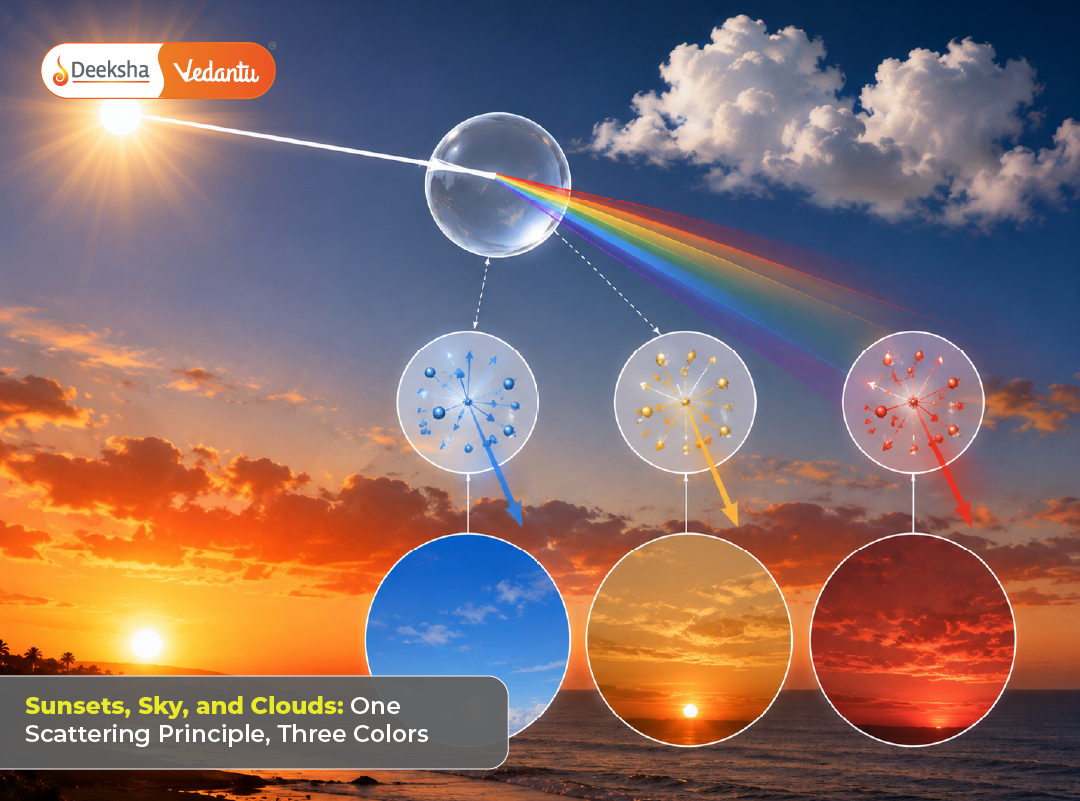


Look up at midday and the sky is blue. Watch the same sky an hour before sunset and it turns orange, then deep red. Look at a cloud passing overhead and it’s neither – it’s simply white. Three completely different colors, from the exact same sun, shining through the exact same atmosphere, on the exact same day. This isn’t three separate phenomena requiring three separate explanations. It’s one single principle, called scattering, producing three different results depending on one variable that changes throughout the day: how much atmosphere sunlight has to travel through before it reaches your eyes.
The One Rule Everything Below Depends On
When sunlight travels through the atmosphere, it collides with countless tiny gas molecules – nitrogen and oxygen, mostly, far smaller than the wavelength of visible light itself. When light scatters off particles this small, it doesn’t scatter equally across all colors. Shorter wavelengths (blue and violet light) scatter far more strongly than longer wavelengths (orange and red light) – a relationship where scattering intensity increases sharply as wavelength decreases. This single, fixed relationship between wavelength and scattering strength is the entire mechanism behind everything that follows: the sky’s blue, the sunset’s red, and the cloud’s white are simply this one rule, applied under three different conditions.
Why the Midday Sky Is Blue, Not Violet
Here’s a question most people never think to ask: if violet light scatters even more strongly than blue light, why isn’t the sky violet instead?
Two separate factors answer this. First, sunlight itself contains considerably less violet light than blue light to begin with, so there’s simply less violet available to scatter in the first place. Second, and more importantly, your own eyes are significantly more sensitive to blue light than to violet light – the biological receptors in your eye register blue far more strongly, meaning even though some violet is genuinely scattering across the sky alongside the blue, your eye perceives the combined result overwhelmingly as blue rather than violet.
So during the middle of the day, when sunlight is taking a comparatively short, direct path through the atmosphere to reach you, blue light scatters strongly in every direction across the sky – including toward your eyes from every angle you look, except directly at the sun itself – which is exactly why the entire sky, not just the area around the sun, appears uniformly blue.
Why the Same Sky Turns Red at Sunset
Now change one variable: the sun’s position in the sky. At sunset (or sunrise), sunlight is no longer taking a short, direct path straight down through the atmosphere – it’s arriving at a steep, glancing angle, which means it has to travel through a dramatically longer stretch of atmosphere before reaching your eyes, compared to the short path at midday.
This longer path is the entire explanation for the color shift. As sunlight travels through this much longer stretch of atmosphere, the strongly-scattering blue and violet light gets scattered away repeatedly, over and over, in countless directions, long before it ever reaches your eyes – effectively “used up” and dispersed elsewhere across the sky. What’s left, having survived that long journey relatively undisturbed, is predominantly the weakly-scattering colors – orange and red – since these longer wavelengths scatter far less easily and can travel that same extended distance without being deflected away nearly as much.
By the time sunlight finally reaches your eyes at sunset, it’s been effectively filtered by its own atmosphere – stripped of most of its blue, and left mostly with the reds and oranges that survived the trip. This is exactly why sunsets over open horizons, where sunlight travels through the most atmosphere, tend to produce the deepest, most dramatic reds, while a sun still fairly high in the sky produces comparatively mild yellow-orange tones, since the atmospheric path at that point is still relatively short.
Why Clouds Are White, Not Blue or Red
Clouds seem to break the pattern entirely – they’re neither blue like the sky nor red like a sunset, they’re simply white, regardless of the time of day. This isn’t an exception to the scattering rule; it’s actually the clearest demonstration of exactly why wavelength-dependent scattering matters in the first place.
The scattering that colors the sky and sunsets specifically depends on the scattering particles being smaller than the wavelength of light – that’s precisely why blue scatters so much more than red under those conditions. Water droplets in a cloud, however, are dramatically larger than the gas molecules responsible for sky-color scattering – large enough that they scatter all wavelengths of visible light roughly equally, rather than favoring blue over red the way smaller gas molecules do. Since all colors scatter off cloud droplets in comparable amounts, they combine back together in your eye as white light – the same white light that entered the cloud in the first place, just scattered many times in many directions by countless droplets before finally reaching you.
This is a genuinely useful contrast to hold onto: it’s not that clouds “don’t scatter light” – they scatter enormously, which is exactly why clouds appear bright and opaque rather than transparent. It’s that they scatter every color equally, while the clear sky scatters colors unequally, and that single difference in particle size is the entire reason one produces color and the other produces white.
One Principle, Three Results
| Phenomenon | Path Length Through Atmosphere | Particle Size | Result |
| Midday blue sky | Short, direct | Small gas molecules | Blue scatters strongly in all directions |
| Sunset/sunrise red | Long, glancing angle | Small gas molecules | Blue scattered away en route; red survives |
| White clouds | Varies | Large water droplets | All colors scatter equally, recombining as white |
Why This Same Principle Also Explains a Dimmer Winter Sun and a Hazy Horizon
This wavelength-dependent scattering explains a few more everyday observations worth connecting here. The sun looks noticeably dimmer and more orange-tinted through fog, smoke, or heavy pollution than it does on a clear day – the added particles in the air scatter even more light away before it reaches you, further depleting the shorter wavelengths and shifting the visible sun further toward orange and red, exaggerating the same effect that happens naturally at every sunset. This same scattering-based reasoning is also why distant mountains often appear slightly blue-tinted on a clear day – you’re looking through a thick enough stretch of atmosphere, even during the middle of the day, that some of that same blue-scattering effect starts becoming visible even over a horizontal distance rather than only vertically at sunset.
Where This Fits Into Your Broader Preparation
The complete formal treatment of this scattering mechanism, including Tyndall effect and its specific NCERT framing, is covered on the scattering of light page, which extends directly from the sky-sunset-cloud story above into the exact terminology and definitions your exam will expect. This concept connects closely to atmospheric refraction, which explains a related but distinct phenomenon – why stars twinkle and why the sun appears slightly displaced near the horizon – often taught alongside scattering in the same chapter.
Since this topic sits within the same broader unit as dispersion, revisiting why we see a rainbow after rain is worth doing together with this piece, since both dispersion and scattering explain different sky-color phenomena using related but distinct wavelength-dependent principles – a distinction NCERT specifically tests. For structured, board-exam-specific coverage, the human eye and colourful world page ties scattering directly into its full chapter context, and testing this understanding against real exam conditions through important questions for Class 10 Physics will confirm how much of this intuition has translated into exam-ready recall.
Frequently Asked Questions
Is the blue sky caused by the same mechanism as a rainbow?
No – a rainbow is caused by dispersion (light splitting by refraction inside raindrops), while the blue sky is caused by scattering (light bouncing off small gas molecules); both are wavelength-dependent, but they’re genuinely different physical processes, a distinction commonly tested directly.
Why doesn’t the sky turn white if enough blue light is scattering in every direction?
Because the scattering is still strongest for blue specifically, not equal across all colors – enough blue dominates the mixture reaching your eyes from the sky that it reads as blue overall, unlike cloud droplets, which are large enough to scatter every color equally and produce true white.
Would the sky be a different color on a planet with a different atmosphere?
Yes, in principle – sky color depends on the specific gases present and their scattering behavior, which is exactly why planets with different atmospheric compositions (like Mars, with its dustier atmosphere) can show visibly different sky colors than Earth’s.
The blue sky, the red sunset, and the white cloud were never three separate mysteries needing three separate explanations – they’re one single wavelength-dependent scattering rule, playing out differently depending on how far sunlight travels and how large the particles are that it collides with along the way. Once you can trace all three back to that one shared mechanism, the entire “why is the sky blue” chapter stops being a memorized fact and becomes something you can actually reconstruct from first principles, in any lighting condition you happen to look up into.











Get Social