


Introduction to Coordinate Geometry
Coordinate Geometry, also known as Cartesian Geometry, is a branch of mathematics that bridges the gap between algebra and geometry. It involves the use of a coordinate plane to study geometric figures, enabling the precise location of points, lines, and shapes in two-dimensional space. This mathematical tool is widely used in physics, engineering, navigation, and architecture. It also forms the basis of many advanced mathematical concepts and has applications in various fields such as robotics, astronomy, and computational graphics.
Key Components of Coordinate Geometry
- Cartesian Plane
- The Cartesian plane consists of two perpendicular axes:
- X-axis (horizontal): Represents the horizontal component of a point.
- Y-axis (vertical): Represents the vertical component of a point.
- The point of intersection of these axes is called the origin (
 ). Every point on the plane is uniquely defined by its distance from the X-axis and Y-axis.
- The Cartesian plane consists of two perpendicular axes:
- Coordinates of a Point
- A point on the Cartesian plane is represented by an ordered pair
 , where:
 is the distance from the Y-axis (horizontal distance).
 is the distance from the X-axis (vertical distance).
- This representation allows for precise plotting of points, making it easier to solve problems related to geometry and algebra.
- A point on the Cartesian plane is represented by an ordered pair
- Quadrants
- The Cartesian plane is divided into four quadrants:
- Quadrant I:
 , where both coordinates are positive.
 - Quadrant II: , where the x-coordinate is negative, and the y-coordinate is positive.
- Quadrant III: , where both coordinates are negative.
- Quadrant IV: , where the x-coordinate is positive, and the y-coordinate is negative.
- Quadrant I:
- Understanding the quadrants is essential for analyzing and solving problems involving points and figures on the Cartesian plane.
- The Cartesian plane is divided into four quadrants:
 ). Every point on the plane is uniquely defined by its distance from the X-axis and Y-axis.
 , where:
 is the distance from the Y-axis (horizontal distance).
 is the distance from the X-axis (vertical distance).
 , where both coordinates are positive.
 , where the x-coordinate is negative, and the y-coordinate is positive.
 , where both coordinates are negative.
 , where the x-coordinate is positive, and the y-coordinate is negative.
Distance Formula
The distance formula is used to calculate the distance between two points  and
and  on the Cartesian plane. The formula is derived from the Pythagorean Theorem and is given by:

Example:
Find the distance between  and
and  .
.

Answer: The distance is  . This formula is frequently used in real-life applications, such as determining the shortest path between two points in navigation or robotics.
Section Formula
The section formula helps in finding the coordinates of a point that divides a line segment joining two points and in a specific ratio  . The formula is:

Example:
Find the coordinates of the point dividing the line joining and  in the ratio
  .
.

Answer: The point is  . This formula is widely used in construction and design to locate specific points on beams or architectural structures.
Midpoint Formula
The midpoint formula calculates the exact center point of a line segment joining two points and . The formula is:
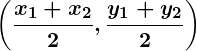
Example:
Find the midpoint of the line joining  and
and  .
.

Answer: The midpoint is  . It is particularly useful in geometry, navigation, and even computer graphics for defining central points.
Area of a Triangle
The area of a triangle formed by three points , , and  on the Cartesian plane can be calculated using the following formula:

Example:
Find the area of the triangle formed by the points ,  , and
, and  .
.

Answer: The area is  . This formula is essential in fields like civil engineering for determining land areas and structural designs.
Applications of Coordinate Geometry
- Navigation Systems: GPS systems use coordinate geometry to pinpoint exact locations on maps, allowing for accurate directions and tracking.
- Architecture: Architects rely on coordinate geometry to design structures, ensuring precision in dimensions and aesthetics.
- Physics and Engineering: It helps in plotting graphs, analyzing motion, designing mechanical systems, and solving real-world problems.
- Computer Graphics: Used extensively in video game development, simulations, and animations to map objects in 2D and 3D spaces.
- Astronomy: Coordinate geometry aids in calculating distances between celestial objects and mapping the universe.
Practice Problems
- Find the distance between the points
 and .
and . - Determine the coordinates of the point dividing the line joining and in the ratio
 .
. - Find the area of the triangle formed by the points , , and .
- Calculate the midpoint of the line joining
 and .
and . - Verify whether the points , , and
 are collinear.
 and
and  .
. and
and  in the ratio
  .
. , and
, and  .
. and
and  .
. , and
, and  are collinear.









Get Social