


SEO Title: Introduction to Motion in a Straight Line – Class 11 Physics Notes
Meta Description: Learn the basics of motion in a straight line with clear NCERT-aligned explanations. Understand motion, point objects, and kinematics with Deeksha Vedantu’s conceptual approach, expanded with detailed examples and deeper conceptual insights.
2.1 Introduction – Motion in a Straight Line
Motion is one of the most observable and essential aspects of the physical world. Everything around us-from the fluttering of leaves and flowing rivers to the movement of vehicles, the beating of the human heart, and even the orbiting of planets-exhibits some form of motion. In physics, we go beyond simply observing motion. We study how objects move, how fast they move, and how their motion can be represented mathematically to make predictions and solve real-world problems.
This section introduces rectilinear motion, or motion in a straight line, the simplest form of motion to analyse. A strong understanding of this topic provides the foundation for studying more complex concepts like two-dimensional motion, vectors, projectiles, and Newton’s laws. At Deeksha Vedantu, we ensure that students not only understand these ideas theoretically but can also apply them confidently in exams.
What Is Motion?
In physics, an object is said to be in motion if its position changes with time relative to a chosen point of reference. This reference point could be a stationary tree, a signpost, or even the Earth itself, depending on the context. Understanding motion requires us to observe how far an object has moved, in what direction, and over what period of time.
We encounter motion everywhere in daily life. Consider the following examples:
- A bus moving along a busy road
- A child running across a playground
- A ball rolling down an inclined surface
- Water flowing gently through a stream
- Blood circulating through the veins in the human body
- The Earth rotating on its axis and revolving around the Sun
Interestingly, even when a person is sitting still, many types of motion continue internally-air moves in and out of the lungs, the heart pumps blood, and food travels through the digestive system. In physics, understanding these movements helps build an appreciation of how dynamic the world truly is.
Motion in a Straight Line (One-Dimensional Motion)
Motion becomes simpler to describe when it occurs straight along a single path. This is known as one-dimensional motion or rectilinear motion. In this case, the motion can be described using just one coordinate axis, usually the x-axis. This eliminates the complexity of direction changes and allows us to deeply explore the fundamental quantities of motion.
In this chapter, students learn to describe motion using:
- Position: The exact location of an object on a reference axis.
- Distance: The total path travelled by an object, regardless of direction.
- Displacement: The shortest straight-line distance between the initial and final positions, along with the direction.
- Speed: The rate at which distance is covered.
- Velocity: The rate of change of displacement, including direction.
- Acceleration: The rate of change of velocity with respect to time.
These ideas lay the foundation for understanding graphs, equations of motion, and advanced physics concepts. At Deeksha Vedantu, we present these ideas through real-life examples and visual demonstrations so students develop intuition alongside analytical skills.
Why Do We Treat Objects as Point Objects?
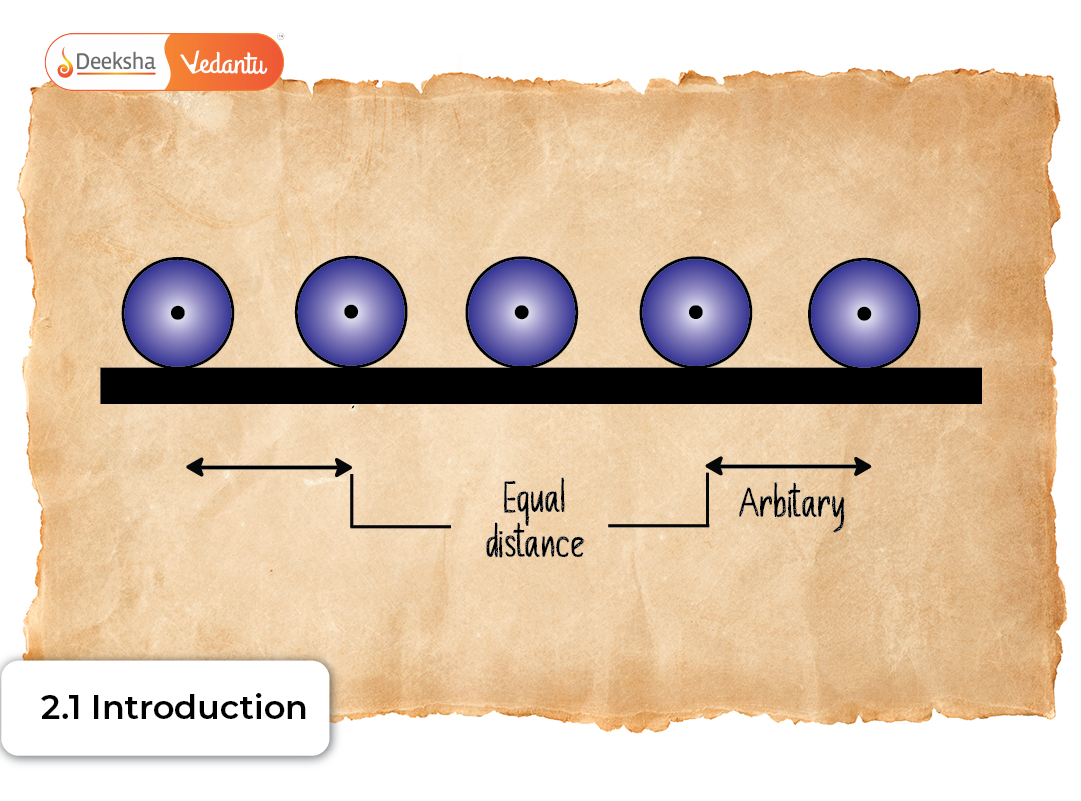
In physics, analysing the motion of a large, complex object can be challenging. To simplify things, we often treat objects as point objects-meaning we consider the entire object to be concentrated at a single point. This is valid when the size of the object is negligible compared to the distance it travels.
For example:
- A train travelling 150 km can be approximated as a point object because its dimensions (length, width, height) are extremely small compared to the distance covered.
- A car driving from one city to another covers tens or hundreds of kilometres, so its actual size becomes irrelevant to motion analysis.
- A cricket ball tossed across a field follows a predictable path where treating it as a point makes the analysis easier and more accurate.
This simplification reduces unnecessary complexity and allows us to focus on the quantities that matter. At Deeksha Vedantu, we emphasise when and why such approximations are valid so students can apply them confidently in physics problems.
Kinematics vs Dynamics
Motion can be studied from two perspectives:
- Kinematics: The branch of physics that deals with describing motion without considering the forces that cause it.
- Dynamics: The study of motion along with the forces responsible for the motion.
This chapter focuses entirely on kinematics. It teaches students to describe motion using graphs, equations, and mathematical relationships. The causes of motion-such as forces, friction, and Newton’s laws-are explored later in the study of dynamics. By learning kinematics first, students build the analytical tools needed to solve motion-related problems effectively.
Why This Topic Matters
Understanding motion in a straight line is essential because it:
- Forms the base for studying more advanced mechanics topics
- Helps students interpret and construct graphs like position-time and velocity-time graphs
- Develops problem-solving skills needed for numerical physics
- Strengthens understanding for competitive exams such as JEE, NEET, KCET, and COMEDK
At Deeksha Vedantu, our teaching approach ensures depth and clarity through:
- Visual explanations: Diagrams, animations, and real-life demonstrations
- Interactive sessions: Doubt-clearing, live problem-solving, and concept reinforcement
- Level-wise practice: From basic problems to high-order thinking questions
- Exam-oriented preparation: Tips, shortcuts, and solved examples for competitive exams
We help students not just memorise concepts but truly understand them.
FAQs – Introduction to Motion
Q1: What does it mean for an object to be in motion?
An object is in motion if its position changes with time relative to a reference point. Motion must always be described with respect to something else.
Q2: What is one-dimensional motion?
One-dimensional motion is motion along a straight line that can be described using a single coordinate. Examples include a train moving on a straight track or a ball thrown vertically upward.
Q3: Why do we treat objects as point objects?
Objects are treated as point objects when their size is negligible compared to the distance they travel. This simplifies calculations without affecting accuracy.
Q4: Does this chapter explain the cause of motion?
No. This chapter deals only with describing motion (kinematics). The causes of motion, such as forces, are explained later in the laws of motion.
Q5: How does Deeksha Vedantu help students learn this topic?
We use real-life examples, visual tools, guided numerical practice, and concept-building exercises to give students a strong grasp of motion. Our structured learning system ensures readiness for both board and entrance exams.
Conclusion
The study of motion in a straight line introduces students to the core concepts of physics and builds the analytical mindset needed for later topics. By understanding motion, displacement, speed, velocity, and the importance of reference frames, students develop a foundation that supports every future chapter in mechanics.
At Deeksha Vedantu, we go beyond traditional teaching by combining conceptual clarity with practice-based learning, encouraging students to think scientifically, solve confidently, and approach physics with curiosity and enthusiasm.



Get Social