


In physics, an object is said to be in motion if its position changes with time with respect to a chosen reference point. When this motion happens along a single straight path, it is called motion in a straight line or one-dimensional motion.
In this chapter, you come across a few fundamental quantities:
- Position: The location of an object on a chosen axis (for example, x-axis).
- Distance: The total path length travelled by the object, irrespective of direction.
- Displacement: The shortest straight-line distance between the initial and final positions, along with direction.
- Scalar quantity: A quantity that has only magnitude (like distance, speed).
- Vector quantity: A quantity that has both magnitude and direction (like displacement, velocity, acceleration).
Distance is always positive and can only increase as the object moves. Displacement, on the other hand, can be positive, negative, or zero depending on the direction of motion and final position.
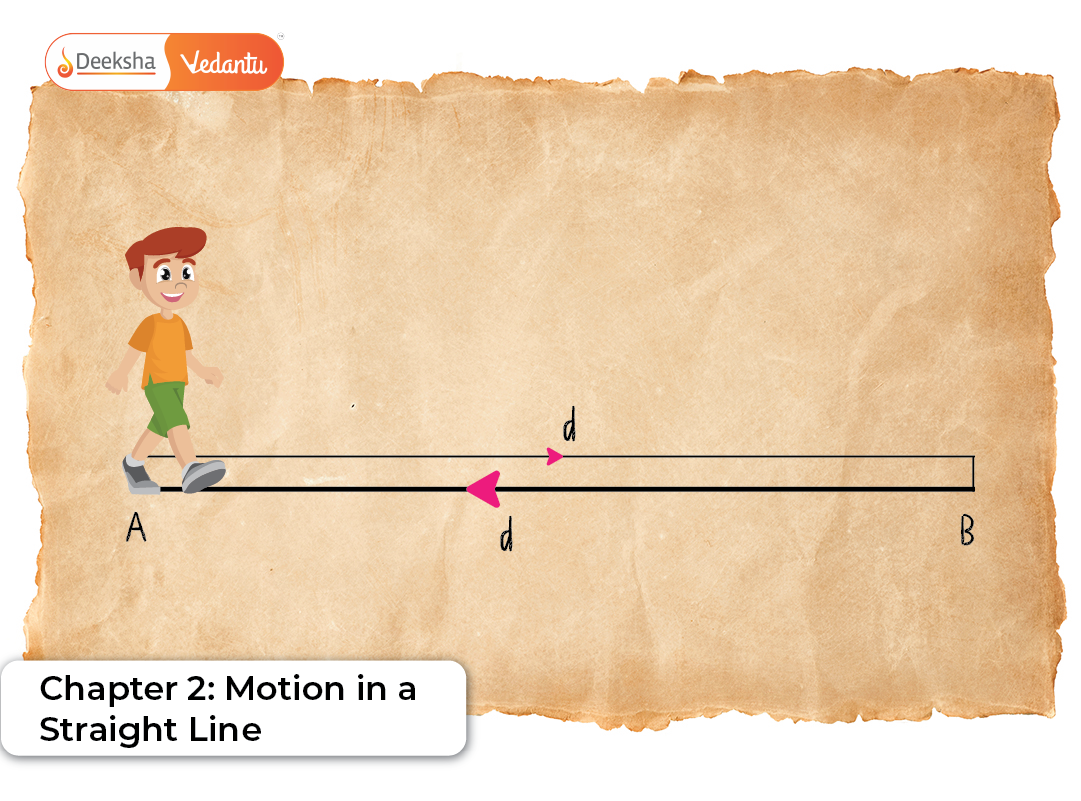
For example, if a student walks 5 m to the right and then 5 m back to the starting point, the distance travelled is 10 m, but the displacement is 0 m because the initial and final positions are the same.
At Deeksha Vedantu, we make sure these ideas are not just definitions on paper. We use real-life examples, motion animations, and classroom discussions so that students can clearly see how distance and displacement differ and where these ideas are used in numerical problems.
Instantaneous Velocity and Speed
To describe how fast an object moves, we use speed and velocity. Although they may seem similar, they are not the same.
- Average speed is the total distance travelled divided by total time taken.
- Average velocity is the displacement divided by total time taken.
Because distance is a scalar and displacement is a vector, average speed is a scalar quantity, while average velocity is a vector quantity.
However, in many situations, especially in exams, we are interested in the value of speed or velocity at a particular instant of time. This is where instantaneous quantities come in.
- Instantaneous speed is the speed of the object at that particular moment.
- Instantaneous velocity is the velocity of the object at a specific instant of time.
Graphically, if you draw a position–time (x–t) graph for the motion of an object:
- The slope of the straight line joining two points gives you average velocity between those two instants.
- The slope of the tangent at a particular point gives you instantaneous velocity at that instant.
If the slope is positive, the object is moving in the positive direction of the axis. If the slope is negative, the object is moving in the opposite direction. A horizontal line on an x–t graph indicates that the position is not changing, so the object is at rest.
Speed is always non-negative. Velocity, being a vector, can be positive, negative, or zero depending on direction.
At Deeksha Vedantu, we help students interpret graphs step by step. Our faculty breaks down x–t graphs and v–t graphs using simple examples like a car moving on a straight road or a ball thrown upwards. Through guided practice, students learn to:
- Read slopes and intercepts.
- Identify whether motion is uniform or non-uniform.
- Connect the shape of the graph with physical motion in real life.
This graphical understanding is especially important in JEE and NEET questions where you are often tested on your ability to interpret motion from graphs rather than just apply formulas.
Acceleration
Acceleration tells you how quickly the velocity of an object is changing with time. It is defined as the rate of change of velocity with respect to time.
- If velocity increases with time, acceleration is positive.
- If velocity decreases with time, the acceleration is negative (often called retardation or deceleration).
- If velocity is constant, acceleration is zero.
Just like speed and velocity, we can talk about average and instantaneous acceleration.
- Average acceleration over a time interval is the change in velocity divided by the time taken.
- Instantaneous acceleration is the acceleration at a particular instant of time.
Graphs again play an important role here. A velocity–time (v–t) graph gives valuable information about acceleration:
- The slope of a v–t graph gives acceleration.
- A straight line with positive slope indicates uniform acceleration.
- A horizontal line (slope zero) indicates zero acceleration with constant velocity.
- A straight line with negative slope indicates uniform negative acceleration.
The area under a v–t graph between two time instants gives the displacement during that time interval. This result is very helpful while solving numerical problems.
Real-life examples of acceleration include:
- A bike starting from rest and speeding up along a straight road.
- A car slowing down before a speed breaker.
- An object falling freely under gravity, experiencing approximately constant acceleration near the Earth’s surface.
At Deeksha Vedantu, we connect these examples with textbook definitions and exam-style questions. Students work through graded practice problems, starting from simple plug-in questions to multi-step problems that involve both graphs and equations. This approach helps them develop both conceptual clarity and speed in problem solving.
Kinematic Equations for Uniformly Accelerated Motion
When an object moves in a straight line with constant acceleration, its motion can be described using three important kinematic equations. These equations relate initial velocity, final velocity, acceleration, time, and displacement.
Let:
- u = initial velocity
- v = final velocity
- a = constant acceleration
- t = time taken
- s = displacement
The three kinematic equations are:
- v = u + at
- s = ut + 1/2 at²
- v² = u² + 2as
These equations are valid only when acceleration is uniform (constant) throughout the motion. They are derived using basic algebra and the definitions of velocity and acceleration. In many textbooks and at Deeksha Vedantu, we also derive them using graphs, which helps students remember when and how to use them.
For example:
- If you know u, a, and t, you can find v using v = u + at.
- If you know u, a, and t, you can find the displacement s using s = ut + 1/2 at².
- If you know u, v, and a, you can find s without using time using v² = u² + 2as.
Common mistakes students make include:
- Applying these equations to situations with non-uniform acceleration.
- Misusing signs when the direction of motion and acceleration differ.
- Forgetting that displacement can be negative depending on the chosen direction.
At Deeksha Vedantu, our faculty trains students to carefully analyse the physical situation before selecting an equation. We guide them to:
- Choose a convenient positive direction.
- Assign proper signs to u, v, a, and s.
- Check whether acceleration is constant before applying the kinematic equations.
We also provide chapter-wise worksheets and past paper questions so that students become comfortable with the variety of ways these equations appear in board and competitive exams.
FAQs on Motion in a Straight Line
Q1: What is the difference between distance and displacement?
Distance is the total path length travelled by an object, and it is always positive. Displacement is the shortest straight-line distance between the initial and final positions of the object, along with direction. Distance is a scalar quantity, while displacement is a vector quantity.
Q2: What is instantaneous velocity?
Instantaneous velocity is the velocity of an object at a particular instant of time. On a position–time graph, it is represented by the slope of the tangent drawn at that specific point on the curve.
Q3: What is uniform acceleration?
Uniform acceleration refers to motion in which the velocity of an object changes by equal amounts in equal intervals of time. In such a case, acceleration remains constant throughout the motion.
Q4: When can we use the kinematic equations?
The kinematic equations can be used only when the motion is along a straight line and the acceleration is constant. If acceleration is changing with time or the motion is not one-dimensional, these equations are not directly applicable.
Q5: How does Deeksha Vedantu help students master Motion in a Straight Line?
At Deeksha Vedantu, we combine concept-building sessions, graphical interpretation, formula-based practice, and regular tests. Students learn through visual aids, solved examples, and doubt-clearing sessions so that they can confidently handle both theory-based questions and numericals from this chapter in board exams and competitive exams.
Conclusion
Motion in a straight line may appear simple, but it introduces many core ideas of physics such as displacement, velocity, speed, acceleration, and the powerful kinematic equations. These concepts are repeatedly used in later chapters and in entrance exams, so it is essential to build a clear and strong understanding at this stage.
At Deeksha Vedantu, our teaching methodology for this chapter is structured, exam-oriented, and student-friendly. We focus on:
- Explaining concepts through everyday examples.
- Helping students interpret graphs and connect them with real motion.
- Training them to apply formulas correctly with proper sign convention.
- Providing targeted practice material for boards, JEE, NEET, KCET, and COMEDK.
With the right guidance and consistent practice, students develop not only accuracy but also confidence in solving problems on Motion in a Straight Line, setting a strong foundation for the rest of mechanics.



Get Social