
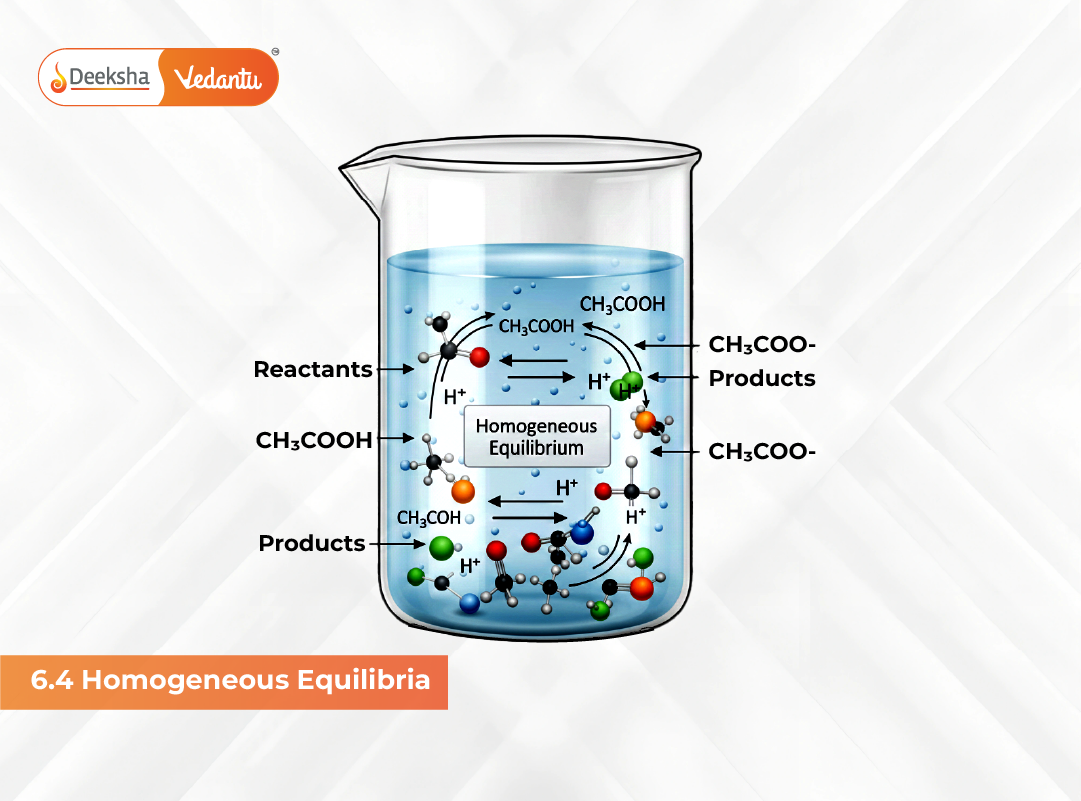


In a homogeneous system, all reactants and products exist in the same phase — gaseous or liquid. Such reactions are fundamental in understanding chemical equilibrium because their uniform phase simplifies the study of reaction dynamics and equilibrium constants.
Examples of Homogeneous Equilibrium
- In Gaseous Systems:
N₂(g) + 3H₂(g) ⇌ 2NH₃(g)
Here, both reactants and products are gases. - In Aqueous Systems:
CH₃COOH(aq) + H₂O(l) ⇌ CH₃COO⁻(aq) + H₃O⁺(aq)
Fe³⁺(aq) + SCN⁻(aq) ⇌ Fe(SCN)²⁺(aq)
All species are in the aqueous phase.
For such homogeneous reactions, we can derive equilibrium constants in terms of both concentration (Kc) and partial pressure (Kp) depending on the system type.
Equilibrium Constant in Gaseous Systems
So far, equilibrium constants have been expressed in terms of molar concentrations. For gaseous reactions, however, it is often more convenient to use partial pressures to represent the equilibrium state.
The ideal gas equation provides a link between pressure and concentration:
pV = nRT or p = (n/V)RT
Since n/V is the concentration of gas (mol/L), we can express pressure in terms of concentration:
p = [gas] × RT
Derivation of Kp and Its Relation to Kc
Consider the general reaction:
aA + bB ⇌ cC + dD
The equilibrium constant in terms of concentration is:
Kc = [C]ᶜ[D]ᵈ / [A]ᵃ[B]ᵇ
Using the ideal gas relationship, [gas] = p / RT, the above equation becomes:
Kc = (pC/RT)ᶜ × (pD/RT)ᵈ / (pA/RT)ᵃ × (pB/RT)ᵇ
Simplifying, we get:
Kp = Kc(RT)ᵈⁿ
where Δn = (c + d) − (a + b), representing the difference in moles of gaseous products and reactants.
This equation links the two equilibrium constants and allows calculation of one from the other.
Example 1: Ammonia Formation
For the reaction:
N₂(g) + 3H₂(g) ⇌ 2NH₃(g)
Δn = (2) − (1 + 3) = −2
Hence, Kp = Kc(RT)⁻²
At a constant temperature, both Kc and Kp represent equilibrium but in different units — concentration and pressure respectively.
Example 2: Decomposition of PCl₅
For the reaction:
PCl₅(g) ⇌ PCl₃(g) + Cl₂(g)
Given at equilibrium and 500 K:
[PCl₅] = 1.41 M, [PCl₃] = 1.59 M, [Cl₂] = 1.59 M
Kc = [PCl₃][Cl₂] / [PCl₅] = (1.59)² / 1.41 = 1.79
Hence, the equilibrium constant Kc = 1.79 for this reaction.
Example 3: CO and H₂O Equilibrium (Water–Gas Shift Reaction)
CO(g) + H₂O(g) ⇌ CO₂(g) + H₂(g)
Given Kc = 4.24 at 800 K, and initial concentrations of CO and H₂O = 0.1 M each.
Let the amount of CO₂ and H₂ formed be x at equilibrium.
At equilibrium:
[CO] = [H₂O] = 0.1 − x, [CO₂] = [H₂] = x
Substitute in the equilibrium expression:
Kc = [CO₂][H₂] / [CO][H₂O] = x² / (0.1 − x)² = 4.24
Solving for x gives x = 0.067, hence:
[CO₂] = [H₂] = 0.067 M, [CO] = [H₂O] = 0.033 M.
Example 4: NOCl Equilibrium
2NOCl(g) ⇌ 2NO(g) + Cl₂(g)
Given Kc = 3.75 × 10⁻⁶ at 1069 K.
For this reaction, Δn = (2 + 1) − 2 = 1
Using Kp = Kc(RT)ᵈⁿ:
Kp = 3.75 × 10⁻⁶ × (0.0831 × 1069)¹ = 0.0333
Thus, Kp = 0.0333.
Equilibrium Constants, Kp for Selected Reactions
| Reaction | Temperature (K) | Kp |
| 2NO(g) ⇌ N₂(g) + O₂(g) | 2000 | 2.4 × 10³⁰ |
| N₂O₄(g) ⇌ 2NO₂(g) | 298 | 0.15 |
| N₂(g) + 3H₂(g) ⇌ 2NH₃(g) | 500 | 1.6 × 10⁻⁵ |
| PCl₅(g) ⇌ PCl₃(g) + Cl₂(g) | 500 | 1.79 |
| CO(g) + H₂O(g) ⇌ CO₂(g) + H₂(g) | 800 | 4.24 |
This table highlights how temperature drastically affects equilibrium constants, reinforcing the dependence of K on thermodynamic conditions.
Relationship Between Kp and Kc
The relationship between Kp and Kc is crucial for converting between pressure-based and concentration-based equilibria:
Kp = Kc(RT)ᵈⁿ
- If Δn = 0, then Kp = Kc (no difference between the two forms).
- If Δn > 0, then Kp > Kc (expansion of gases increases pressure dependency).
- If Δn < 0, then Kp < Kc (compression reduces gas moles and pressure impact).
NEET & JEE Key Insights
- Kp and Kc conversion questions are frequently asked in exams.
- Knowing Δn and applying the ideal gas law correctly is vital.
- Reactions like ammonia synthesis and decomposition of PCl₅ are classic equilibrium examples.
- Understanding how temperature shifts affect Kc and Kp is important for predicting equilibrium direction.
FAQs
Q1. What is homogeneous equilibrium?
It is a state where all reactants and products are in the same physical phase (gas or solution).
Q2. What is the relationship between Kp and Kc?
They are related by the equation Kp = Kc(RT)ᵈⁿ, where Δn is the difference in moles of gaseous products and reactants.
Q3. How does Δn affect Kp and Kc?
If Δn = 0, then Kp = Kc; if Δn > 0, Kp > Kc; and if Δn < 0, Kp < Kc.
Q4. Why do equilibrium constants vary with temperature?
Because equilibrium is temperature-dependent — changing temperature alters reaction rates and equilibrium positions.
Q5. What units are used for Kp and Kc?
Kc is expressed in (mol/L)ⁿ, while Kp is expressed in pressure units (atm or bar) depending on Δn.
Conclusion
The study of homogeneous equilibria helps bridge the gap between theoretical chemistry and real-world reactions, especially those involving gases. Understanding Kp and Kc relationships provides a deeper insight into reaction behavior under various thermodynamic conditions. This knowledge is fundamental in solving numerical problems and predicting equilibrium shifts in NEET and JEE Chemistry examinations.


Get Social