


The chapter Neural Control and Coordination contributes 2–3 direct NEET questions (8–12 marks). It integrates concepts from anatomy, physiology, and neurobiology. Commonly tested areas include:
- Neuron structure and types
- Resting and action potentials
- Synaptic transmission
- Brain and spinal cord anatomy
- Reflex action and reflex arc
- Sense organs, especially eye and ear
- Neurological disorders
Diagram-based questions are common, especially for neuron structure, synaptic transmission steps, brain labeling, and eye/ear anatomy.
Introduction
The nervous system coordinates and regulates body functions through rapid electrical impulses and chemical messengers. Neural control ensures quick responses, maintains homeostasis, enables voluntary and involuntary movements, and processes sensory information. In humans, it works in close association with the endocrine system for integrated body control.
Neuron Structure
A neuron is the structural and functional unit of the nervous system. It is specialized for excitability and conductivity.
- Cell body (Soma): Contains the nucleus, cytoplasm, and Nissl bodies for protein synthesis.
- Dendrites: Short, branched processes that receive incoming signals and conduct them toward the cell body.
- Axon: Long process transmitting impulses away from the cell body.
- Myelin sheath: Lipid-rich covering produced by Schwann cells (PNS) or oligodendrocytes (CNS) for insulation and faster conduction.
- Nodes of Ranvier: Gaps between myelin segments aiding saltatory conduction.
Types of neurons:
- Sensory (afferent)
- Motor (efferent)
- Interneurons (association neurons)
Generation and Conduction of Nerve Impulse
- Resting potential: Around −70 mV, maintained by Na⁺/K⁺ ATPase pumps and selective ion permeability.
- Depolarization: Stimulus opens Na⁺ channels, causing Na⁺ influx and membrane potential becoming less negative.
- Action potential peak: Membrane potential reverses (~+30 mV).
- Repolarization: K⁺ channels open, allowing K⁺ efflux, restoring negativity.
- Hyperpolarization: Slight overshoot before returning to resting potential.
Impulse conduction:
- Saltatory: In myelinated axons, impulse jumps between nodes of Ranvier; faster.
- Continuous: In unmyelinated fibers, impulse travels along the entire length.
Synaptic Transmission
Types of synapses:
- Electrical: Direct ionic flow through gap junctions; faster.
- Chemical: Neurotransmitter-mediated; more common in humans.
Steps in chemical transmission:
- Arrival of impulse at presynaptic terminal.
- Opening of voltage-gated Ca²⁺ channels.
- Ca²⁺ influx triggers vesicle fusion.
- Neurotransmitters (e.g., acetylcholine) release into synaptic cleft.
- Binding to postsynaptic receptors.
- Initiation of postsynaptic potential and possible action potential.
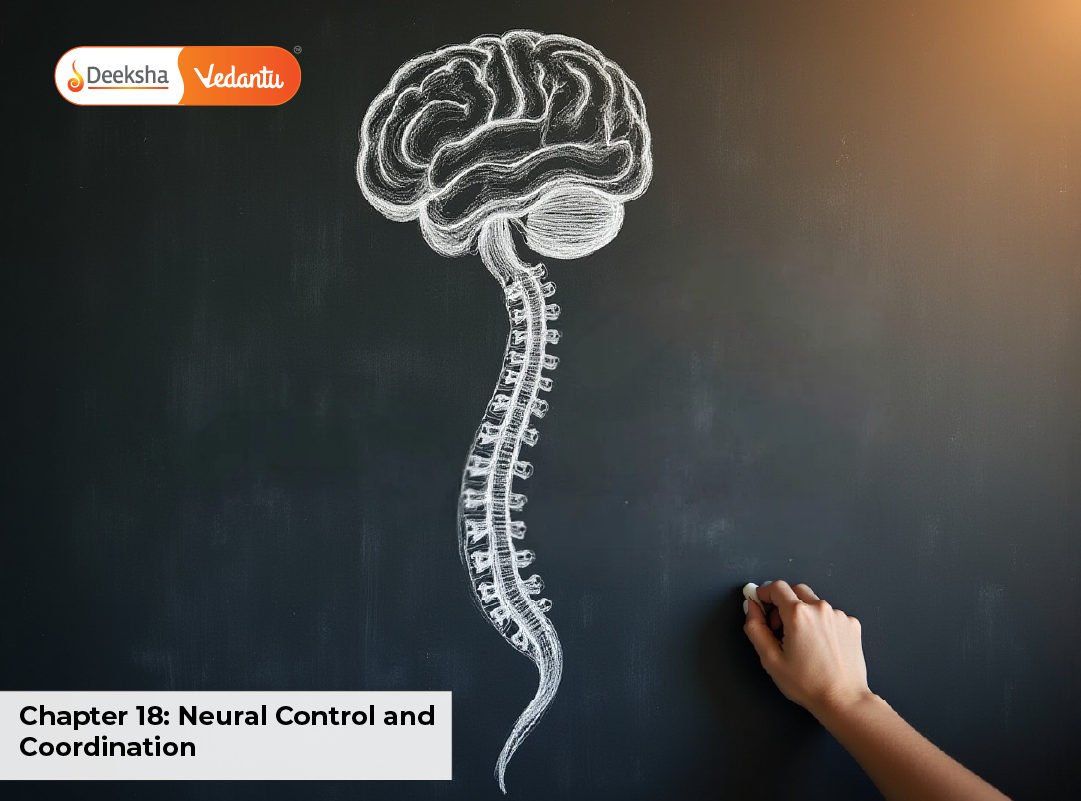
Central Nervous System
Brain:
- Forebrain: Cerebrum (sensory processing, voluntary actions), thalamus (relay center), hypothalamus (homeostasis, endocrine control).
- Midbrain: Visual and auditory reflexes.
- Hindbrain: Pons (bridge), cerebellum (balance, coordination), medulla oblongata (vital centers for heart rate, respiration).
Spinal cord:
- Conduction pathway between brain and body.
- Reflex center for rapid responses.
Peripheral Nervous System
- Somatic nervous system: Voluntary control of skeletal muscles.
- Autonomic nervous system: Involuntary control, with sympathetic (fight/flight) and parasympathetic (rest/digest) divisions.
Reflex Action
A reflex is an involuntary, immediate response to a stimulus.
Reflex arc: receptor → sensory neuron → CNS → motor neuron → effector.
Types:
- Monosynaptic: Single synapse (e.g., knee-jerk).
- Polysynaptic: Multiple synapses involving interneurons.
Sense Organs
Eye:
- Cornea, lens, iris, retina.
- Image formation via refraction.
- Photoreceptors: rods (dim light), cones (color vision).
Ear:
- Outer ear: pinna, auditory canal.
- Middle ear: ossicles (malleus, incus, stapes).
- Inner ear: cochlea (hearing), semicircular canals (balance).
Disorders
- Epilepsy: abnormal electrical brain activity.
- Parkinson’s disease: dopamine deficiency.
- Alzheimer’s disease: neurodegeneration.
- Multiple sclerosis: myelin sheath destruction.
- Glaucoma: increased intraocular pressure.
- Deafness: conduction or nerve defects.
Practice MCQs with Answers
- Which ion influx causes depolarization, and why is it essential for impulse generation?
Answer: Sodium ion (Na⁺) influx; it reverses membrane potential, initiating an action potential. - What is the functional role of the Node of Ranvier in myelinated neurons?
Answer: Facilitates saltatory conduction, speeding impulse transmission. - Name the neurotransmitter released at the neuromuscular junction and its mode of action.
Answer: Acetylcholine; binds to muscle fiber receptors, causing depolarization and muscle contraction. - Which part of the brain is primarily responsible for balance and posture maintenance?
Answer: Cerebellum. - Identify the photoreceptor responsible for high acuity color vision and explain its distribution in the retina.
Answer: Cones; concentrated in the fovea centralis for sharp vision. - Differentiate between saltatory and continuous conduction with examples.
Answer: Saltatory occurs in myelinated axons (impulse jumps nodes), continuous in unmyelinated (impulse travels entire length). - List two vital functions of the hypothalamus and explain their importance.
Answer: Regulates body temperature and controls pituitary hormone release; vital for homeostasis. - Classify the knee-jerk reflex and describe its pathway.
Answer: Monosynaptic reflex; receptor → sensory neuron → spinal cord → motor neuron → muscle. - State the role of the cochlea in hearing and how it converts sound into nerve impulses.
Answer: Detects sound vibrations; hair cells convert mechanical vibrations into electrical impulses. - Explain how demyelination leads to multiple sclerosis symptoms.
Answer: Slows or blocks nerve conduction, causing muscle weakness, coordination loss, and sensory deficits.
FAQs
- What is the structural difference between a neuron and a nerve? – A neuron is a single excitable cell, while a nerve is a bundle of axons from multiple neurons enclosed in connective tissue.
- Why is myelin important in neural conduction? – Myelin increases conduction velocity by enabling saltatory conduction, conserving energy and ensuring faster responses.
- How does a reflex arc protect the body from harm? – It bypasses conscious control for instant response, minimizing injury risk.
- Which part of the ear helps maintain balance? – The semicircular canals detect angular acceleration, while the vestibule detects linear acceleration.
- How does the hypothalamus regulate body temperature? – It senses temperature changes via thermoreceptors and triggers mechanisms like sweating or shivering to restore normal temperature.
Conclusion
Neural control and coordination form the communication network that integrates body functions for rapid, precise, and adaptive responses. Mastery of neuron physiology, synaptic mechanisms, brain and spinal cord anatomy, reflex actions, and sensory systems is vital for NEET aspirants. Combining conceptual clarity with diagram-based learning, consistent MCQ practice, and quick revision strategies will ensure maximum retention and scoring potential.



Get Social