


Introduction
Section 3.2 of Chapter 3 Motion in a Plane marks the beginning of two-dimensional kinematics. When motion is no longer restricted to a straight line, quantities such as displacement, velocity, and acceleration cannot be described by magnitude alone. Direction becomes equally important. This need leads to the classification of physical quantities into scalars and vectors, which is the central idea of this section as presented in NCERT.
For JEE aspirants, this section is foundational because vectors form the basic language of mechanics and are used extensively in later chapters. At Deeksha Vedantu, scalars and vectors are introduced as the starting point for understanding motion analysis in higher dimensions.
Scalar Quantities
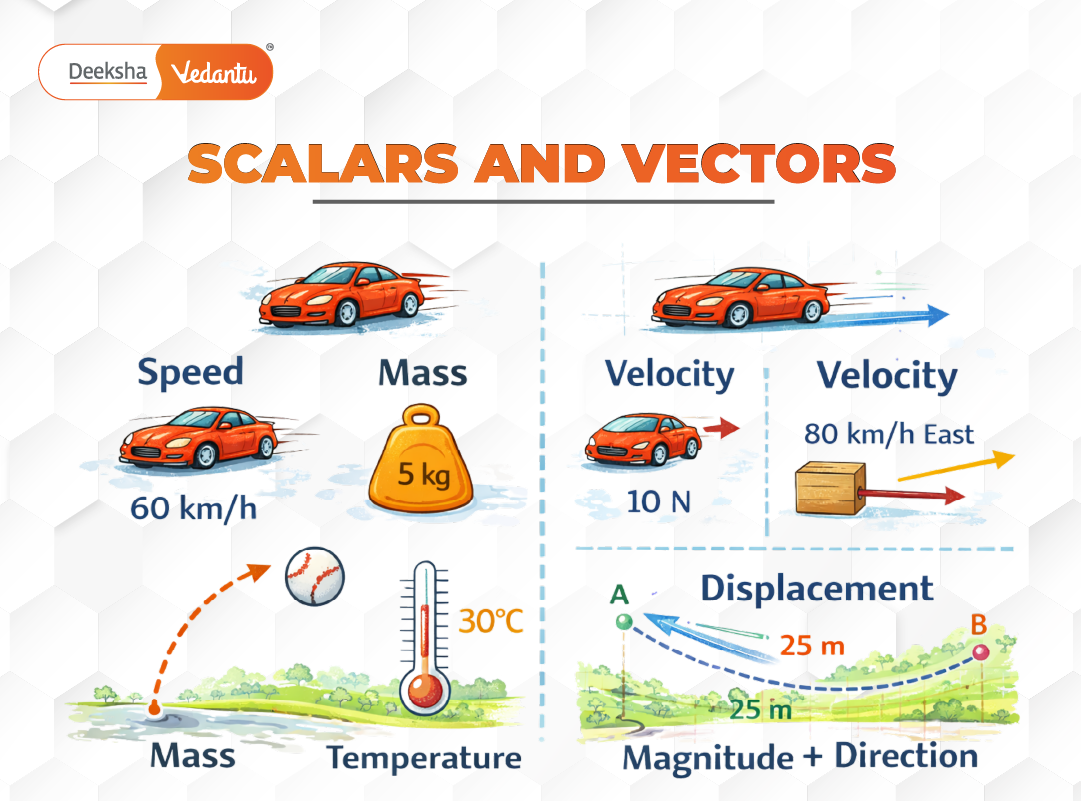
A scalar quantity is a physical quantity that is completely specified by its magnitude alone. Direction is not required to define or describe a scalar quantity.
Characteristics of Scalars
- They have magnitude only
- They do not have any associated direction
- They follow ordinary rules of algebra for addition and subtraction
Examples of Scalar Quantities
Common scalar quantities mentioned and implied in NCERT include:
- Mass
- Time
- Distance
- Speed
- Temperature
- Energy
- Density
Even though scalars do not involve direction, they are essential for describing physical situations. In JEE questions, students must be careful not to confuse scalar quantities such as speed with their vector counterparts like velocity.
Vector Quantities
A vector quantity is a physical quantity that requires both magnitude and direction for its complete description. Vectors are necessary to describe motion in a plane because the direction of motion can change continuously with time.
Characteristics of Vectors
- They possess both magnitude and direction
- They are represented graphically by directed line segments
- They are added using vector rules rather than ordinary algebra
Examples of Vector Quantities
Important vector quantities discussed in NCERT include:
- Displacement
- Velocity
- Acceleration
- Force
- Momentum
Vectors play a central role in mechanics. In JEE problems, incorrect handling of vector direction is a common source of errors, making this section particularly important.
Representation of Vectors
A vector is represented graphically by an arrow. The length of the arrow represents the magnitude of the vector, while the arrowhead indicates its direction. The tail of the arrow represents the initial point of the vector.
Vectors can also be represented algebraically using symbols such as bold letters or arrow notation. This representation is useful when performing vector operations and resolving vectors into components.
Types of Vectors
NCERT introduces a few basic types of vectors to help students understand vector properties and operations.
Zero Vector
A zero vector is a vector whose magnitude is zero. It has no definite direction. It represents situations where the resultant of several vectors is zero.
Unit Vector
A unit vector is a vector whose magnitude is unity. Unit vectors are used to specify direction and are extremely useful in resolving vectors along coordinate axes.
Equal Vectors
Two vectors are said to be equal if they have the same magnitude and the same direction, irrespective of their positions in space.
Negative of a Vector
The negative of a vector has the same magnitude as the given vector but points in the opposite direction.
Parallel and Collinear Vectors
Parallel vectors have the same or opposite directions but may not lie along the same straight line. Collinear vectors lie along the same straight line.
Coplanar Vectors
Coplanar vectors are vectors that lie in the same plane. Since motion in this chapter is restricted to a plane, the vectors discussed here are coplanar.
Importance of Scalars and Vectors in Motion Analysis
To describe motion completely, both scalar and vector quantities are required. Scalars describe how much of a quantity is involved, while vectors describe how much and in which direction.
In motion in a plane:
- Position, displacement, velocity, and acceleration are vector quantities
- Time, mass, distance, and speed are scalar quantities
Correct identification of scalar and vector quantities is essential for applying equations of motion and analysing physical situations accurately in JEE-level problems.
Common Conceptual Errors (JEE Perspective)
Some common mistakes students make include:
- Treating speed as a vector quantity
- Adding vector magnitudes without considering direction
- Ignoring direction while interpreting displacement and velocity
At Deeksha Vedantu, emphasis is placed on correcting these conceptual errors early so that students can handle advanced mechanics problems with confidence.
FAQs
Q1. What is the difference between scalar and vector quantities?
A scalar quantity has magnitude only, while a vector quantity has both magnitude and direction.
Q2. Can a vector have zero magnitude?
Yes, a zero vector has zero magnitude and represents no net effect.
Q3. Why are vectors essential in motion in a plane?
Because motion in a plane involves changes in both magnitude and direction, which cannot be described using scalars alone.
Q4. Is speed a vector quantity?
No, speed is a scalar quantity as it has magnitude only and no direction.
Q5. Why are unit vectors important?
Unit vectors are used to represent direction and help resolve vectors along coordinate axes.
Conclusion
Section 3.2 Scalars and Vectors introduces the basic concepts required to study motion in two dimensions. For JEE aspirants, mastering this section is essential because vectors are used throughout physics. A strong conceptual foundation, as emphasised at Deeksha Vedantu, ensures clarity, accuracy, and confidence when solving advanced problems in mechanics.



Get Social