


Introduction
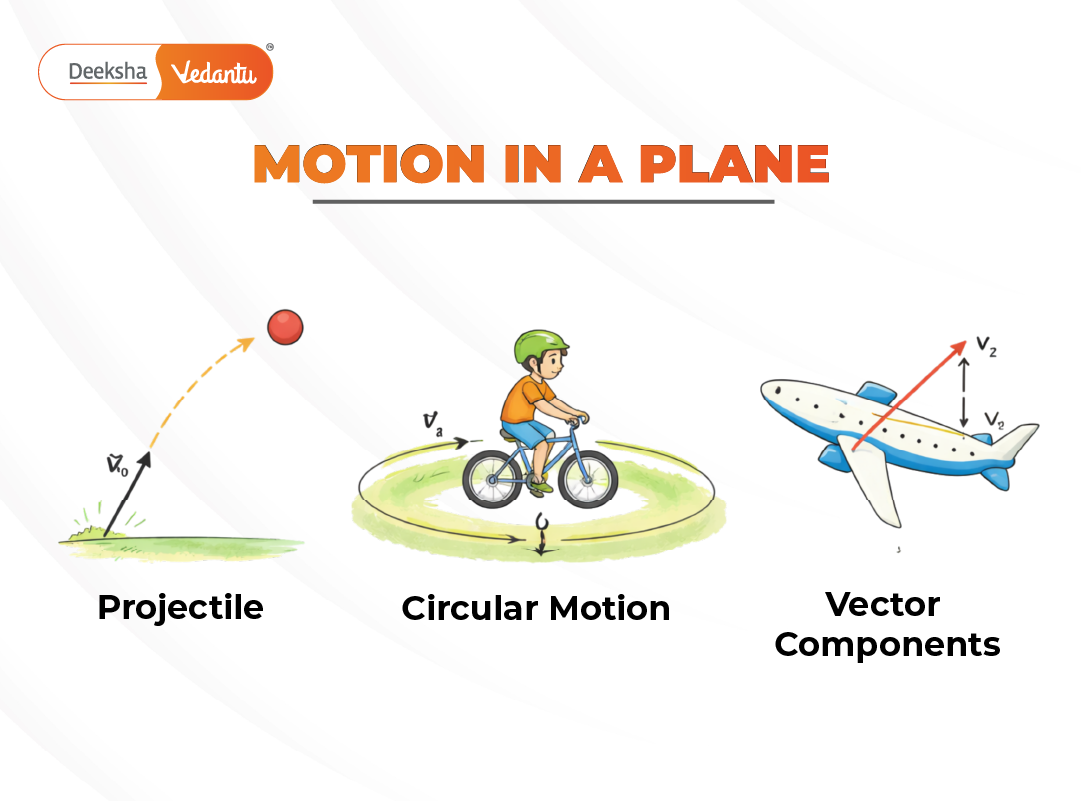
Chapter 3 Motion in a Plane extends the ideas of kinematics from one-dimensional motion to two-dimensional motion. In this chapter, the motion of objects is analysed when displacement, velocity, and acceleration occur in more than one direction simultaneously. The chapter introduces vectors as the mathematical tools required to describe motion in a plane and lays the foundation for advanced problem-solving in mechanics.
For JEE aspirants, this chapter is extremely important because it connects mathematical vector concepts with physical motion and serves as a base for later topics such as laws of motion, work–energy, circular motion, and projectile-based numericals. At Deeksha Vedantu, this chapter is approached as a conceptual bridge between basic kinematics and advanced mechanics.
Scalars and Vectors
This section introduces the classification of physical quantities based on whether direction is involved.
Scalars
Scalars are physical quantities that have only magnitude and no direction. They can be completely described by a numerical value and unit.
Examples include mass, time, speed, distance, temperature, and energy. Scalars are added using ordinary algebraic rules.
Vectors
Vectors are physical quantities that possess both magnitude and direction. They are essential for describing motion in a plane where direction changes continuously.
Examples include displacement, velocity, acceleration, force, and momentum. Vectors are represented graphically by arrows and algebraically using vector notation.
Types of Vectors
NCERT introduces several basic types of vectors that help in understanding vector operations:
- Zero vector
- Unit vector
- Equal vectors
- Negative of a vector
- Parallel and collinear vectors
- Coplanar vectors
Unit Vectors
Unit vectors are vectors with magnitude equal to one and are used to specify direction. They form the basis of resolving vectors along coordinate axes.
Vector Algebra
Vector algebra provides the mathematical framework for handling vectors in motion analysis.
Addition of Vectors
Vector addition is explained using:
- Triangle law of vector addition
- Parallelogram law of vector addition
These graphical methods help visualise resultant vectors.
Subtraction of Vectors
Vector subtraction is defined as the addition of a vector with the negative of another vector.
Resolution of Vectors
Resolution of vectors involves breaking a vector into its components along mutually perpendicular directions, usually along the x-axis and y-axis.
This concept is crucial for analysing motion in a plane because it allows complex motion to be treated as two independent one-dimensional motions.
Analytical Method of Vector Addition
In this method, vector components are added algebraically along each axis. This approach is extensively used in projectile motion and relative velocity problems.
Motion in a Plane
This section applies vector concepts to describe the motion of particles in two dimensions. Unlike motion along a straight line, motion in a plane involves simultaneous changes along two mutually perpendicular directions. Therefore, vector quantities such as position, displacement, velocity, and acceleration become essential tools for describing and analysing such motion accurately.
In two-dimensional motion, the position and motion of a particle at any instant are described relative to a chosen coordinate system, usually consisting of perpendicular x- and y-axes. By resolving motion along these axes, complex trajectories can be analysed systematically as combinations of simpler one-dimensional motions.
Position Vector
The position vector specifies the location of a particle with respect to a chosen origin at a given time. It is a vector drawn from the origin of the coordinate system to the instantaneous position of the particle.
In motion in a plane, the position vector helps in tracking how the particle’s location changes with time. It can be resolved into components along the x-axis and y-axis, allowing the position of the particle to be expressed in terms of its coordinates. The position vector forms the starting point for defining displacement, velocity, and acceleration in two-dimensional motion.
Displacement Vector
The displacement vector represents the change in position of a particle over a given time interval. It is defined as the vector difference between the final position vector and the initial position vector.
Displacement depends only on the initial and final positions of the particle, not on the actual path followed. In motion in a plane, displacement is a vector quantity and can be resolved into horizontal and vertical components. Understanding displacement as a vector is crucial for analysing trajectories such as projectile motion, where the path is curved but displacement is determined solely by end points.
Velocity in a Plane
Velocity in a plane is defined as the rate of change of the position vector with respect to time. Since the position vector changes in both magnitude and direction during two-dimensional motion, velocity is inherently a vector quantity.
Both average velocity and instantaneous velocity are defined using vector concepts. The direction of instantaneous velocity at any point is always tangential to the path of the particle at that point. In plane motion, velocity can be resolved into components along the x- and y-directions, allowing each component to be analysed independently using the principles of one-dimensional kinematics.
Acceleration in a Plane
Acceleration in a plane is the rate of change of the velocity vector with respect to time. It accounts for changes in both the magnitude and direction of velocity.
In two-dimensional motion, acceleration may arise due to a change in speed, a change in direction of motion, or both. Like velocity, acceleration can be resolved into components along the coordinate axes. This component-wise treatment of acceleration is essential for analysing motions such as projectile motion and uniform circular motion, where acceleration plays a central role in shaping the trajectory and behaviour of the particle.
Motion with Constant Acceleration in a Plane
This section generalises the equations of motion from one dimension to two dimensions.
The motion is analysed by resolving it into two perpendicular directions, and the kinematic equations are applied independently along each axis.
This approach forms the basis for solving projectile motion problems.
Relative Velocity in Two Dimensions
Relative velocity describes the velocity of one object as observed from another moving object.
This concept is important for analysing motion involving multiple bodies, such as rain–man problems, river–boat problems, and pursuit scenarios.
Projectile Motion
Projectile motion is a specific case of motion in a plane where an object moves under the influence of gravity alone.
Key Features of Projectile Motion
- Motion is analysed along horizontal and vertical directions
- Horizontal motion has constant velocity
- Vertical motion has constant acceleration due to gravity
Important Quantities in Projectile Motion
- Time of flight
- Maximum height
- Horizontal range
- Trajectory of the projectile
Projectile motion is one of the most numerically intensive and frequently tested subtopics in JEE.
Uniform Circular Motion
Uniform circular motion is another important example of motion in a plane where an object moves with constant speed along a circular path.
Angular Variables
The chapter briefly introduces angular displacement, angular velocity, and angular acceleration as tools to describe circular motion.
Centripetal Acceleration
Centripetal acceleration is directed towards the centre of the circular path and is responsible for changing the direction of velocity while keeping its magnitude constant.
Importance of Motion in a Plane for JEE
This chapter is fundamental for JEE preparation because:
- It introduces vectors, which are used throughout mechanics
- It builds problem-solving skills using component analysis
- It forms the base for projectile motion and circular motion numericals
- It strengthens conceptual understanding required for advanced physics topics
At Deeksha Vedantu, students are encouraged to master the conceptual structure of this chapter before moving into detailed problem-solving, ensuring long-term retention and exam confidence.
FAQs
Q1. Why are vectors necessary for motion in a plane?
Vectors are required because motion in a plane involves both magnitude and direction, which cannot be described using scalars alone.
Q2. What is the importance of resolving vectors?
Resolving vectors simplifies two-dimensional motion into independent one-dimensional motions along perpendicular axes.
Q3. Why is projectile motion analysed using components?
Because horizontal and vertical motions are independent, component analysis makes solving projectile problems systematic.
Q4. What causes centripetal acceleration in circular motion?
Centripetal acceleration arises due to the continuous change in direction of velocity in circular motion.
Q5. How is this chapter important for JEE?
It forms the foundation for mechanics-based problem solving and is directly linked to multiple high-weightage JEE topics.
Conclusion
Chapter 3 Motion in a Plane provides the conceptual and mathematical foundation required to understand motion in two dimensions. For JEE aspirants, this chapter must be treated as a base chapter, with emphasis on vectors, component analysis, and application to projectile and circular motion. A structured learning approach, as followed at Deeksha Vedantu, ensures clarity, accuracy, and readiness for advanced mechanics problems.



Get Social