
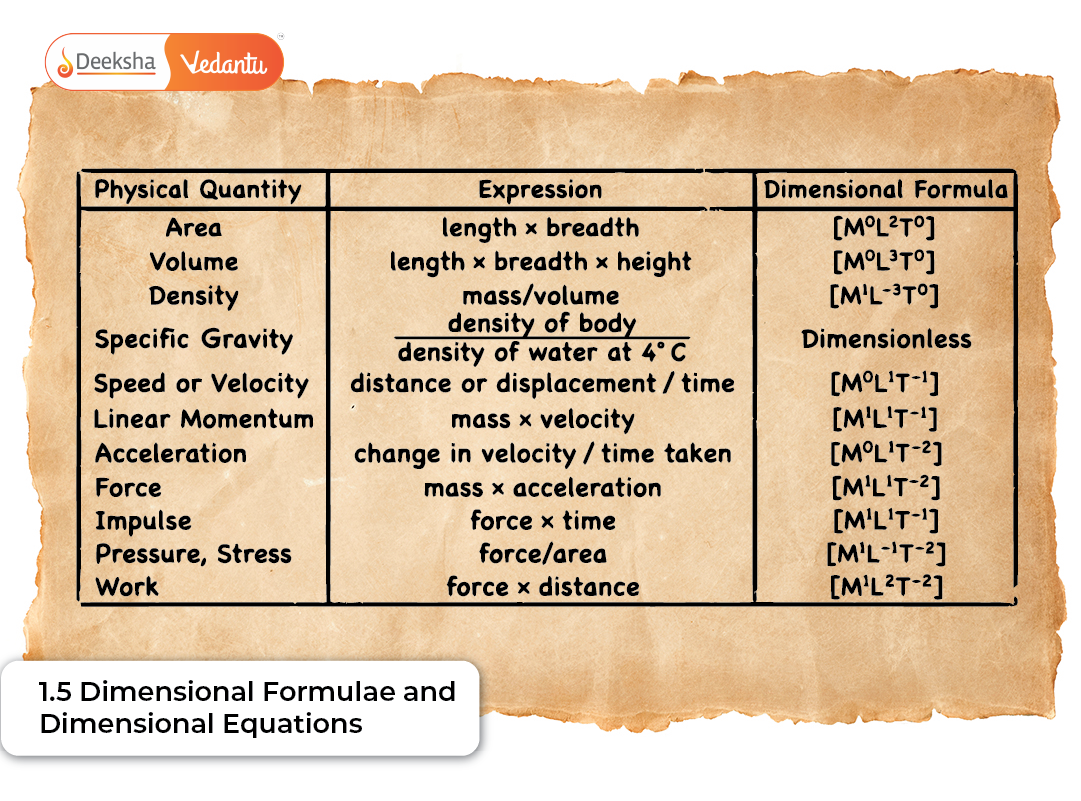


Dimensional formulae and dimensional equations are essential tools in physics that allow students to analyse physical relationships, verify equations, derive unknown expressions, and convert complex quantities into simpler forms. By expressing any physical quantity in terms of fundamental dimensions-mass (M), length (L), time (T), electric current (I), temperature (Θ), amount of substance (N), and luminous intensity (J)-we gain the capability to evaluate whether a physical formula is meaningful and logically consistent.
This topic extends the foundation built in the previous section (1.4 Dimensions of Physical Quantities), moving from expressing quantities dimensionally to applying those expressions inside full mathematical relations. Mastering this section greatly improves numerical accuracy and conceptual depth for both board exams and competitive exams like JEE, NEET, and KCET.
Dimensional Formula
A dimensional formula expresses a physical quantity in terms of the powers of fundamental dimensions.
For example:
- Force = [M L T⁻²]
- Work = [M L² T⁻²]
- Power = [M L² T⁻³]
- Density = [M L⁻³]
Dimensional formulas help identify how one quantity depends on other base quantities. They are especially useful when deriving relations between variables or checking the correctness of equations.
Why Dimensional Formulae Matter
Dimensional formulae allow us to:
- Understand the structure of a physical quantity.
- Analyze how a change in one variable affects another.
- Convert units systematically.
- Determine proportional relationships.
For example, writing force as [M L T⁻²] immediately shows it depends directly on mass and acceleration.
Dimensional Equation
A dimensional equation is obtained when we replace each physical quantity in an equation with its dimensional formula.
Example: Work = Force × displacement → [M L² T⁻²] = [M L T⁻²] × [L]
Dimensional equations help verify whether mathematical expressions are physically meaningful.
Uses of Dimensional Equations (Expanded)
Dimensional equations have multiple applications, making them an essential part of physics problem-solving.
1. Checking the Correctness of a Physical Equation
A physical equation is dimensionally correct only if: Dimensions of LHS = Dimensions of RHS
Example: v² = u² + 2as
- v² → [L² T⁻²]
- u² → [L² T⁻²]
- 2as → [L T⁻²][L] = [L² T⁻²] All terms match → Equation is dimensionally valid.
This method quickly highlights incorrect equations during exams.
2. Deriving Relations Between Physical Quantities
When the functional dependence between physical quantities is known but the exact form is unknown, dimensional analysis helps deduce the relationship.
Example: Time period of pendulum depends on: l → length m → mass g → acceleration due to gravity
Assuming: T = k lᵃ mᵇ gᶜ Solving dimensionally gives: T ∝ √(l/g)
The constant k cannot be obtained using dimensions alone.
3. Converting Units
Dimensions allow converting quantities from one unit system to another.
Example: Convert 1 erg to SI. 1 erg = 1 g·cm²/s² = (10⁻³ kg)(10⁻² m)² / s² = 10⁻⁷ J
This technique is vital in numerical problems involving energy, force, and momentum.
4. Predicting Forms of Unknown Expressions
If a new quantity is introduced, dimensional analysis helps hypothesize its equation based on known variables.
Example: Escape velocity depends on the mass of the planet (M), radius (R), and gravitational constant (G). Dimensional reasoning leads to v ∝ √(GM/R).
5. Understanding Scaling Laws
Scaling laws explain how physical systems behave when size or mass is scaled.
For example:
- Doubling length in a pendulum increases period by √2.
- Increasing radius of a planet affects escape velocity as √R.
Limitations of Dimensional Analysis
Even though dimensional analysis is powerful, it has important limitations:
- It cannot provide numerical constants such as 1/2, 2π, or 3.
- It fails when non-dimensional functions (sin, log, exp) appear.
- It cannot be used when two quantities of the same dimension are added or subtracted.
- It cannot determine if a physical quantity is scalar or vector.
- It works only when variable dependence is complete and correct.
Understanding its limitations prevents conceptual mistakes.
NCERT-Style Solved Examples
Example 1: Check dimensional correctness of v = u + at.
v → [L T⁻¹]
u → [L T⁻¹]
at → [L T⁻²][T] = [L T⁻¹]
All terms have the same dimensions → Equation correct.
Example 2: Check correctness of KE = mv³.
LHS → KE = [M L² T⁻²]
RHS → mv³ = [M][L T⁻¹]³ = [M L³ T⁻³]
Mismatch → Equation incorrect.
Example 3: Derive formula for wave speed on a string.
Variables: tension (T), mass/length (μ)
Assume: v = k Tᵃ μᵇ
Solve dimensions → v = √(T/μ)
Example 4: Derive relation for time period of simple pendulum.
Assume dependence on l, m, g.
Solve → T = k √(l/g), k ≈ 2π.
Example 5: Verify if P = Fv is dimensionally consistent.
Power = [M L² T⁻³]
Force × velocity = [M L T⁻²][L T⁻¹] = [M L² T⁻³]
Correct.
Example 6: Check if s = ut + 1/3 at³ is dimensionally valid.
[L] ≠ [L T] → Incorrect.
Example 7: Dimensional formula of angular momentum.
L = mvr → [M][L T⁻¹][L] = [M L² T⁻¹]
Example 8: Convert 1 dyne to SI units.
1 dyne = 10⁻⁵ N.
JEE / NEET Level Questions
Problem 1
Escape velocity v depends on gravitational constant G, mass M, and radius R.
Use dimensional analysis to derive expression.
Solution:
v ∝ √(GM/R).
Problem 2
Dimensional formula of surface tension.
Surface tension = Force/length = [M L T⁻²] / [L] = [M T⁻²]
Problem 3
Find dimensions of permittivity ε₀.
From Coulomb’s law: ε₀ = q²/(F r²)
Dimensions = [M⁻¹ L⁻³ T⁴ I²]
Problem 4
Check correctness of equation: KE = 1/2 mvr.
LHS → [M L² T⁻²]
RHS → [M][L T⁻¹][L] = [M L² T⁻¹]
Mismatch → Incorrect.
Problem 5
Dimensional analysis of spring constant k.
k = Force/displacement = [M L T⁻²]/[L] = [M T⁻²]
Problem 6
Derive dimensional relation for centripetal force.
F = mv²/r → [M][L² T⁻²]/[L] = [M L T⁻²]
Problem 7
If X = (a² b) / √c, and dimensions of a = [L], b = [M], c = [T]:
X = [M L² T⁻¹/²].
Problem 8
Find dimension of Planck’s constant.
h = E/ν = [M L² T⁻²]/[T⁻¹] = [M L² T⁻¹].
Problem 9
The force acting on a particle is given as F = k v² r.
Find dimensions of k.
Solution → [M L⁻²].
Problem 10
Which quantities are dimensionless?
- Refractive index
- Strain
- Angle
All are dimensionless.
FAQs
Q1. What is a dimensional formula?
A dimensional formula expresses a physical quantity in terms of powers of fundamental dimensions such as M, L, and T.
Q2. What is a dimensional equation?
A dimensional equation equates the dimensional formulae of quantities present on both sides of a physical expression.
Q3. Can dimensional analysis determine numerical constants?
No. Constants like 2, 1/2, π, or e cannot be derived using dimensional methods.
Q4. Why is dimensional analysis important in exams?
It quickly verifies equations, converts units, and eliminates incorrect options in JEE/NEET.
Q5. What are common limits of dimensional analysis?
It fails for equations involving trigonometric/exponential functions or when variables are incompletely chosen.
Q6. Can two entirely different quantities have the same dimensions?
Yes, such quantities are called dimensionally similar (e.g., torque and energy).
Q7. Why can’t dimensional analysis identify vector or scalar nature?
Because dimensions only express dependency on base quantities, not direction. Vectors and scalars with identical dimensions cannot be distinguished dimensionally.
Q8. Can dimensional analysis help in deriving new physical formulas?
Yes-but only when the dependency of the quantity on relevant variables is known. Dimensional analysis then helps determine the mathematical form of the relation.
Q9. Why does dimensional analysis fail when variable dependence is incomplete?
If important variables are missing, the dimensional equation becomes underdetermined and yields incorrect or ambiguous results.
Q10. Why is dimensional consistency necessary but not sufficient to guarantee correctness?
An equation may be dimensionally correct yet physically wrong because dimensions cannot detect missing constants, wrong numerical coefficients, or incorrect functional forms.
Conclusion
Dimensional formulae and dimensional equations provide a powerful and elegant language for interpreting the structure of physical laws. They allow students to dissect complex relationships, verify mathematical validity, derive unknown dependences, and perform unit conversions with confidence and accuracy. Through dimensional analysis, learners discover how physical quantities are interconnected and how scaling one variable influences another.
While dimensional methods have limitations-such as inability to produce numerical constants or distinguish between vector and scalar quantities-they remain one of the most versatile tools in physics. Their applications range from mechanics to electromagnetism, thermodynamics, waves, and even quantum physics. This makes them indispensable for both board-level problem-solving and competitive examinations like JEE, NEET, and KCET.
At Deeksha Vedantu, students are guided step-by-step through intuitive reasoning, practical examples, and application-based learning so they can confidently use dimensional analysis not only to solve exam problems but also to build a deeper conceptual understanding of the physical world.



Get Social