
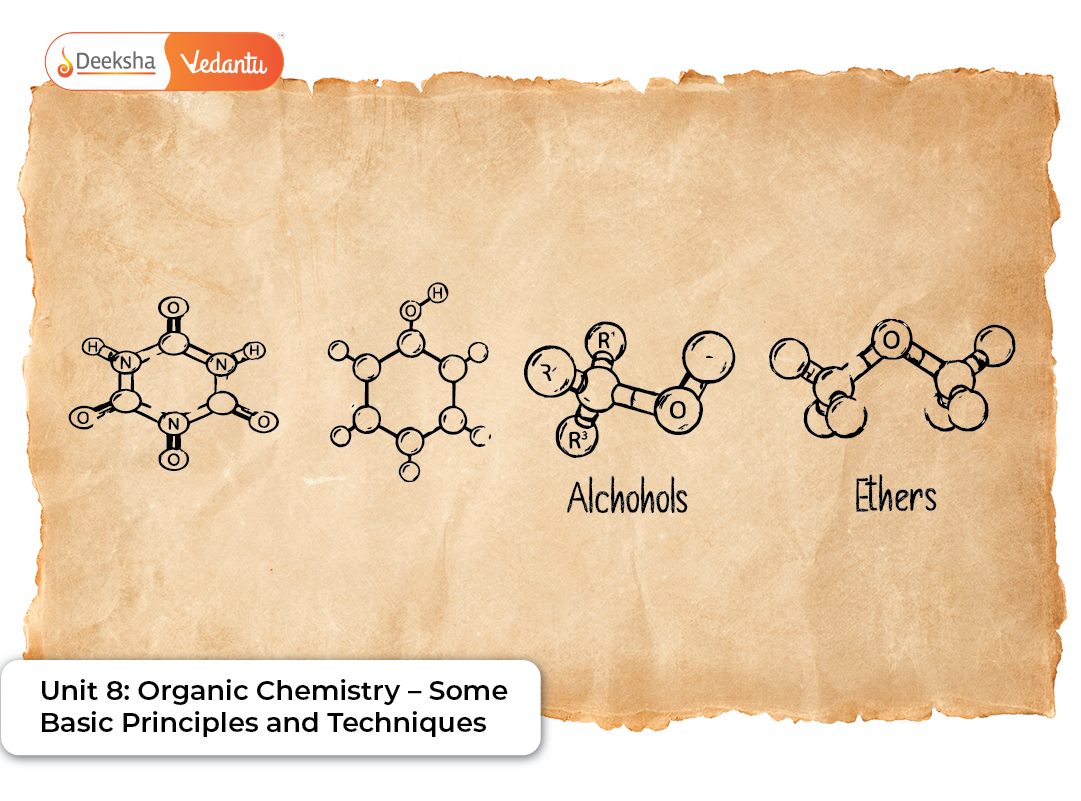


Organic chemistry is one of the most fascinating branches of chemistry because it focuses on the incredible diversity of carbon‑based compounds. From the molecules that make up living organisms to the materials used in medicines, fuels, plastics, paints, and dyes, organic chemistry forms the basis of several essential aspects of modern life. The unique bonding characteristics of carbon allow it to create complex structures with millions of possible combinations. Understanding these principles at the Class 11 level helps students create a strong foundation for advanced learning in Class 12 and competitive exams.
At Deeksha Vedantu, we ensure that students approach this unit with clarity by explaining every concept visually, breaking down reactions and mechanisms, and connecting theory with practical relevance. Our teaching approach builds confidence by helping students understand why organic compounds behave the way they do, not just what they are.
General Introduction
Organic chemistry primarily deals with carbon compounds. The earlier belief was that organic compounds could only be synthesized by living organisms because they possessed a “vital force.” This misconception was eliminated when Friedrich Wöhler synthesized urea from ammonium cyanate, proving that organic compounds follow the same chemical principles as inorganic ones.
Carbon’s importance in organic chemistry arises from:
- Its ability to form four covalent bonds
- Its property of catenation (bonding with itself)
- Its ability to form single, double, and triple bonds
- Its capacity to bond with elements like hydrogen, oxygen, nitrogen, sulfur, and halogens
These features make carbon chemistry vast, diverse, and structurally rich.
Tetravalence of Carbon: Shapes of Organic Compounds
Carbon exhibits tetravalence, meaning it forms four covalent bonds. This property enables the formation of a wide variety of structures, such as chains, rings, and branched frameworks. The arrangement of electron pairs around carbon determines the geometry:
- sp³ hybridisation forms tetrahedral structures, such as methane
- sp² hybridisation creates trigonal planar shapes, such as ethene
- sp hybridisation results in linear structures, such as ethyne
The shapes of organic molecules determine their physical properties, polarity, reactivity, and interaction with other substances. At Deeksha Vedantu, students learn to identify molecular geometry using models and interactive diagrams, which makes visualisation easier and helps in reaction mechanism analysis.
Structural Representations of Organic Compounds
Understanding how organic compounds are represented is essential for visualising and interpreting their properties. Some common ways to represent organic molecules include:
- Complete structural formulas: Show all bonds and atoms
- Condensed formulas: Provide a compact representation
- Bond‑line structural formulas: Simplify complex structures using zig‑zag lines
- Three‑dimensional (3D) representations: Display spatial orientation of atoms
The skill of converting one representation into another is a core part of understanding organic chemistry. Students at Deeksha Vedantu practice extensively with all forms of structural representation so that they can interpret exams and textbooks with ease.
Classification of Organic Compounds
Organic compounds are classified in several ways depending on their structure and functional groups. Some of the main classifications include:
- Acyclic or open‑chain compounds: Straight or branched chains, such as alkanes
- Cyclic compounds: Ring structures, either saturated or unsaturated
- Aromatic compounds: Compounds containing benzene rings
- Heterocyclic compounds: Rings that contain atoms other than carbon
- Functional group classification: Alcohols, aldehydes, ketones, acids, amines, etc.
Recognising classes of organic compounds helps in predicting reactions, physical properties, and naming patterns. Deeksha Vedantu provides charts, summary tables, and memory techniques to help students quickly identify functional groups.
Nomenclature of Organic Compounds
Naming organic compounds systematically is essential for clear communication in chemistry. The International Union of Pure and Applied Chemistry (IUPAC) provides rules to ensure that organic compounds have unique and meaningful names.
Naming is based on:
- Selecting the longest carbon chain (parent chain)
- Numbering carbon atoms to give substituents the lowest possible numbers
- Identifying and naming substituents such as alkyl groups
- Naming and locating functional groups
- Using prefixes and suffixes appropriately
At Deeksha Vedantu, we teach an easy step‑by‑step method for IUPAC naming, including exceptions and special cases, so students can confidently solve textbook and competitive exam questions.
Isomerism
Isomerism refers to compounds with the same molecular formula but different structures or spatial arrangements. It is one of the most important concepts in organic chemistry because isomers often have different physical and chemical properties.
There are two major types:
- Structural isomerism: Variation in the connectivity of atoms
- Stereoisomerism: Variation in spatial arrangement, such as geometrical (cis/trans) isomers
Students often find isomerism confusing, which is why Deeksha Vedantu uses molecular models and diagrams to help students visualise structures and understand differences between isomers.
Fundamental Concepts in Organic Reaction Mechanism
Organic reactions occur through stepwise processes that involve breaking and forming bonds. To understand these reactions, students must learn several foundational ideas:
- Bond fission: Homolytic fission forms free radicals, while heterolytic fission produces ions
- Reactive intermediates: Carbocations, carbanions, free radicals, and carbenes
- Electronic effects: Inductive effect, resonance, electromeric effect, and hyperconjugation
- Nature of reagents: Electrophiles (electron‑loving) and nucleophiles (electron‑rich)
At Deeksha Vedantu, mechanisms are taught through animated pathways so that students clearly understand how a reaction progresses from reactants to products.
Methods of Purification of Organic Compounds
Purification ensures that organic compounds are free from impurities before analysis or use. Some widely used purification methods include:
- Sublimation: Used for substances that transition directly from solid to gas
- Crystallisation: Purifies solids based on solubility differences
- Distillation: Separates liquids based on boiling points
- Chromatography: Separates mixtures using adsorption and polarity differences
Students learn when and why each method is used, along with diagrams and lab‑based examples, to connect theory with practical chemistry.
Qualitative Analysis of Organic Compounds
Qualitative analysis helps identify elements present in organic compounds. Lassaigne’s test is a crucial technique that converts organic elements into ionic forms, making their detection easier.
Tests help detect:
- Nitrogen
- Sulfur
- Halogens (chlorine, bromine, iodine)
Students also understand how confirmatory tests support initial observations, which is a valuable skill for Class 12 board practicals.
Quantitative Analysis
Quantitative analysis determines how much of each element is present in an organic compound. Techniques include:
- Combustion analysis for carbon and hydrogen
- Kjeldahl’s method for nitrogen
- Carius method for halogens and sulfur
These calculations help determine the empirical and molecular formulas of compounds.
FAQs
Q1. Why is carbon considered the central element in organic chemistry?
Carbon’s tetravalency and ability to form stable bonds with other carbon atoms lead to the formation of millions of organic compounds with diverse structures.
Q2. What is the purpose of IUPAC nomenclature?
IUPAC naming provides a uniform and systematic method to name organic compounds so that their structure and composition can be easily understood.
Q3. What makes isomerism important in organic chemistry?
Isomerism allows compounds with the same formula to have different structural arrangements and properties, making it essential for understanding reactivity.
Q4. Why is purification essential before analysing organic compounds?
Purification removes impurities so that accurate qualitative and quantitative analysis can be performed.
Conclusion
Unit 8 covers the fundamental principles that define organic chemistry. By mastering classification, bonding, nomenclature, isomerism, reaction mechanisms, and analytical techniques, students gain the foundation needed for advanced organic chemistry. At Deeksha Vedantu, we ensure that learners build deep understanding through structured explanation, guided practice, and exam‑oriented strategies.



Get Social