
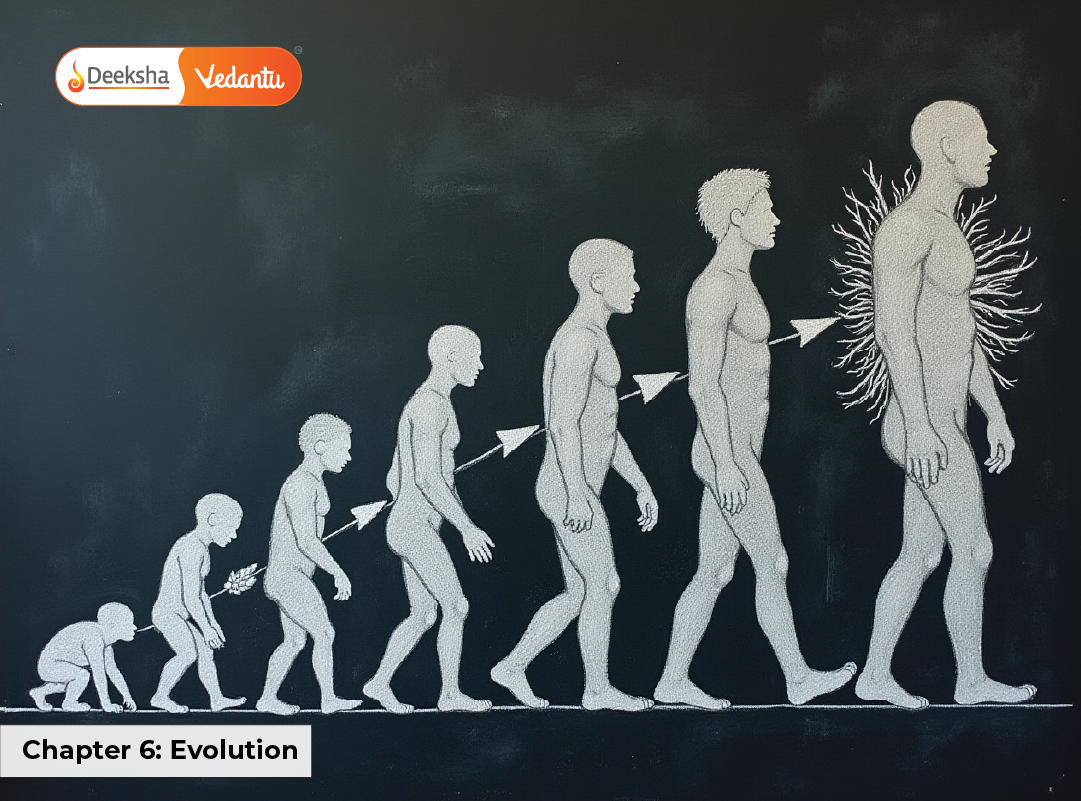


Evolution is a fascinating and critical chapter in Class 12 Biology, offering a glimpse into the vast timeline and complexity of life's history on Earth. For NEET aspirants, this chapter acts as a crucial connector between genetics, ecology, physiology, and biotechnology. Evolution explains the scientific journey from the origin of life to the rise of modern humans, showcasing the genetic and environmental interplay behind biodiversity. It integrates biology with elements of geology, paleontology, anthropology, and molecular biology, providing a multi-dimensional platform for understanding how life on Earth has transformed and diversified through natural and scientific processes.
Key Topics and Concepts:
1. Origin of Life
- Life is hypothesized to have originated around 3.5 to 4 billion years ago under primitive Earth conditions.
- Early Earth had a reducing atmosphere rich in methane (CH₄), ammonia (NH₃), hydrogen (H₂), and water vapor (H₂O), but lacked free oxygen (O₂).
- The Oparin-Haldane hypothesis proposed that these molecules interacted under high energy from UV rays, lightning, and volcanic activity to form organic compounds.
- Stanley Miller and Harold Urey recreated these early conditions in 1953. Their experiment led to the formation of simple amino acids like glycine and alanine, suggesting the plausibility of abiogenesis.
- Over millions of years, simple molecules may have formed complex macromolecules such as proteins and nucleic acids, possibly inside coacervates or protocells.
- Eventually, the first self-replicating systems emerged, possibly RNA-based (RNA World Hypothesis), laying the groundwork for the origin of cellular life.
2. Evolution of Life Forms
- Life evolved from anaerobic prokaryotes to photosynthetic cyanobacteria, which significantly increased Earth's oxygen levels.
- This oxygen revolution triggered the evolution of aerobic organisms and the ozone layer, providing a protective shield against UV radiation.
- The endosymbiotic theory suggests that mitochondria and chloroplasts evolved from engulfed aerobic and photosynthetic bacteria respectively.
- Multicellular eukaryotes emerged, giving rise to various kingdoms of life including plants, fungi, and animals.
- Sexual reproduction increased genetic variation, accelerating evolutionary diversification.
- Fossil records indicate the Cambrian explosion (~540 MYA) as a key era of rapid diversification of life forms in oceans.
3. Theories of Evolution
- Lamarckism: Jean-Baptiste Lamarck emphasized use and disuse of organs and inheritance of acquired traits (e.g., giraffe's neck). Though discredited, it introduced the concept of adaptation.
- Darwinism: Charles Darwin proposed natural selection after observing finches and other organisms on the Galapagos Islands. Key tenets include:
- Variation exists within populations.
- Organisms compete for limited resources.
- Individuals with advantageous traits survive and reproduce (survival of the fittest).
- Mutation Theory: Hugo de Vries observed sudden, inheritable changes (mutations) in evening primrose. He suggested mutations drive evolution, complementing Darwin's gradualism.
- Modern Synthetic Theory: Integrates Darwin's selection, Mendelian genetics, population genetics, and paleontology. Emphasizes mutation, recombination, genetic drift, gene flow, and natural selection.
4. Evidences of Evolution
- Paleontological Evidence: Fossil records show gradual changes (e.g., horse evolution from Eohippus to Equus).
- Comparative Anatomy and Morphology:
- Homologous organs indicate divergent evolution and common ancestry.
- Analogous organs suggest convergent evolution due to similar environments.
- Embryological Evidence: Vertebrate embryos show pharyngeal gill slits and tails, reflecting evolutionary origins.
- Molecular Evidence:
- Universal genetic code (ATGC).
- Similar proteins like cytochrome c and hemoglobin among species.
- DNA-DNA hybridization shows closeness of species (e.g., chimpanzees and humans share ~98% DNA).
- Vestigial Organs: Organs like the human appendix and pelvic bones in whales suggest evolutionary remnants.
5. Adaptive Radiation
- Adaptive radiation is the rapid evolution of multiple species from a common ancestor, adapted to different environments.
- Darwin's finches diversified into species with distinct beaks suited for seed-eating, insect-catching, or flower-feeding.
- Australian marsupials evolved into herbivores, carnivores, and burrowers.
- Adaptive radiation can occur due to ecological opportunity or geographic isolation.
- Related concepts:
- Convergent Evolution: Unrelated species evolve similar traits (e.g., dolphin and ichthyosaur).
- Divergent Evolution: Related species develop differences (e.g., forelimbs of bats and humans).
6. Hardy-Weinberg Principle
- Mathematical model to study genetic equilibrium in populations.
- Equation:
 where:
 : Represents the frequency of the dominant allele (A) in the population.
 : Represents the frequency of the recessive allele (a) in the population.
 : Denotes the proportion of individuals who are homozygous dominant (AA).
 : Denotes the proportion of heterozygous individuals (Aa).
 : Denotes the proportion of individuals who are homozygous recessive (aa).
- Assumptions:
- Large population
- Random mating
- No mutation, migration, or natural selection
- Disrupting factors lead to evolution:
- Mutation (new alleles)
- Gene flow (immigration/emigration)
- Genetic drift (founder/bottleneck effects)
- Natural selection (favors advantageous alleles)
 where:
 : Represents the frequency of the dominant allele (A) in the population.
 : Represents the frequency of the recessive allele (a) in the population.
 : Denotes the proportion of individuals who are homozygous dominant (AA).
 : Denotes the proportion of heterozygous individuals (Aa).
 : Denotes the proportion of individuals who are homozygous recessive (aa).
7. Speciation
- Speciation is the process by which new species arise.
- Types:
- Allopatric Speciation: Physical barriers separate populations.
- Sympatric Speciation: Genetic or behavioral isolation in the same area.
- Stages of speciation:
- Isolation → Genetic divergence → Reproductive isolation
- Prezygotic barriers: Temporal, behavioral, mechanical
- Postzygotic barriers: Hybrid sterility (e.g., mule)
- Laboratory studies on Drosophila confirm reproductive isolation.
8. Evolutionary History of Humans
- The evolutionary tree shows progression from primates to modern humans.
- Key ancestors:
- Dryopithecus and Ramapithecus: Tree-dwelling, ape-like primates.
- Australopithecus afarensis (Lucy): Bipedal, ~4.2 MYA.
- Homo habilis: "Handy man" with tools, ~2 MYA.
- Homo erectus: Upright posture, fire usage, ~1.8 MYA.
- Neanderthals: Robust build, cultural tools, ~200,000 years ago.
- Cro-Magnon: Early modern humans in Europe, skilled artists.
- Homo sapiens: Modern humans emerged in Africa and spread globally ~100,000 years ago.
- Traits:
- Bipedalism
- Opposable thumbs
- Cranial expansion
- Speech and social structure
Practice MCQs for NEET:
- The genetic material in the earliest forms of life was likely:
- Answer: RNA
- The first life forms were:
- Answer: Anaerobic prokaryotes
- What is the role of cytochrome c in evolutionary studies?
- Answer: Molecular marker of common ancestry
- Darwin's finches are examples of:
- Answer: Adaptive radiation
- Which factor does NOT disturb Hardy-Weinberg equilibrium?
- Answer: Random mating
- Homologous structures arise due to:
- Answer: Divergent evolution
- The wings of birds and insects are:
- Answer: Analogous organs
- Which scientist disproved Lamarck's theory experimentally?
- Answer: August Weismann
- The founder effect is a type of:
- Answer: Genetic drift
- Which fossil is a transitional form between reptiles and birds?
- Answer: Archaeopteryx
FAQs
Q1. What is the RNA World Hypothesis?
It suggests that RNA was the first genetic material capable of self-replication before DNA and proteins evolved.
Q2. Why is natural selection more accepted than Lamarckism?
Natural selection is supported by fossil, genetic, and molecular evidence, while Lamarckism lacks experimental validation.
Q3. What are the implications of Hardy-Weinberg principle in population genetics?
It helps detect if a population is evolving by measuring deviation from expected allele/genotype frequencies.
Q4. How is molecular biology used to trace evolution?
By comparing sequences of DNA, RNA, and proteins across organisms to find similarities and divergences.
Q5. What does a vestigial organ indicate?
That the organ once had a function in ancestors but is now reduced or non-functional due to evolution.
Q6. How does speciation occur in real-world populations?
Through genetic drift, geographic isolation, mutations, and reproductive barriers that accumulate over generations.
Q7. What is convergent evolution?
Different species independently evolve similar traits due to similar environmental pressures.
Q8. What distinguishes Homo erectus from Homo sapiens?
Homo erectus had a smaller brain and lacked complex language and cultural behavior.
Q9. Why are Drosophila often used in evolution experiments?
Short life cycle, easy to breed, and genetic similarities with humans make them ideal for observing speciation.
NEET Tips:
- Focus on evolutionary mechanisms, especially natural selection and Hardy-Weinberg applications.
- Practice numerical questions involving allele frequencies.
- Learn timelines of human evolution and fossil chronology.
- Draw diagrams of evolutionary trees and organ comparison charts.
- Read NCERT line by line, and attempt NCERT exemplar questions.
- Use flashcards to remember scientific names and key terms.
Conclusion:
Evolution is a cornerstone of biology that unifies all life through a shared history. It not only explains the origin and transformation of life but also equips students with an understanding of genetic variation, speciation, and natural selection. For NEET aspirants, mastering evolution means building a conceptual toolkit that aids both MCQs and real-world biological applications. By thoroughly studying its principles, evidence, and theories, students gain insights into how life adapts, survives, and flourishes across generations. Stay curious, explore the past, and prepare confidently for the future.



Get Social