


Introduction
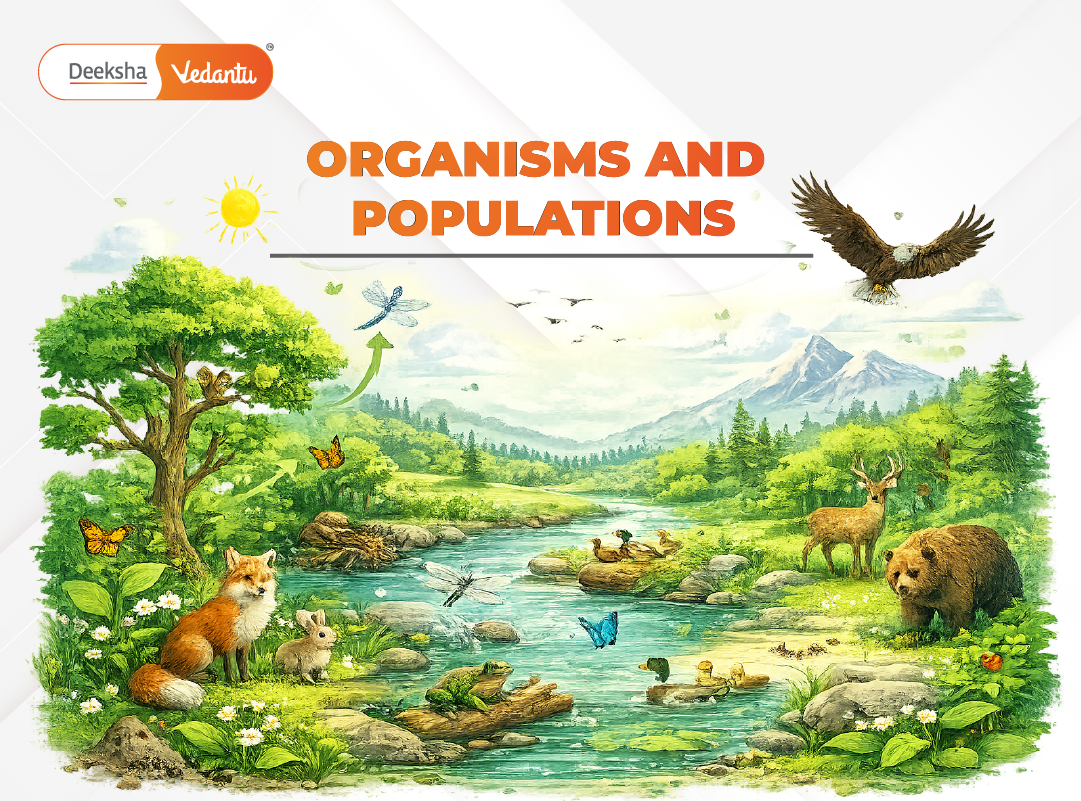
Chapter 11 Organisms and Populations is one of the most conceptually important chapters in Class 12 NCERT Biology under the unit of Ecology. This chapter explains how individual organisms interact with their physical environment and how populations behave as dynamic units over time. Unlike molecular biology chapters, ecology requires logical reasoning, interpretation, and application of concepts, which aligns closely with the way JEE questions are framed.
From a JEE perspective, this chapter is extremely important because most questions are concept-driven and test a student’s understanding of ecological principles rather than factual recall. Topics such as population growth models, adaptations, and species interactions are frequently asked in assertion–reason, match-the-following, and statement-based formats. At Deeksha Vedantu, this chapter is approached by linking theoretical ecology with real-life ecological examples, helping students build clarity and confidence while handling complex reasoning-based questions.
Organism and Its Environment
Every organism lives in a specific environment and continually interacts with both living and non-living components. These interactions determine the organism’s survival, growth, reproduction, and distribution. The environment is not static; it changes over time, and organisms must either adapt to these changes or migrate to more favourable conditions.
Environmental factors that influence organisms can be broadly classified into:
- Abiotic factors such as temperature, water, light, and soil
- Biotic factors such as competition, predation, and mutualism
Understanding organism–environment relationships is crucial for solving JEE questions related to tolerance limits, niche, and adaptation strategies.
Major Abiotic Factors
Temperature
Temperature is one of the most significant abiotic factors affecting living organisms. It directly influences enzyme activity, metabolic rate, growth, and physiological processes. Most organisms function efficiently only within a specific temperature range.
Based on temperature tolerance, organisms are classified as:
- Eurythermal organisms, which can tolerate a wide range of temperatures
- Stenothermal organisms, which can survive only within a narrow temperature range
JEE questions often test these classifications along with examples and ecological significance, especially in relation to species distribution.
Water
Water is essential for life, and its availability largely determines the distribution of organisms on Earth. Aquatic organisms are surrounded by water, while terrestrial organisms face the challenge of conserving water.
Based on water availability and requirement, organisms are classified as:
- Hydrophytes, which grow in water-rich environments
- Mesophytes, which grow in moderate water conditions
- Xerophytes, which are adapted to dry conditions
Adaptations related to water conservation, such as thick cuticles and reduced leaf surface area, are commonly tested in JEE questions.
Light
Light plays a crucial role in photosynthesis, flowering, seed germination, and biological rhythms. Both intensity and duration of light influence plant growth and productivity.
Plants show adaptations to:
- High light intensity environments
- Low light or shaded conditions
Photoperiodism, the response of organisms to the length of day and night, is an important ecological concept often tested in competitive exams.
Soil
Soil is an important abiotic factor that influences vegetation type and nutrient availability. Soil characteristics such as pH, mineral content, texture, and water-holding capacity affect the types of organisms that can survive in a habitat.
Different soil types support different plant communities, which in turn influence animal distribution.
Responses of Organisms to Abiotic Factors
Organisms show different strategies to cope with environmental stress caused by changes in abiotic factors.
Major response mechanisms include:
- Regulation, where organisms maintain constant internal conditions
- Conformation, where internal conditions change with the environment
- Migration, where organisms move to favourable environments
- Suspension, where metabolic activities are temporarily reduced
Regulators are usually warm-blooded animals, while most plants and cold-blooded animals are conformers. These concepts are frequently tested in JEE assertion–reason questions.
Adaptations
Adaptations are structural, physiological, or behavioural features that increase an organism’s chances of survival in a particular environment. Adaptations arise through natural selection over long periods.
Examples of adaptations include:
- Thick cuticle and sunken stomata in desert plants to reduce water loss
- Streamlined body shape in aquatic animals to reduce resistance
- Hibernation and aestivation in animals to survive unfavourable seasons
Understanding adaptations helps students answer application-based JEE questions that link structure with function.
Life History Variation
Life history variation refers to differences in life cycle patterns among organisms that affect survival, reproduction, and population growth. NCERT emphasises that organisms have evolved different life history strategies depending on environmental conditions, availability of resources, and mortality risks.
Life history traits include:
- Age at first reproduction
- Number and size of offspring produced
- Frequency of reproduction
- Lifespan of the organism
These traits are shaped by natural selection and directly influence population dynamics. From a JEE perspective, life history variation is important because questions often test the reasoning behind why certain organisms produce many offspring while others produce only a few.
Trade-offs in Life History Traits
Organisms face trade-offs in allocating limited energy between growth, reproduction, and survival.
Common trade-offs include:
- Producing a large number of small-sized offspring versus a few large-sized offspring
- Early reproduction with shorter lifespan versus delayed reproduction with longer lifespan
For example, organisms such as insects and fish produce a large number of offspring with minimal parental care, increasing the probability that at least some survive. In contrast, mammals and birds usually produce fewer offspring but invest more energy in parental care, increasing survival chances of each offspring.
Life History Strategies and Environment
Life history strategies are closely linked to environmental conditions.
- In unstable or unpredictable environments, organisms tend to produce many offspring to ensure species survival
- In stable environments, organisms invest more in individual offspring and long-term survival
NCERT highlights that these strategies are adaptive responses rather than conscious choices. JEE questions may test understanding of environmental pressure, reproductive strategy, and survival logic rather than direct examples.
Importance of Life History Variation for JEE
Life history variation is commonly tested through conceptual questions that link reproduction strategy with population growth patterns. Understanding this topic helps in solving assertion–reason questions and case-based problems in ecology.
Population Ecology
A population is defined as a group of individuals of the same species living in a specific geographical area and capable of interbreeding. Population ecology studies changes in population size, density, structure, and dynamics over time.
Key population attributes include:
- Population size
- Population density
- Natality (birth rate)
- Mortality (death rate)
- Age distribution
- Sex ratio
These attributes are population-level characteristics and cannot be studied at the level of an individual organism, making them unique and conceptually important for JEE.
Population Growth
Population growth refers to changes in population size over time and depends on birth rate, death rate, immigration, and emigration.
Exponential Growth Model
When resources are unlimited and environmental resistance is absent, populations show exponential growth.
Key features include:
- Rapid increase in population size
- J-shaped growth curve
- Growth rate proportional to population size
This model is theoretical and helps understand population potential under ideal conditions.
Logistic Growth Model
In natural ecosystems, resources are limited, and populations show logistic growth.
Characteristics include:
- Initial exponential growth phase
- Decrease in growth rate due to resource limitation
- Stabilisation of population size at carrying capacity (K)
Understanding assumptions, curves, and differences between exponential and logistic growth is essential for numerical and conceptual JEE questions.
Population Interactions
In nature, different species living together interact in various ways that influence population dynamics and community structure.
Major types of population interactions include:
- Mutualism
- Competition
- Predation
- Parasitism
- Commensalism
JEE questions often test identification of interaction types using real-life or NCERT-based examples.
Mutualism
In mutualism, both interacting species benefit from the association, and the survival or reproduction of both partners is enhanced. Such interactions are often highly specific and may evolve over long periods through co-evolution.
Key characteristics of mutualism include:
- Both species gain a benefit from the interaction
- The association may be obligatory or facultative
- Mutualistic relationships often improve reproductive success
Common NCERT examples include pollination, where insects obtain nectar while aiding plant reproduction, and lichens, where algae provide food and fungi offer protection. JEE questions may test identification of mutualistic relationships and distinguish them from other positive interactions.
Competition
Competition occurs when two species or individuals compete for limited resources such as food, space, light, or nutrients. This interaction negatively affects both competitors, though the degree of impact may vary.
Important features of competition include:
- Occurs when resources are limiting
- Leads to reduced growth, reproduction, or survival
- Can be interspecific or intraspecific
According to NCERT, competition can result in competitive exclusion, where one species outcompetes another. JEE questions often assess understanding of competitive exclusion and resource partitioning concepts.
Predation
In predation, one organism, the predator, benefits by feeding on another organism, the prey, which is harmed. Predation plays a crucial role in regulating population sizes and maintaining ecosystem stability.
Key roles of predation include:
- Controlling prey population growth
- Maintaining species diversity
- Acting as a selective force in evolution
Predators often improve the health of prey populations by eliminating weak or diseased individuals. In JEE, predation-based questions may test ecological significance rather than simple definitions.
Parasitism
Parasitism is an interaction where one organism, the parasite, benefits while the host is harmed. Parasites live on or inside the host and derive nourishment without immediately killing the host.
Important aspects of parasitism include:
- Parasites show high host specificity
- Host fitness is reduced due to nutrient loss
- Parasites may have complex life cycles
NCERT highlights that parasites often show adaptations such as loss of unnecessary organs and high reproductive capacity. JEE questions may test these adaptive features and their ecological significance.
Importance of This Chapter for JEE Preparation
Conceptual Importance
This chapter strengthens understanding of ecological balance, population regulation, and environmental adaptations. It integrates biology with environmental science, geography, and evolutionary principles, making it ideal for testing integrated conceptual understanding in JEE.
Scoring Potential
Organisms and Populations is a high-scoring chapter for JEE when concepts are clearly understood. Questions are mostly NCERT-based, logic-driven, and do not require heavy memorisation. A structured and concept-oriented approach, as emphasised at Deeksha Vedantu, helps students consistently score well from this chapter.
FAQs
Q1. What is population ecology?
Population ecology is the branch of ecology that studies factors affecting population size, density, structure, and growth over time.
Q2. What is carrying capacity?
Carrying capacity is the maximum population size that an environment can support sustainably without degradation.
Q3. What is the difference between exponential and logistic growth?
Exponential growth occurs under unlimited resources, whereas logistic growth occurs when resources are limited and population growth stabilises.
Q4. What are eurythermal organisms?
Eurythermal organisms are those that can tolerate a wide range of temperatures.
Q5. Why is Chapter 11 important for JEE?
This chapter is important for JEE because it tests ecological reasoning, population concepts, and application-based understanding derived directly from NCERT.
Conclusion
Chapter 11 Organisms and Populations provides a strong conceptual foundation in ecology by explaining how organisms respond to environmental factors and how populations grow, interact, and stabilise over time. For JEE aspirants, the emphasis should be on understanding ecological principles, growth models, and interaction types rather than memorising definitions. A disciplined NCERT-based preparation strategy, similar to the approach followed at Deeksha Vedantu, can significantly improve accuracy, reasoning ability, and overall performance in competitive examinations.



Get Social