


Introduction
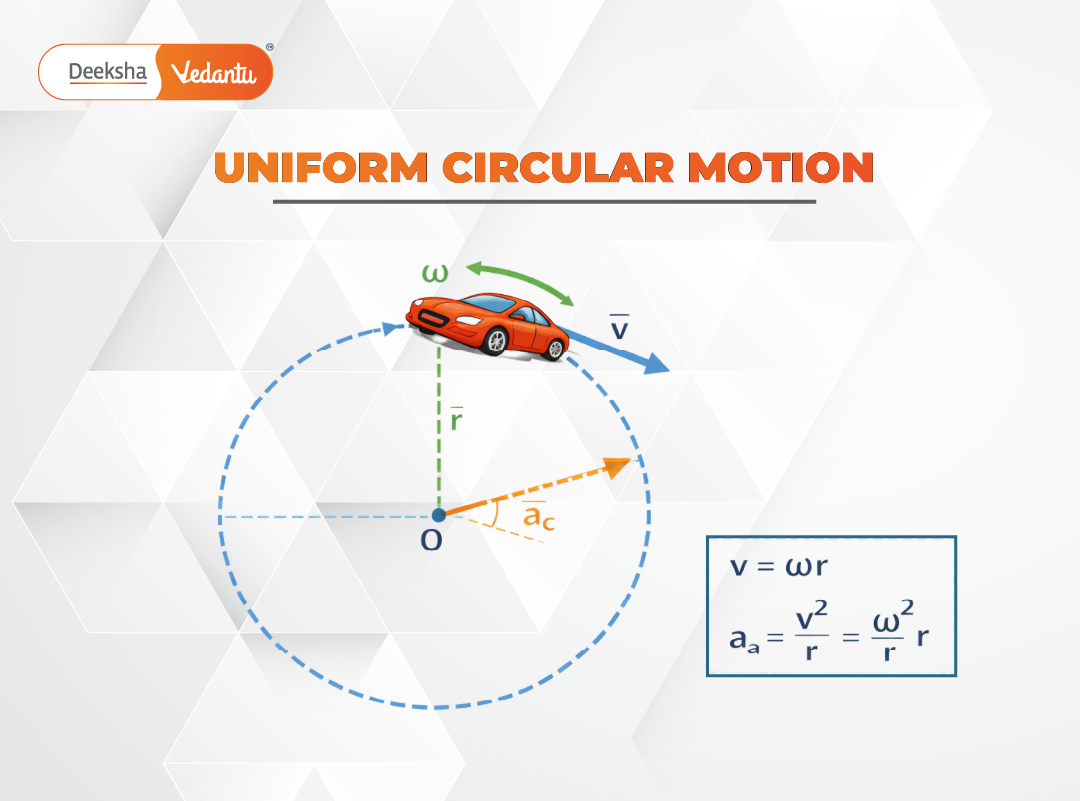
Uniform Circular Motion refers to the motion of a particle along a circular path with constant speed. Although the magnitude of velocity remains unchanged, the direction of velocity changes continuously at every point on the circular path. Since velocity is a vector quantity, any change in its direction implies the presence of acceleration.
This makes uniform circular motion fundamentally different from straight-line motion. In linear motion, constant speed implies zero acceleration, but in circular motion, acceleration exists even when speed is constant. This topic is extremely important for JEE aspirants because it introduces the idea of acceleration without change in speed, a concept that later becomes central to rotational mechanics, gravitation, and orbital motion. At Deeksha Vedantu, uniform circular motion is treated as a conceptual turning point that deepens students' understanding of motion beyond one dimension.
Circular Motion and Its Characteristics
When a particle moves in a circle of fixed radius, its position changes continuously along the circumference of the circle. At every instant, the direction of motion is different, even though the particle covers equal distances in equal intervals of time.
Important characteristics of uniform circular motion include:
- Constant speed throughout the motion
- Fixed radius of the circular path
- Continuously changing direction of velocity
- Presence of acceleration despite constant speed
These characteristics highlight why circular motion must be analysed using vectors rather than simple scalar quantities.
Angular Displacement
To describe circular motion more conveniently, angular quantities are introduced.
Angular displacement is defined as the angle through which the position vector of the particle rotates about the centre of the circle during motion. It provides a measure of how much the particle has moved along the circular path in terms of angle.
If a particle moves from one point on the circle to another such that the angle subtended at the centre is θ, the angular displacement is θ.
Angular displacement is measured in radians and is related to the arc length s by:

where r is the radius of the circular path. Angular displacement allows circular motion to be linked mathematically with linear motion along the arc.
Angular Velocity
Angular velocity describes how fast the angular position of the particle changes with time.
It is defined as the rate of change of angular displacement with respect to time:

In uniform circular motion, angular velocity remains constant because the particle sweeps out equal angles in equal intervals of time. Angular velocity provides a powerful way to analyse circular motion without referring directly to linear quantities.
Relation Between Linear Velocity and Angular Velocity
The linear velocity of a particle moving in a circular path is related to its angular velocity.
The relation is given by:

This equation shows that linear speed increases with radius for the same angular velocity. The direction of linear velocity at any point is always tangential to the circle, which means it is perpendicular to the radius at that point.
Centripetal Acceleration
Even though the speed remains constant in uniform circular motion, the velocity vector changes continuously due to change in direction. This continuous change in velocity gives rise to an acceleration known as centripetal acceleration.
Centripetal acceleration is always directed towards the centre of the circular path. It is responsible for continuously turning the velocity vector so that the particle remains on the circular path.
The magnitude of centripetal acceleration is:

Using the relation between linear and angular velocity, centripetal acceleration can also be expressed as:

These expressions are extremely important for numerical problem-solving in JEE.
Direction of Velocity and Acceleration
In uniform circular motion:
- The velocity vector is always tangential to the circular path
- The acceleration vector is always directed radially inward towards the centre
Velocity and acceleration are perpendicular to each other at every point on the circular path. This perpendicular nature explains why speed remains constant while direction changes. Understanding this geometric relationship is crucial for conceptual JEE questions.
Time Period and Frequency
The time period T is defined as the time taken by the particle to complete one full revolution along the circular path.
It is given by:

The frequency f is the number of revolutions completed per second.
It is related to the time period by:

Time period and frequency are often used while analysing rotating systems and orbital motion.
Centripetal Force
For a particle to move along a circular path, a force must continuously act towards the centre of the circle. This inward force is called the centripetal force.
The centripetal force required is given by:

Centripetal force is not a separate physical force. It is provided by existing forces such as tension in a string, friction between tyres and road, gravitational force in orbital motion, or normal reaction in constrained motion.
Physical Examples of Uniform Circular Motion
Uniform circular motion is observed in many real-life and physical systems:
- Motion of a stone tied to a string and whirled in a horizontal circle
- Motion of a car taking a turn on a circular road
- Motion of satellites revolving around the Earth in circular orbits
- Motion of electrons around a nucleus in classical models
In each case, a centripetal force acts to maintain the circular path.
Importance of Uniform Circular Motion for JEE
Uniform circular motion is extremely important for JEE because:
- It introduces centripetal acceleration and force concepts
- It strengthens understanding of vector direction and force balance
- It forms the foundation for rotational mechanics and gravitation
- It appears frequently in both conceptual and numerical questions
At Deeksha Vedantu, students are trained to visualise velocity and acceleration vectors clearly, which significantly improves accuracy in circular motion problems.
Common Conceptual Errors (JEE Perspective)
Students often make mistakes such as:
- Assuming acceleration is zero when speed is constant
- Confusing centripetal force with centrifugal force
- Applying straight-line motion formulas to circular motion
- Ignoring the direction of velocity and acceleration vectors
Recognising and correcting these errors early helps improve exam performance.
FAQs
Q1. What is uniform circular motion?
Uniform circular motion is the motion of a particle along a circular path with constant speed but continuously changing direction of velocity.
Q2. Why does acceleration exist even when speed is constant?
Because velocity changes direction continuously, resulting in centripetal acceleration.
Q3. What is the direction of centripetal acceleration?
It is always directed towards the centre of the circular path.
Q4. Is centripetal force a real force?
It is provided by real forces such as tension, friction, or gravity, depending on the situation.
Q5. Why is uniform circular motion important for JEE?
Because it forms the foundation for rotational motion, gravitation, and orbital dynamics.
Conclusion
Uniform Circular Motion provides deep insight into how objects move along curved paths even when their speed remains constant. For JEE aspirants, mastering this topic is essential as it builds a strong understanding of acceleration, force, and vector direction in non-linear motion. A structured and concept-driven approach, as emphasised at Deeksha Vedantu, ensures confidence, clarity, and accuracy while solving circular motion problems in competitive examinations.



Get Social