
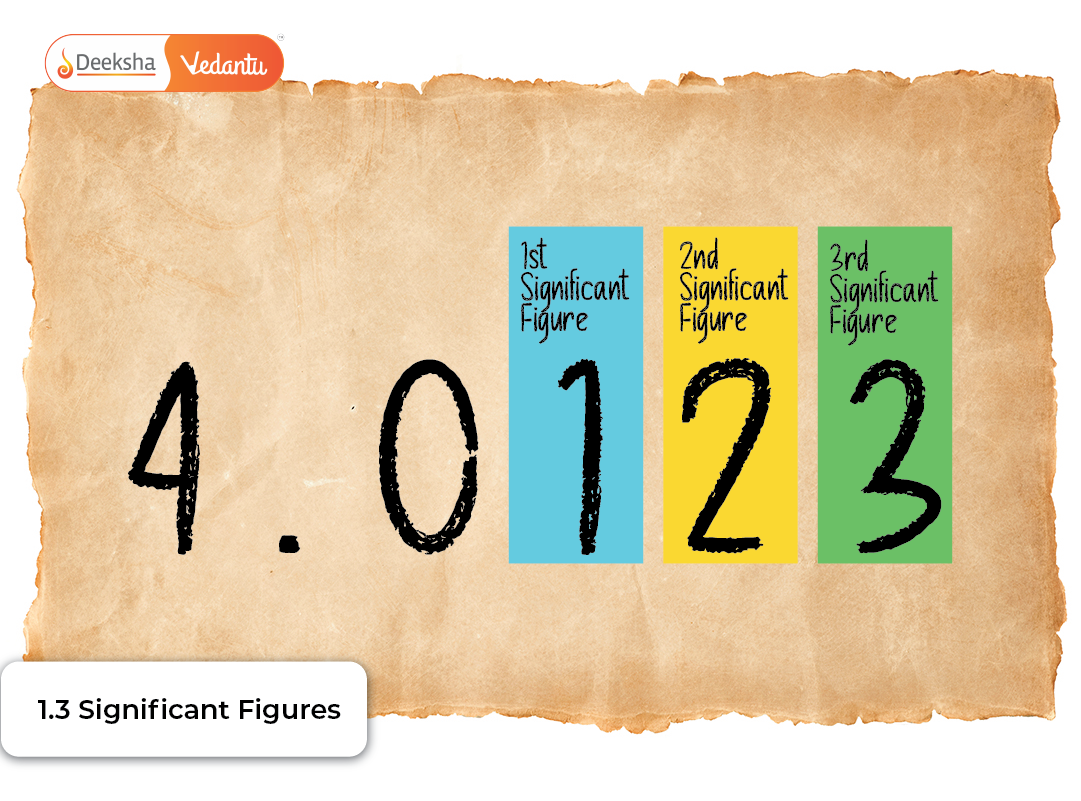


Significant figures are the digits in a measurement that carry meaningful information about its precision. They arise from the limitations of measuring instruments and represent the reliability of the measured value.
Every measurement has two components:
- A numerical value, and
- A degree of uncertainty (because no measurement is perfectly exact).
Significant figures help quantify this uncertainty so that the final reported value reflects the precision of the measurement process.
What Are Significant Figures?
Significant figures include:
- All non-zero digits
- Zeros between non-zero digits
- Leading zeros not significant
- Trailing zeros significant only if a decimal point is present
Rules for Counting Significant Figures
Rule 1: All non‑zero digits are significant.
Example: 345 → 3 significant figures
Rule 2: Zeros between non‑zero digits are significant.
Example: 507 → 3 significant figures
Rule 3: Leading zeros are not significant.
Example: 0.0046 → 2 significant figures
Rule 4: Trailing zeros are significant if a decimal is present.
Example: 25.00 → 4 significant figures
Rule 5: Trailing zeros without a decimal are not significant.
Example: 3000 → 1 significant figure (unless written as 3.000 × 10³)
Rule 6: Exact numbers have infinite significant figures.
Examples: Counting numbers, defined quantities (1 km = 1000 m)
Rounding Off Significant Figures
To round off a number:
- If the digit to be removed is less than 5 → drop it
- If it is 5 or more → increase preceding digit by 1
Examples
- 2.746 → 2.75 (rounded to 3 significant figures)
- 5.4321 → 5.43 (rounded to 3 significant figures)
Significant Figures in Arithmetic Operations
1. Addition and Subtraction
The result should have the same number of decimal places as the least precise term.
Example: 12.56
- 3.1 = 15.66 → reported as 15.7 (1 decimal place)
2. Multiplication and Division
The result should have the same number of significant figures as the factor with the fewest significant figures.
Example: 4.21 × 2.1 = 8.841 → 8.8 (2 significant figures)
Scientific Notation and Significant Figures
Scientific notation helps represent very large or very small numbers clearly while preserving significant figures.
Example: 0.000456 → 4.56 × 10⁻⁴ (3 significant figures)
Understanding Precision and Accuracy
Significant figures are fundamentally connected to the ideas of precision and accuracy, two concepts that students often confuse. Accuracy refers to how close a measured value is to the true value, while precision refers to how reproducible repeated measurements are. A measurement with many significant figures is typically more precise because it captures finer detail.
For example, a digital balance reading 12.450 g reflects higher precision (5 significant figures) compared to a triple-beam balance reading 12.5 g (3 significant figures). The improved resolution of the digital balance allows more digits to be considered significant.
Why Instruments Influence Significant Figures
Every measuring instrument, ruler, stopwatch, ammeter, thermometer has a least count, which determines the smallest value it can measure. A ruler with markings every 1 mm allows measurements like 4.56 cm (3 significant figures), whereas a ruler with only 1-cm markings might only allow 5 cm (1 significant figure).
Thus, significant figures reflect the fineness of the instrument. Students must remember that adding digits beyond what the instrument can measure is incorrect and misleading.
More About Uncertainty and Error Propagation
Significant figures also help handle uncertainty propagation in calculations.
- When adding or subtracting, uncertainties relate to decimal places.
- When multiplying or dividing, uncertainties relate to the number of significant figures.
This allows uncertainty to be transmitted correctly through equations, ensuring the final reported value does not appear artificially precise.
For instance, if:
- Length = 2.48 cm (3 sig figs)
- Width = 3.1 cm (2 sig figs)
Then area = 2.48 × 3.1 = 7.688 → reported as 7.7 cm² (2 sig figs). This ensures that the least certain measurement controls the precision of the final answer.
Additional Concept: Ambiguous Zeros
A common confusion occurs with numbers like 1500. Without context, zeros are not significant. To indicate significance:
- Use decimal: 1500. → 4 sig figs
- Use scientific notation: 1.500 × 10³ → 4 sig figs
More Clarification on Scientific Notation
Scientific notation is essential because:
- It avoids ambiguity in zeros.
- It explicitly shows significant figures.
- It simplifies very large/small values.
For example: 0.00004020 → 4.020 × 10⁻⁵ (4 significant figures)
Deep Insight: Why Round Only at the End?
Intermediate rounding ruins accuracy. Example: (2.468 × 3.1) / 1.21 If rounded early, error increases. Always keep extra digits until the final step, then apply significant figures.
Solved NCERT‑Style Examples
Example 1
How many significant figures are in 0.003080?
- Leading zeros → not significant
- Digits 3,0,8,0 → significant → 4 significant figures
Example 2
Round 5.673 to 2 significant figures. 5.673 → 5.7
Example 3
Perform: 12.01 + 3.2 + 0.345 Raw sum = 15.555 Least decimal places = 1 → 15.6
Example 4
How many significant figures are in 0.010250?
- Leading zeros → not significant
- Digits 1,0,2,5,0 → significant (decimal present)
- Total = 5 significant figures
Example 5
Round 72.8457 to 4 significant figures. Digits: 7 2 8 4 | 5 → next digit 5 raises previous digit Final: 72.85
Example 6
Divide 5.620 by 0.34 with proper significant figures. Raw answer = 16.529… Least sig figs = 2 → Final = 17
Example 7
A thermometer reads 37.240°C. Express with 3 significant figures. Answer: 37.2°C
Example 8
Evaluate (425.6 − 23.11 + 1.4) Raw result = 403.89 → 1 decimal place → 403.9
Additional JEE/NEET‑Level Numerical Problems
Problem 1
A measurement is recorded as 6.375 m. Round it to 3 significant figures. Solution: 6.38 m
Problem 2
Calculate with correct significant figures: (3.142 × 2.1) Raw product = 6.5982 Least sig figs = 2 → 6.6
Problem 3
A rod measures 2.462 m and 3.1 m. Find the total length. 2.462 + 3.1 = 5.562 → 5.6 m (1 decimal place)
Problem 4
Express 0.00023040 in scientific notation. = 2.3040 × 10⁻⁴ (5 significant figures)
Problem 5
A value is given as 4.500 g. How many significant figures are present? Answer: 4 significant figures
Problem 6
A stopwatch measures time to the nearest 0.01 s. A student records reaction time as 0.245 s. How many significant figures? Solution: Digits: 2,4,5 → 3 significant figures.
Problem 7
Mass of an object = 4.52 g; Volume = 1.4 cm³. Find density with correct sig figs. Density = 4.52 / 1.4 = 3.228 → 3.2 g/cm³
Problem 8
Convert 0.000450060 to significant figures and scientific notation. Significant digits: 4,5,0,0,6,0 → 6 significant figures Scientific form: 4.50060 × 10⁻⁴
Problem 9
Pressure = Force / Area. Force = 12.450 N (5 sig figs) Area = 4.2 m² (2 sig figs) Pressure = 2.964 → 3.0 N/m² (2 sig figs)
Problem 10
A meter scale measures length to the nearest mm. If length is recorded as 14.2 cm, what is its precision? 1 mm = 0.1 cm → measurement has 3 significant figures and precision of ±0.1 cm.
FAQs
Q1. Why do we need significant figures?
They show how precise a measurement is based on the limitations of the instrument.
Q2. Are trailing zeros always significant?
No. They are significant only when a decimal is explicitly present.
Q3. Do exact numbers affect significant figures?
No. Defined or counted quantities have infinite precision.
Q4. Why do multiplication and division rules differ from addition and subtraction?
Because they depend on overall precision, not decimal places.
Q5. How can I avoid errors in rounding off?
Always round only at the end of the calculation, not during intermediate steps.
Q6. Why do digital instruments often show more significant figures?
Because their resolution is higher, and they can detect smaller increments. However, more digits do not always mean more accuracy/calibration matters.
Q7. Can two instruments show the same measurement but different significant figures?
Yes. A coarse instrument may show 12.5 cm, while a higher-resolution one shows 12.54 cm.
Q8. Why do we reduce significant figures in subtraction?
Because subtraction depends on the least precise decimal place, not the number of digits.
Q9. Can significant figures be used in theoretical physics?
Yes, particularly in experimental data analysis, uncertainty evaluation, and error propagation.
Q10. Which topic should students master first: significant figures or dimensional analysis?
Students should master significant figures first because they influence how results are reported in dimensions and physical equations.
Conclusion
Significant figures are a cornerstone of experimental physics. They provide a disciplined framework for expressing measured values, ensuring that calculations do not pretend to offer greater precision than the measuring instrument allows. By following rules for counting, rounding, and performing arithmetic operations, students develop accuracy, consistency, and confidence critical skills for both academic success and scientific inquiry.
At Deeksha Vedantu, students are taught to approach numerical problems methodically, understand sources of uncertainty, and apply significant figure rules to laboratory work, board exam numericals, and competitive exams like JEE and NEET. This structured learning ensures mastery of precision skill that extends far beyond the classroom.



Get Social