


Introduction
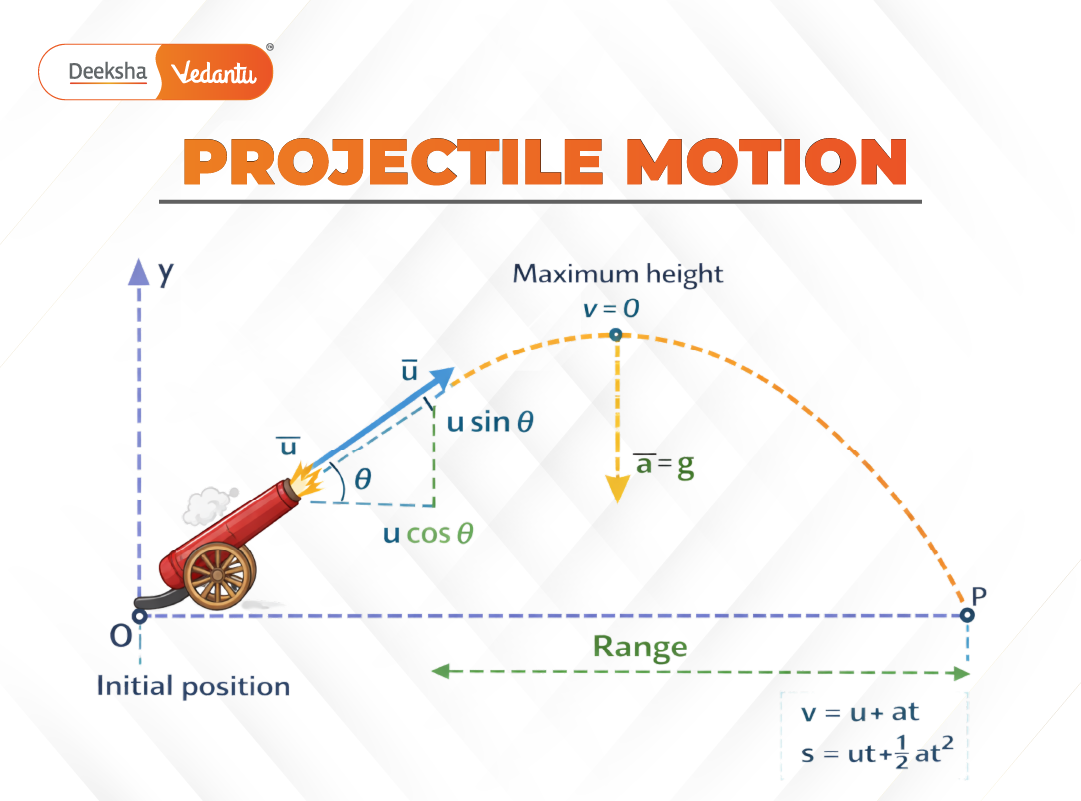
Projectile motion is one of the most important and widely applied examples of motion in a plane with constant acceleration. In projectile motion, an object is projected into space with an initial velocity and thereafter moves only under the influence of gravity. The acceleration acting on the projectile remains constant in magnitude and direction and is always directed vertically downward.
This topic occupies a central place in mechanics because it integrates multiple ideas studied earlier, such as vector resolution, equations of motion, and the independence of perpendicular components of motion. Almost every competitive examination, especially JEE, tests projectile motion in some form, either directly through formula-based questions or indirectly through conceptual applications. At Deeksha Vedantu, projectile motion is introduced as a logical continuation of two-dimensional kinematics, ensuring students build a strong foundation before approaching advanced mechanics topics.
What Is a Projectile?
A projectile is any object that, after being given an initial velocity, moves freely under the action of gravity alone. During its flight, no force other than gravity acts on the object. Effects such as air resistance, buoyancy, or wind are neglected in ideal projectile motion.
Common examples of projectiles include:
- A ball thrown into the air
- A stone projected at an angle from the ground
- A bullet fired from a gun (idealised situation)
- A ball rolling off the edge of a table
Once the object is projected, its entire motion is governed by its initial velocity and the constant downward acceleration due to gravity.
Assumptions in Projectile Motion
To analyse projectile motion mathematically and derive standard results, certain simplifying assumptions are made:
- Air resistance is neglected
- Acceleration due to gravity remains constant
- The Earth's surface is assumed to be flat over the range of motion
- The projectile is treated as a point mass
These assumptions simplify calculations and are valid for most examination-level problems encountered in JEE.
Basic Principle of Projectile Motion
The most important principle used in analysing projectile motion is the independence of motion along perpendicular directions. Although the projectile follows a curved path, its horizontal and vertical motions can be analysed separately using one-dimensional equations.
- Motion along the horizontal direction is uniform
- Motion along the vertical direction is uniformly accelerated
This principle allows complex motion to be broken down into simpler components.
Types of Projectile Motion
Projectile motion is broadly classified into two types based on the direction of initial projection.
Horizontal Projection
In horizontal projection, the projectile is launched with an initial velocity only in the horizontal direction. There is no initial vertical component of velocity.
The initial velocity components are:


This type of motion occurs when an object moves off a horizontal surface, such as a ball rolling off a table or a stone thrown horizontally from a cliff.
Oblique Projection
In oblique projection, the projectile is launched with an initial velocity making an angle with the horizontal.
If the magnitude of initial velocity is u and the angle of projection is θ:


Most JEE problems on projectile motion involve oblique projection.
Analysis of Projectile Motion Using Components
To analyse projectile motion quantitatively, the motion is resolved into horizontal and vertical components.
Motion Along the Horizontal Direction
Along the horizontal direction:
- Acceleration is zero
- Velocity remains constant throughout the motion
The equations governing horizontal motion are:


This shows that horizontal displacement increases linearly with time.
Motion Along the Vertical Direction
Along the vertical direction:
- Acceleration is equal to −g
- Velocity changes uniformly with time
The equations governing vertical motion are:


These vertical equations determine how the projectile rises, reaches maximum height, and falls back under gravity.
Time of Flight
The time of flight is the total time for which the projectile remains in the air.
For a projectile projected at an angle θ and landing at the same vertical level from which it was projected, the time of flight is:

The time of flight depends entirely on the vertical component of the initial velocity and the acceleration due to gravity.
Maximum Height
The maximum height is the highest vertical position reached by the projectile during its motion.
At the maximum height, the vertical component of velocity becomes zero.
The expression for maximum height is:

This result is frequently used in numerical and conceptual JEE questions.
Horizontal Range
The horizontal range is the horizontal distance travelled by the projectile during its entire time of flight.
It is given by:

The range depends on both the magnitude and direction of the initial velocity.
Maximum Range Condition
The range of a projectile is maximum when the angle of projection is:

The corresponding maximum range is:

An important result is that two complementary angles of projection give the same range.
Equation of the Trajectory
The trajectory of a projectile is the path it traces during its motion.
By eliminating time from the equations of horizontal and vertical motion, the equation of the trajectory is obtained as:

This equation represents a parabola, which is why projectile motion is described as parabolic motion.
Velocity at Any Point on the Trajectory
The velocity of the projectile at any point is obtained by combining its horizontal and vertical components.
The magnitude of velocity is:

While the direction of velocity changes continuously, the acceleration always remains vertically downward.
Special Results in Projectile Motion
Some important results commonly tested in examinations include:
- Time taken to reach maximum height is half of the total time of flight
- Speed of projection equals speed of landing when the projectile lands at the same level
- Horizontal velocity remains constant throughout the motion
- Vertical velocity changes uniformly under gravity
These results help simplify many JEE problems.
Importance of Projectile Motion for JEE
Projectile motion is extremely important for JEE because:
- It combines vector concepts with kinematics
- It involves multiple standard formulas tested directly
- It strengthens component-wise problem-solving skills
- It forms the foundation for advanced topics like relative motion and circular motion
At Deeksha Vedantu, emphasis is placed on understanding derivations and physical reasoning rather than rote memorisation, helping students tackle unfamiliar problems with confidence.
Common Conceptual Errors (JEE Perspective)
Students often make mistakes such as:
- Failing to resolve velocity into horizontal and vertical components
- Interchanging sine and cosine terms incorrectly
- Ignoring sign conventions for gravity
- Assuming acceleration acts along the direction of motion
Careful component-wise analysis and conceptual clarity help avoid these errors.
FAQs
Q1. What is projectile motion?
Projectile motion is the motion of an object that is projected into space and thereafter moves only under the influence of gravity.
Q2. Why is projectile motion considered two-dimensional?
Because the motion involves simultaneous horizontal and vertical components.
Q3. Why is the trajectory of a projectile parabolic?
Because horizontal motion is uniform while vertical motion is uniformly accelerated.
Q4. At what angle is the horizontal range maximum?
The horizontal range is maximum when the angle of projection is 45°.
Q5. Why is projectile motion important for JEE preparation?
Because it is a high-weightage topic that tests both conceptual understanding and numerical problem-solving skills.
Conclusion
Projectile Motion is a complete and elegant application of motion in a plane with constant acceleration. For JEE aspirants, mastering this topic is essential as it integrates vectors, equations of motion, and component-wise analysis into a single framework. A structured and concept-driven approach, as emphasised at Deeksha Vedantu, ensures accuracy, speed, and confidence while solving projectile-based problems in competitive examinations.



Get Social