


Introduction
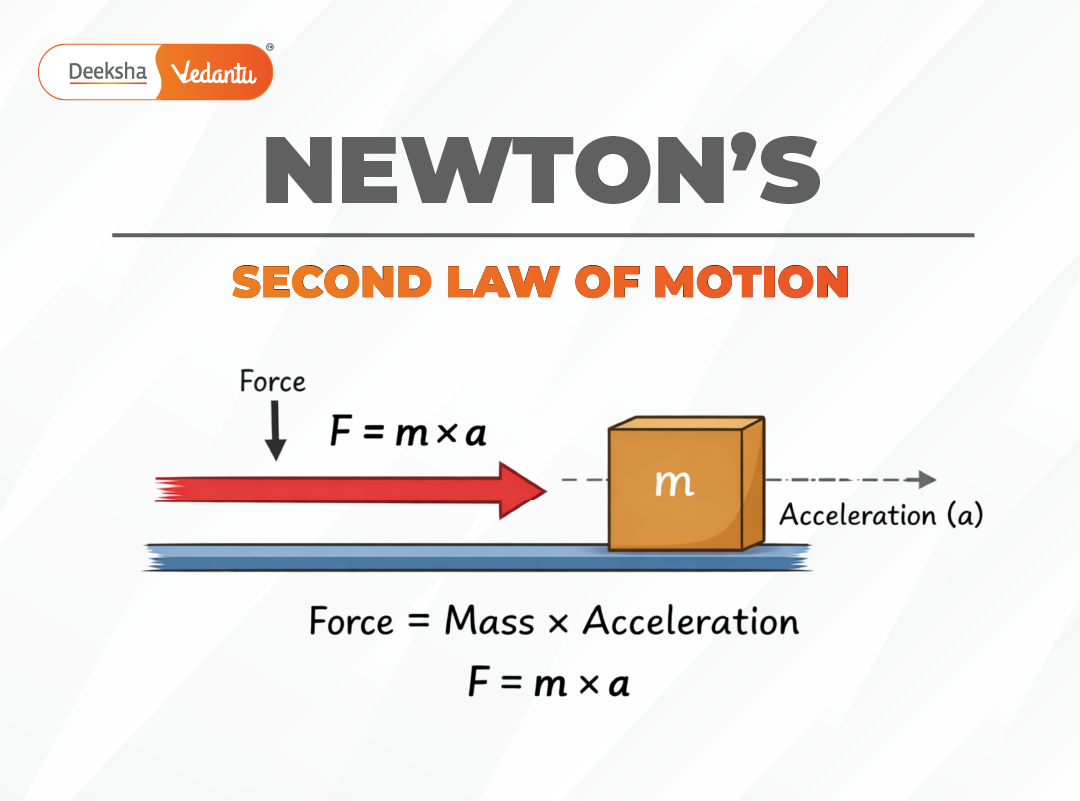
Newton's Second Law of Motion is the most central and practically useful law of classical mechanics. While Newton's First Law identifies situations where motion remains unchanged due to zero net force, the Second Law explains how and why motion changes when a net force acts. It introduces a precise mathematical relationship between force, mass, and acceleration, making it the backbone of quantitative problem-solving in mechanics.
For JEE aspirants, Newton's Second Law is indispensable because nearly every mechanics problem ultimately relies on it. Whether the problem involves straight-line motion, circular motion, friction, tension, or connected bodies, this law provides the starting point. At Deeksha Vedantu, students are trained to view Newton's Second Law as the core engine of mechanics that converts force analysis into measurable motion.
Statement of Newton's Second Law
Newton's Second Law states that the rate of change of momentum of a body is directly proportional to the net external force acting on it and occurs in the direction of that force.
This statement conveys two crucial physical ideas:
- Force is fundamentally linked to change in momentum, not merely to motion itself
- The direction of the applied force determines the direction in which motion changes
This law applies to both variable and constant mass systems, making it a highly general principle.
Momentum
Momentum is a vector quantity defined as the product of the mass and velocity of a body.

Momentum depends on both how heavy an object is and how fast it is moving. An object with a large mass moving slowly may have the same momentum as a lighter object moving at high speed. Because momentum is a vector, both magnitude and direction are important while analysing collisions and force interactions.
Mathematical Form of Newton's Second Law
Newton's Second Law mathematically relates force to the time rate of change of momentum.

This is the most general form of the law and remains valid even when mass changes with time. In many situations relevant to JEE, the mass of the object remains constant, allowing the equation to simplify.
When mass is constant:

This simplified form is widely used in numerical problem-solving and forms the foundation of most mechanics equations.
Physical Meaning of F = ma
The equation has deep physical significance:
- For a given mass, greater force produces greater acceleration
- For a given force, larger mass results in smaller acceleration
This explains why it is easier to accelerate lighter objects and harder to accelerate heavier ones. It also establishes mass as a quantitative measure of inertia, linking Newton's Second Law directly to the Law of Inertia discussed earlier.
Vector Nature of Newton's Second Law
Newton's Second Law must always be applied in vector form because force, acceleration, and momentum are vector quantities.
This means:
- Acceleration always occurs in the direction of the net external force
- Forces in different directions must be resolved into components
This vector nature is essential while analysing motion in two dimensions, motion on inclined planes, circular motion, and systems involving multiple forces.
Impulse and Change in Momentum
Impulse is defined as the product of force and the time interval for which it acts.

Impulse is equal to the change in momentum of the body:

This relationship explains why increasing the time of impact reduces the force experienced. Applications of impulse are seen in safety devices like airbags, helmets, and shock absorbers, which increase collision time to reduce impact force.
Applications of Newton's Second Law
Newton's Second Law is applied across a wide range of mechanical situations:
- Motion of bodies under gravity
- Objects moving on rough or smooth inclined planes
- Systems involving friction and normal reaction
- Motion of bodies connected by strings and pulleys
- Multi-body systems where forces act simultaneously
In each case, accurate application of the law depends on identifying all forces correctly.
Role of Free Body Diagrams
Free Body Diagrams (FBDs) are an essential tool for applying Newton's Second Law. An FBD represents all external forces acting on a body after isolating it from its surroundings.
Steps for effective use of FBDs include:
- Isolating the body under consideration
- Representing all forces acting on it
- Choosing convenient coordinate axes
At Deeksha Vedantu, strong emphasis is placed on FBDs because most JEE errors originate from incomplete or incorrect force representation rather than calculation mistakes.
Importance of Newton's Second Law for JEE
Newton's Second Law is crucial for JEE preparation because:
- It is directly used in most mechanics numericals
- It links abstract forces to observable motion
- It provides the basis for analysing constrained and connected systems
- It forms the foundation for advanced topics such as rotational motion and gravitation
Mastery of this law significantly improves problem-solving speed and accuracy.
Common Conceptual Errors (JEE Perspective)
Students often make mistakes such as:
- Applying
 without considering all acting forces
 - Ignoring the vector nature of force and acceleration
- Treating force and momentum as the same quantity
- Skipping free body diagrams and jumping directly to equations
Recognising and correcting these mistakes is essential for success in competitive exams.
FAQs
Q1. What does Newton's Second Law of Motion state?
It states that the net external force acting on a body is equal to the rate of change of its momentum.
Q2. When is the equation F = ma valid?
It is valid when the mass of the body remains constant.
Q3. Is Newton's Second Law applicable in all reference frames?
No, it is valid only in inertial frames of reference.
Q4. What is the significance of impulse in mechanics?
Impulse explains how a force acting over time changes momentum.
Q5. Why is Newton's Second Law important for JEE?
Because it is the primary law used to solve numerical problems involving force and motion.
Conclusion
Newton's Second Law of Motion provides a comprehensive and quantitative framework for understanding how forces influence motion. By connecting force, mass, acceleration, momentum, and impulse, it forms the core of classical mechanics. For JEE aspirants, a deep conceptual command over this law is essential for tackling a wide range of problems with confidence. A systematic, force-based approach, as emphasised at Deeksha Vedantu, ensures strong fundamentals and consistent exam performance.



Get Social