


Introduction
Section 3.7 of NCERT Class 11 Physics brings together all the vector concepts studied earlier and applies them to describe the actual motion of a particle in two dimensions. Unlike motion along a straight line, motion in a plane requires both magnitude and direction to specify position, displacement, velocity, and acceleration at every instant. This section therefore acts as the conceptual bridge between pure vector algebra and real kinematical motion.
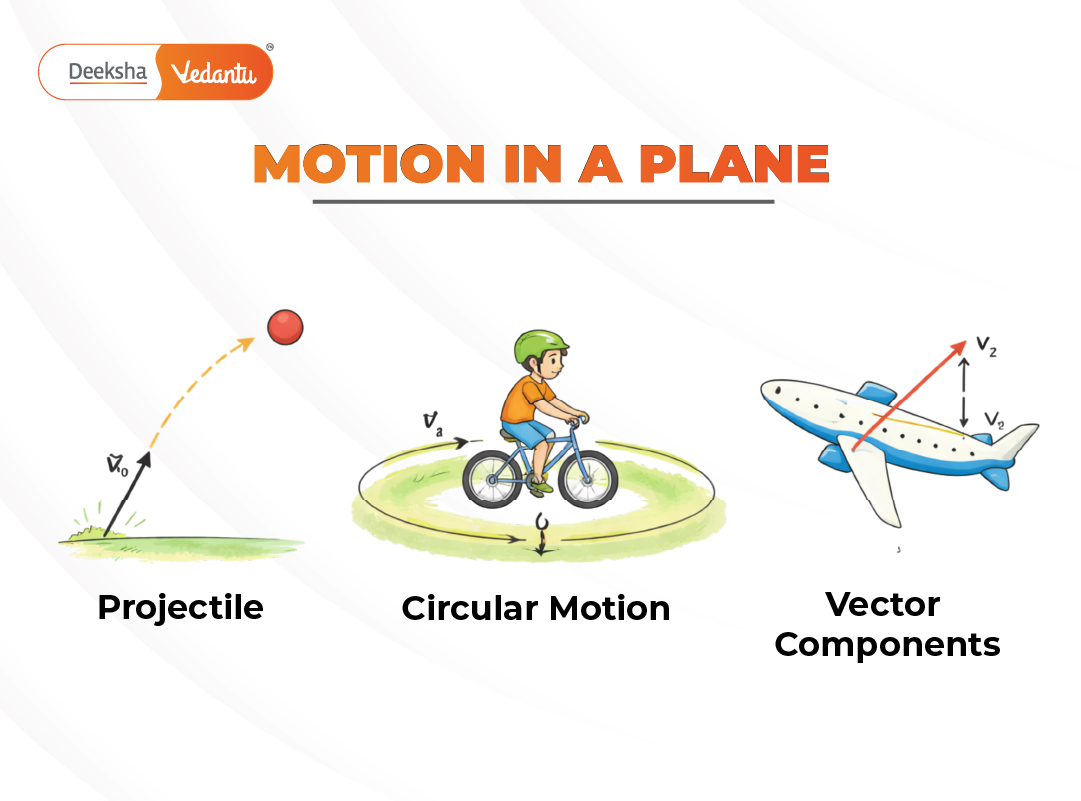
In real life, most motions occur in two dimensions rather than along a straight line. Examples include the motion of a thrown ball, the path of a vehicle turning on a road, or the motion of a satellite. Understanding motion in a plane allows students to analyse such situations accurately. For JEE aspirants, this topic is extremely important because it lays the foundation for projectile motion, relative velocity, circular motion, and several advanced mechanics problems. At Deeksha Vedantu, Motion in a Plane is taught as a unifying topic where vectors and kinematics come together to describe real physical motion in a systematic way.
Position Vector
To describe the position of a particle in a plane, a fixed point called the origin is chosen. The position of the particle at any instant is specified using a position vector, which joins the origin to the location of the particle.
If a particle is located at point P with coordinates (x, y), the position vector of the particle with respect to the origin O is written as:

The position vector provides complete information about where the particle is located in the plane. As time progresses and the particle moves, both x and y coordinates may change, leading to a continuous change in the position vector. This time dependence of the position vector forms the basis for defining velocity and acceleration in two-dimensional motion.
Displacement in a Plane
Displacement in a plane is defined as the change in position vector of a particle during a given time interval. It represents the shortest directed distance between the initial and final positions of the particle.
If the position vector of a particle changes from  to
to  , the displacement vector is given by:

Displacement is a vector quantity and depends only on the initial and final positions, not on the actual path followed by the particle. This distinction between displacement and distance becomes very important in two-dimensional motion and is frequently tested in JEE through both conceptual and numerical questions.
Average Velocity in a Plane
Average velocity is defined as the ratio of displacement to the corresponding time interval. It indicates how fast and in which direction the particle moves on average during the given time.
If a particle undergoes displacement  in time interval
  , the average velocity is:

The direction of average velocity is always the same as the direction of displacement, irrespective of the actual path taken. This property is useful while analysing motion over finite intervals and is often used in JEE problems involving net displacement.
Instantaneous Velocity in a Plane
Instantaneous velocity describes the velocity of a particle at a particular instant of time. It is defined as the rate of change of position vector with respect to time.
Mathematically, instantaneous velocity is given by:

The instantaneous velocity vector is always tangent to the path of the particle at the given point. This geometric interpretation is extremely important for understanding curved paths and forms the basis for analysing circular motion and trajectory-related problems in JEE.
Average Acceleration in a Plane
Average acceleration is defined as the rate of change of velocity with respect to time over a given interval.
If velocity changes from  to
to  in time , the average acceleration is:

In two-dimensional motion, acceleration may occur due to change in speed, change in direction of velocity, or both. This makes acceleration analysis more involved than in straight-line motion.
Instantaneous Acceleration in a Plane
Instantaneous acceleration is the acceleration of a particle at a specific instant and is defined as the rate of change of velocity with respect to time.
It is given by:

Even if the speed of a particle remains constant, acceleration can still be present if the direction of motion changes. This idea is crucial for understanding circular motion and is frequently tested in JEE conceptual questions.
Motion in a Plane with Constant Acceleration
One of the most important applications of motion in a plane is the case where acceleration remains constant in magnitude and direction. A common example is projectile motion, where acceleration due to gravity acts vertically downward and remains constant.
In such situations, motion is analysed by resolving it into two perpendicular directions, usually along x and y axes. The key idea is that motion along one direction does not influence motion along the perpendicular direction.
Component-wise Description of Motion
If acceleration is constant, the equations of motion can be applied independently along each direction.
Along the x-direction:


Along the y-direction:


This independence of motion along perpendicular directions is a key idea in NCERT and forms the backbone of projectile motion analysis in JEE.
Velocity and Acceleration Vectors in Component Form
Velocity and acceleration vectors are conveniently expressed in component form to simplify calculations.
The velocity vector is written as:

The acceleration vector is written as:

These representations allow precise calculation of speed, direction of motion, and the shape of the trajectory followed by the particle.
Importance of Motion in a Plane for JEE
Motion in a Plane is a high-weightage conceptual topic because:
- It connects vector algebra directly with kinematics
- It forms the base for projectile motion and relative velocity
- It develops the idea of component-wise independence of motion
- It prepares students for circular motion and rotational dynamics
At Deeksha Vedantu, special emphasis is placed on building a strong conceptual framework for this topic before moving to advanced applications and numerical problem-solving.
Common Conceptual Errors (JEE Perspective)
Students often make mistakes such as:
- Confusing displacement with distance in two dimensions
- Ignoring direction while interpreting velocity and acceleration
- Applying equations of motion without resolving vectors into components
- Forgetting that acceleration can exist even when speed is constant
Being aware of these errors and practising systematic problem-solving helps improve accuracy in competitive examinations.
FAQs
Q1. What is meant by motion in a plane?
Motion in a plane refers to motion in two dimensions where both x and y coordinates of a particle change with time.
Q2. Why are vectors necessary to describe motion in a plane?
Because quantities like displacement, velocity, and acceleration require both magnitude and direction in two-dimensional motion.
Q3. Can equations of motion be applied directly in two dimensions?
No, equations of motion must be applied separately along perpendicular directions after resolving vectors.
Q4. Is acceleration always opposite to velocity in plane motion?
No, acceleration may change the magnitude, the direction, or both, depending on the nature of motion.
Q5. Why is this topic important for JEE preparation?
Because it forms the foundation for projectile motion, relative velocity, and circular motion problems.
Conclusion
Section 3.7 Motion in a Plane provides a complete and expanded framework for describing two-dimensional motion using vectors. For JEE aspirants, mastering this topic is essential as it integrates vector concepts with kinematics in a rigorous manner. A structured and concept-driven understanding, as emphasised at Deeksha Vedantu, ensures clarity, accuracy, and confidence while tackling a wide range of mechanics problems in competitive examinations.



Get Social