


Introduction
The study of mechanics becomes truly meaningful only when the laws governing motion and forces are applied effectively to solve numerical and conceptual problems. Although the fundamental principles of mechanics are simple and logically structured, students often find mechanics problem-solving difficult due to incorrect force identification, improper system selection, or a lack of a disciplined, step-by-step approach.
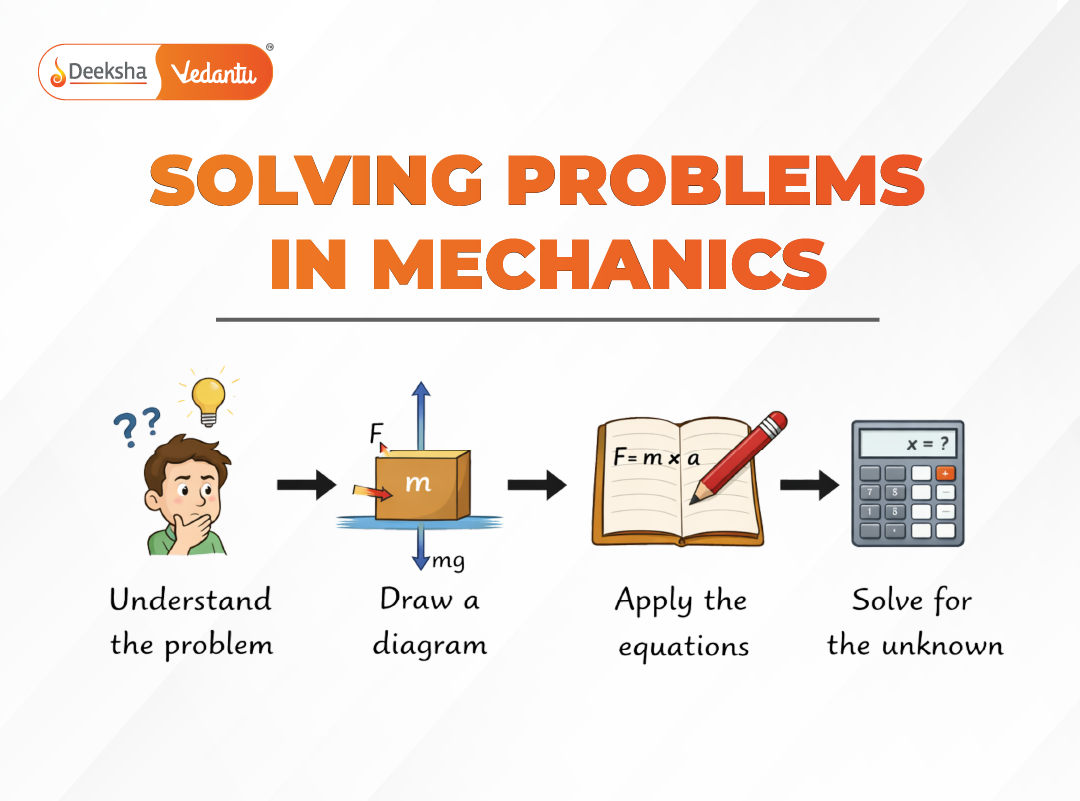
Problems in mechanics range from very simple situations involving motion under a single force to complex systems involving several interacting bodies, strings, pulleys, and constraints. To handle this wide variety of problems with confidence, it is essential to follow a well-defined and systematic method. This section outlines a standard problem-solving strategy recommended by NCERT and reinforced through extensive classroom practice at Deeksha Vedantu, helping students develop clarity, accuracy, and confidence.
Need for a Systematic Approach
In mechanics, multiple forces often act simultaneously on bodies, and their effects must be analysed carefully. Without a systematic approach, students may miss important forces, apply Newton's Laws incorrectly, or misinterpret action–reaction pairs.
A structured method helps students to:
- Break down complex physical situations into simpler components
- Identify all relevant forces acting on a body or system
- Apply Newton's Laws logically and consistently
- Avoid common conceptual and sign-related errors
A disciplined approach also improves speed and accuracy, which is crucial in time-bound examinations like JEE.
Step-by-Step Method to Solve Mechanics Problems
Step 1: Draw a Schematic Diagram of the Situation
The first step in solving any mechanics problem is to draw a rough but clear schematic diagram representing the physical situation described.
This diagram should clearly show:
- All bodies involved in the problem
- Points of contact between bodies
- Strings, pulleys, supports, surfaces, or constraints
A schematic diagram allows students to visualise the situation clearly and serves as a reference point for identifying forces and interactions.
Step 2: Choose the System
After understanding the physical situation, an appropriate system must be chosen for analysis.
The system may consist of:
- A single body
- Two or more interacting bodies
- A combination of bodies treated together as one system
The choice of system plays a crucial role in simplifying the analysis. In some problems, analysing the entire assembly is convenient, while in others, analysing individual bodies separately provides better clarity.
Step 3: Draw the Free Body Diagram (FBD)
A free body diagram (FBD) is a diagram that represents all the external forces acting on the chosen system after isolating it from its surroundings.
Important guidelines for drawing an accurate FBD:
- Include only forces acting on the chosen system
- Exclude forces exerted by the system on other bodies
- Represent each force with correct direction and point of application
Forces commonly appearing in FBDs include weight, normal reaction, tension, friction, and applied forces.
It is essential to remember that an FBD must contain only one system at a time. Forces between bodies that are part of the same system are internal and must not appear in the FBD.
Step 4: Identify External Forces on the System
Once the free body diagram is drawn, all external agencies acting on the system must be identified carefully.
Examples of external forces include:
- Gravitational force due to the Earth
- Contact forces exerted by surfaces
- Tension exerted by strings or rods
Forces exerted by different parts of the system on each other are internal forces and should not be included when analysing the motion of the system as a whole.
Step 5: Choose Suitable Axes of Reference
Choosing appropriate coordinate axes simplifies force resolution and equation formation.
General guidelines for selecting axes:
- Choose one axis along the direction of motion or expected acceleration
- Choose the other axis perpendicular to the direction of motion
- For inclined plane problems, align axes parallel and perpendicular to the plane
A good choice of axes often eliminates unnecessary trigonometric calculations.
Step 6: Resolve Forces Along Chosen Axes
After choosing the axes, resolve all forces into components along these directions wherever required.
Important points to remember:
- Do not resolve forces unnecessarily if they already act along an axis
- Maintain sign conventions consistently
- Ensure that all force components are correctly accounted for
Accurate force resolution is essential for the correct application of Newton's Laws.
Step 7: Apply Newton's Laws of Motion
Once forces are identified and resolved, Newton's Laws are applied to obtain equations of motion.
Application of Newton's First Law
Newton's First Law is applied when the system is:
- At rest, or
- Moving with constant velocity
In such cases:

This condition is commonly used in equilibrium problems.
Application of Newton's Second Law
Newton's Second Law is applied when the system is accelerating:

This law must be applied separately along each independent direction of motion.
Step 8: Solve the Equations Systematically
After writing the equations using Newton's Laws:
- Solve them step by step
- Keep algebraic work neat and organised
- Check signs, units, and final results
In problems involving multiple bodies, equations may be coupled and must be solved simultaneously.
Action and Reaction Forces
A frequent source of confusion in mechanics is the identification of action–reaction pairs.
Key points to remember:
- Action and reaction forces act on different bodies
- They are equal in magnitude and opposite in direction
- They never cancel each other because they do not act on the same body
For example, the force exerted by a block on the floor and the force exerted by the floor on the block constitute an action–reaction pair.
Internal and External Forces
When analysing a system consisting of multiple bodies:
- Internal forces act between bodies within the system
- External forces act on the system from outside
Only external forces influence the motion of the system as a whole. Internal forces cancel out when the system is analysed collectively.
Role of Constraints in Mechanics Problems
Constraints such as inextensible strings, rigid rods, and smooth surfaces restrict the motion of bodies and relate their accelerations.
Correct use of constraints helps:
- Reduce the number of unknowns
- Relate motions of different bodies
- Simplify multi-body problems significantly
Illustrative Insight from NCERT
In problems involving a block resting on another block or blocks connected by strings, it is often useful to analyse:
- Each body separately using individual free body diagrams, and
- The combined system to eliminate internal forces
This dual approach helps in correctly identifying normal reactions, tensions, and interaction forces.
Importance of This Method for JEE
For JEE aspirants, this systematic approach is extremely valuable because:
- It works for both straightforward and complex problems
- It minimises careless and conceptual errors
- It ensures clarity in problems involving multiple bodies and constraints
At Deeksha Vedantu, students practise this method repeatedly so that it becomes second nature during examinations.
Common Mistakes in Solving Mechanics Problems
Students often make mistakes such as:
- Drawing incomplete or incorrect free body diagrams
- Including internal forces in the FBD of a system
- Confusing action–reaction pairs with force balance
- Applying Newton's Laws without verifying conditions
Recognising and avoiding these mistakes significantly improves problem-solving accuracy.
FAQs
Q1. Why is a free body diagram essential before solving a mechanics problem?
Because it ensures that all forces acting on the system are identified correctly and clearly.
Q2. Can action and reaction forces cancel each other?
No. They act on different bodies and therefore cannot cancel.
Q3. Should problems always be solved by analysing individual bodies?
Not always. In some cases, analysing the entire system simplifies the solution.
Q4. Why do students commonly struggle with mechanics problems?
Due to lack of conceptual clarity, improper force identification, and absence of a systematic approach.
Q5. How can I improve my mechanics problem-solving skills for JEE?
By following a structured method, drawing accurate free body diagrams, and practising regularly.
Conclusion
Solving problems in mechanics requires a clear, logical, and disciplined approach grounded in fundamental principles. By carefully understanding the physical situation, selecting the correct system, drawing accurate free body diagrams, resolving forces properly, and applying Newton's Laws consistently, even complex problems can be solved with confidence. For JEE aspirants, mastering this structured approach is essential for success. The methodical problem-solving strategy emphasised at Deeksha Vedantu helps students build strong fundamentals, reduce errors, and perform reliably in competitive examinations.



Get Social