


Introduction
The Laws of Motion form the very backbone of classical mechanics and provide a systematic explanation of how objects behave when forces act on them. This chapter establishes the relationship between force, mass, and motion and offers the tools required to analyse all mechanical systems, ranging from simple everyday experiences to complex engineering structures and astronomical motions.
A deep understanding of the Laws of Motion is essential because almost every topic in mechanics is built upon these principles. Whether it is motion in one dimension, circular motion, rotational dynamics, or gravitation, the laws introduced in this chapter remain central. For students preparing for highly competitive examinations like JEE, this chapter holds immense importance. At Deeksha Vedantu, the Laws of Motion are taught as a logical framework that connects physical intuition with mathematical formulation, rather than as isolated laws to be memorised.
Force and Inertia
A force is defined as an external influence that can change the state of rest, the state of uniform motion, or the shape of an object. Forces may act through direct contact, such as friction and tension, or without contact, such as gravitational and magnetic forces. The effect of a force depends not only on its magnitude but also on its direction and point of application.
Inertia is the inherent property of matter by which an object resists any change in its state of rest or uniform motion. The greater the mass of an object, the greater is its inertia. Inertia explains why heavier objects are harder to start or stop compared to lighter ones.
Types of inertia include:
- Inertia of rest, which resists a change from rest to motion
- Inertia of motion, which resists a change in velocity
- Inertia of direction, which resists a change in the direction of motion
Understanding inertia helps explain many real-life situations, such as why passengers lean forward when a moving bus stops suddenly or lean backward when it starts abruptly.
Newton's First Law of Motion
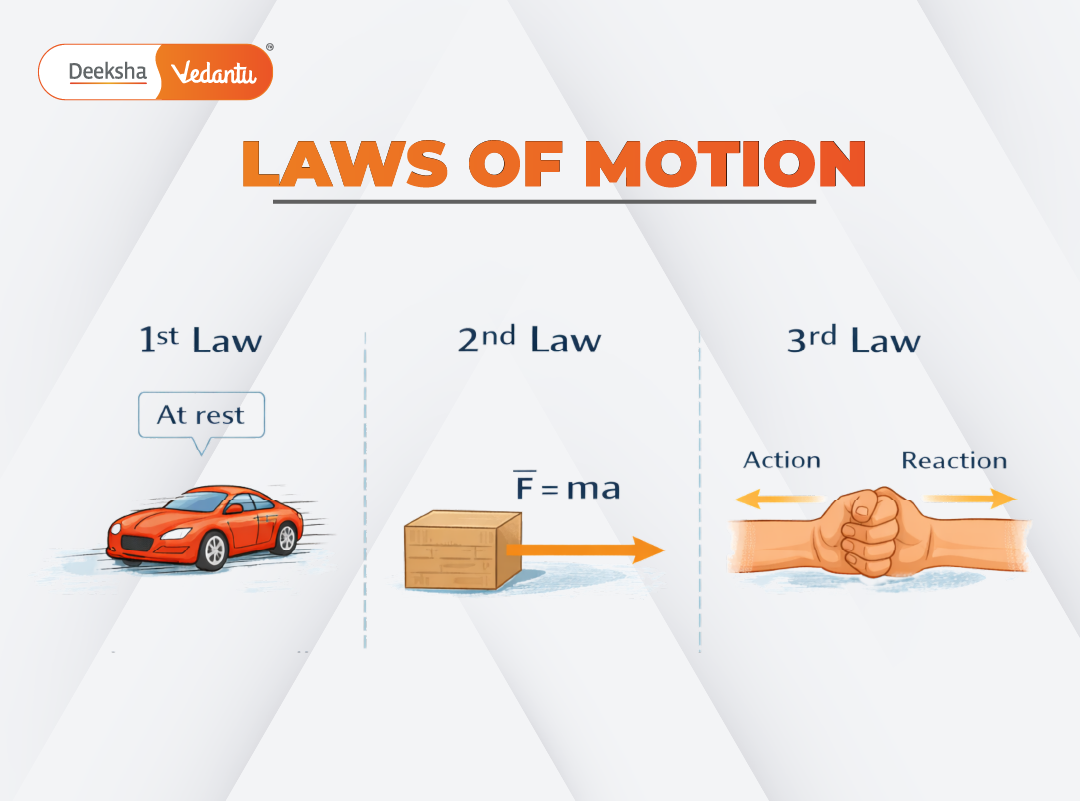
Newton's First Law states that a body remains at rest or continues to move with uniform velocity in a straight line unless acted upon by an external unbalanced force.
This law highlights that force is required not to maintain motion, but to change the state of motion. It introduces inertia as the fundamental reason why objects do not change their motion on their own. In the absence of external forces, an object would continue moving indefinitely with constant velocity.
Newton's Second Law of Motion
Newton's Second Law provides a quantitative description of how forces affect motion. It states that the rate of change of momentum of a body is directly proportional to the applied force and occurs in the direction of that force.
Momentum is defined as:

The force acting on a body is expressed as:

For constant mass, this relationship simplifies to:

This equation forms the cornerstone of mechanics and is extensively used in JEE problems to analyse motion under the influence of multiple forces.
Impulse and Its Applications
Impulse is defined as the product of force and the time interval for which it acts. It measures the effect of a force applied over a short duration.

Impulse is equal to the change in momentum of the body:

This concept explains why increasing the time of impact, such as catching a ball by moving the hands backward or using airbags in cars, reduces the force experienced by the body.
Newton's Third Law of Motion
Newton's Third Law states that for every action, there is an equal and opposite reaction.
These action–reaction force pairs act on different bodies and therefore do not cancel each other. This law explains various phenomena such as walking, swimming, recoil of a gun, and rocket propulsion.
Conservation of Linear Momentum
When no external force acts on a system, the total linear momentum of the system remains constant.

The principle of conservation of momentum is widely used to solve problems involving collisions, explosions, and recoil, making it a crucial concept for JEE.
Free Body Diagrams
A Free Body Diagram (FBD) is a visual representation that shows all the forces acting on an object. Drawing an accurate FBD is the most important step in solving problems related to the Laws of Motion.
Steps to draw a correct FBD include:
- Isolating the body from its surroundings
- Identifying and representing all forces acting on the body
- Choosing a suitable coordinate system for analysis
Systematic use of FBDs greatly improves accuracy and clarity while solving mechanics problems.
Friction and Its Role in Motion
Friction is a force that opposes the relative motion or the tendency of motion between two surfaces in contact. It plays a crucial role in everyday activities, such as walking and driving.
Types of friction include:
- Static friction, which prevents motion from starting
- Kinetic friction, which acts during motion
- Rolling friction, which acts when an object rolls over a surface
The maximum value of static friction, called limiting friction, is given by:

where μ is the coefficient of friction and N is the normal reaction. Friction-related problems form an important part of JEE mechanics questions.
Motion on an Inclined Plane
When an object moves on an inclined plane, its weight is resolved into components parallel and perpendicular to the plane.
The component of gravitational force along the plane is:

Analysis of motion on inclined planes involves balancing forces, considering friction, and applying Newton's laws, making it a favourite topic in competitive exams.
Tension and Constrained Motion
Tension is the force transmitted through a string, rope, or cable when it is pulled tight. In ideal situations, the string is considered massless and inextensible, and the tension remains the same throughout.
Problems involving pulleys, strings, and multiple connected bodies require careful application of Newton's laws and accurate free body diagrams.
Importance of Laws of Motion for JEE
The Laws of Motion are extremely important for JEE because:
- They form the foundation of all mechanics topics
- They provide a systematic method to analyse forces and motion
- They are directly applied in advanced chapters like rotational mechanics and gravitation
- They carry significant weightage in the examination
At Deeksha Vedantu, students are trained to approach problems using force analysis and FBD-based reasoning, which builds strong problem-solving confidence.
Common Conceptual Errors (JEE Perspective)
Students often make errors such as:
- Confusing action–reaction force pairs
- Ignoring friction or normal reaction in force analysis
- Drawing incomplete or incorrect free body diagrams
- Applying formulas without understanding the forces involved
Recognising and avoiding these mistakes is essential for improving performance in competitive exams.
FAQs
Q1. Why are the Laws of Motion fundamental to physics?
They describe how forces govern motion and form the basis of all classical mechanics.
Q2. Is force required to keep an object moving with constant velocity?
No, force is required only to change the state of motion, not to maintain it.
Q3. How does friction affect motion?
Friction opposes motion and influences acceleration, energy loss, and stability.
Q4. Why are free body diagrams essential in mechanics?
They help visualise all acting forces and apply Newton's laws correctly.
Q5. Why is this chapter crucial for JEE preparation?
Because it is used directly or indirectly in almost every mechanics-based question.
Conclusion
Chapter 4: Laws of Motion provides the fundamental principles that govern all mechanical motion. For JEE aspirants, mastering this chapter is essential for understanding and solving problems across mechanics with confidence. A clear, force-based and concept-driven approach, as emphasised at Deeksha Vedantu, ensures strong conceptual clarity, accuracy, and exam readiness.



Get Social