


Introduction
The Law of Inertia is one of the most fundamental ideas in physics and forms the conceptual basis of the Laws of Motion. It explains the natural tendency of objects to resist any change in their state of rest or uniform motion. This principle helps bridge intuitive observations with scientific reasoning and lays the groundwork for understanding how forces influence motion.
For students preparing for JEE, the Law of Inertia is not just a definition to remember but a powerful idea that explains why objects behave the way they do when forces are applied or removed. At Deeksha Vedantu, this law is taught as a core conceptual tool that helps students analyse motion logically and accurately.
What Is Inertia?
Inertia is the inherent property of matter by which an object resists any change in its state of rest, uniform motion, or direction. An object will continue doing what it is already doing unless an external force compels it to change.
The amount of inertia possessed by an object depends on its mass. Objects with greater mass have greater inertia and therefore require a larger force to produce the same change in motion compared to lighter objects.
Statement of the Law of Inertia
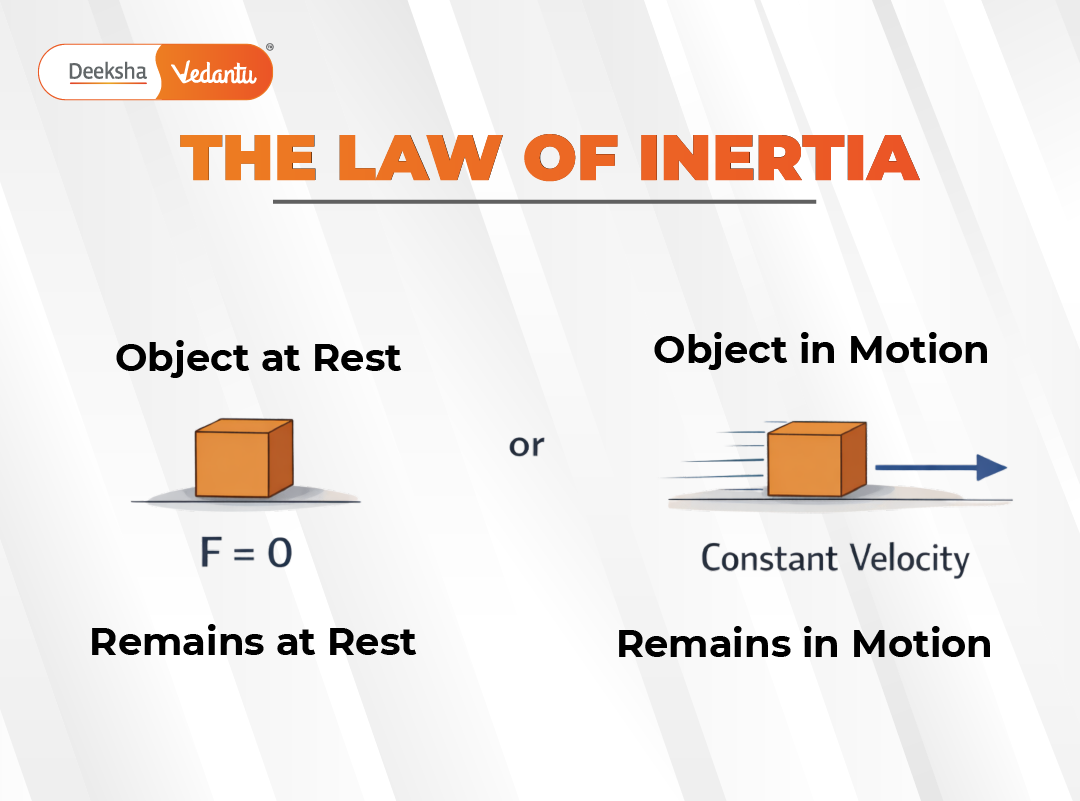
The Law of Inertia states that a body remains at rest or continues to move with uniform velocity in a straight line unless acted upon by an external unbalanced force.
This statement clarifies that:
- Force is not required to maintain motion
- Force is required only to change the state of motion
This idea corrects earlier misconceptions that motion naturally comes to an end without continuous force.
Types of Inertia
The Law of Inertia manifests in three distinct forms depending on the nature of change involved.
Inertia of Rest
Inertia of rest is the tendency of a body at rest to remain at rest unless acted upon by an external force.
For example, when a stationary bus starts suddenly, passengers tend to fall backward because their bodies resist the change from rest to motion.
Inertia of Motion
Inertia of motion is the tendency of a moving body to continue moving with the same velocity unless acted upon by an external force.
When a moving bus stops suddenly, passengers tend to move forward due to their inertia of motion.
Inertia of Direction
Inertia of direction is the tendency of a body to resist a change in the direction of its motion.
When a car takes a sharp turn, passengers experience a sideways push because their bodies tend to continue moving in the original direction.
Role of Force in Overcoming Inertia
Force plays a crucial role in overcoming inertia. The greater the inertia of an object, the greater the force required to change its state of motion.
This relationship between force, inertia, and motion sets the stage for understanding Newton’s Second Law, which quantifies how force produces acceleration.
Everyday Examples of the Law of Inertia
The Law of Inertia can be observed in many everyday situations:
- Dust particles fall off carpets when they are beaten
- Fruits fall from trees when branches are shaken
- Seat belts prevent passengers from moving forward suddenly during braking
These examples demonstrate how objects resist changes in motion due to inertia.
Inertia and Mass
Mass is a quantitative measure of inertia. An object with larger mass offers greater resistance to changes in motion.
This is why it is easier to push a bicycle than a car and easier to stop a rolling ball than a moving truck.
Importance of the Law of Inertia for JEE
Understanding the Law of Inertia is essential for JEE preparation because:
- It forms the conceptual basis of Newton’s First Law
- It explains motion in the absence of net external force
- It helps in identifying inertial and non-inertial frames
- It prevents common misconceptions in mechanics problems
At Deeksha Vedantu, students are encouraged to analyse problems by first identifying whether forces are present or absent and then applying the Law of Inertia accordingly.
Common Conceptual Errors (JEE Perspective)
Students often make mistakes such as:
- Believing that force is required to keep an object moving
- Ignoring inertia while analysing motion changes
- Confusing inertia with momentum or force
Recognising these errors early helps build strong fundamentals.
FAQs
Q1. What is the Law of Inertia?
It states that a body remains at rest or in uniform straight-line motion unless acted upon by an external unbalanced force.
Q2. Is inertia a force?
No, inertia is a property of matter, not a force.
Q3. What determines the inertia of a body?
The mass of the body determines its inertia.
Q4. Why do passengers lean forward when a bus stops suddenly?
Due to inertia of motion, their bodies tend to continue moving forward.
Q5. Why is the Law of Inertia important for JEE?
Because it forms the foundation of Newton’s laws and helps avoid conceptual errors in mechanics.
Conclusion
The Law of Inertia provides a clear and logical explanation of how objects respond to forces and changes in motion. It establishes that motion does not require a force to continue, but only to change. For JEE aspirants, mastering this concept is crucial for building a strong foundation in mechanics. A concept-driven approach, as followed at Deeksha Vedantu, ensures clarity, confidence, and accuracy while solving physics problems.



Get Social