
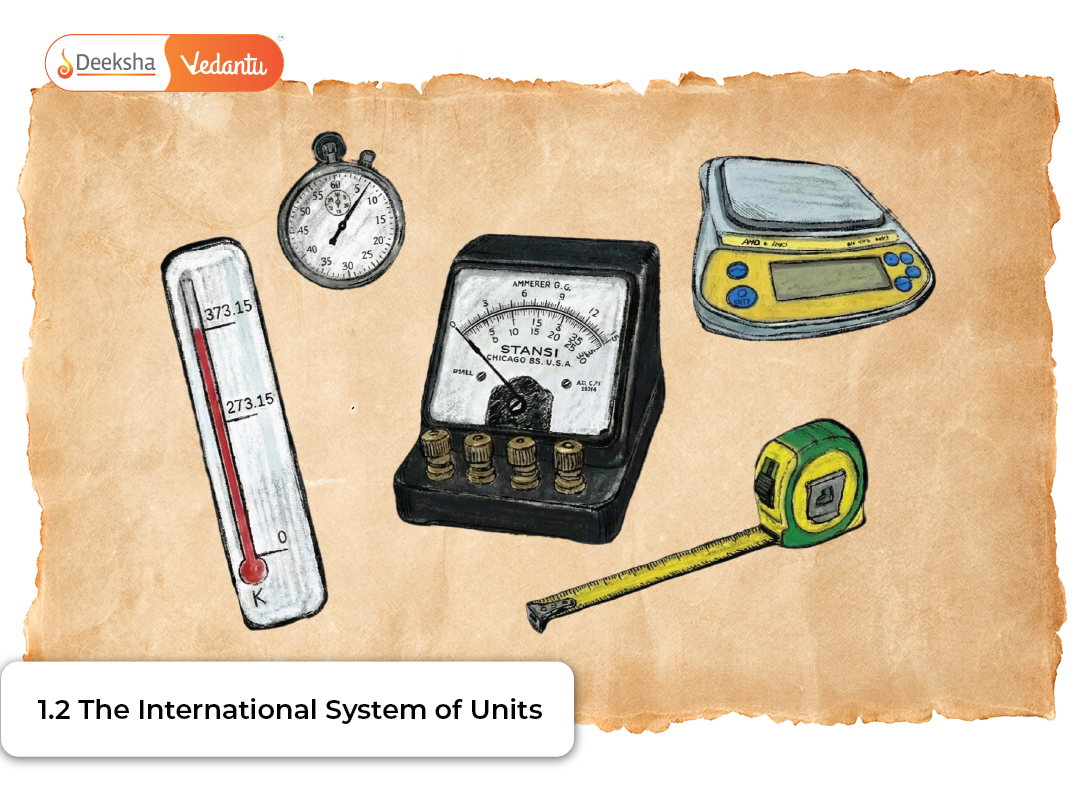


The International System of Units (SI) is the modern, globally accepted standard of measurement used in science, engineering, medicine, industry, and technology. It was developed to eliminate inconsistencies created by earlier measurement systems such as the CGS (centimetre–gram–second) and FPS (foot–pound–second) systems. SI units provide a stable, precise, and universal structure that allows scientists across the world to speak the same quantitative language.
The SI system was formally adopted in 1960 by the General Conference on Weights and Measures (CGPM) and is maintained by the International Bureau of Weights and Measures (BIPM). The power of SI lies not only in its standardization but also in its reliance on immutable constants of nature, such as the speed of light and Planck’s constant.
This section explains SI base units, supplementary units, derived units, prefixes, writing conventions, examples, and real‑world relevance with depth and clarity.
Why Do We Need the SI System?
Measurements made with different systems create confusion. For example:
- A foot is not the same length across all cultures.
- A pound could refer to force or mass.
- Temperature scales differ significantly.
To avoid such inconsistencies, SI offers:
- Universality: Used globally in science and most industries.
- Reproducibility: Based on constants, not objects.
- Precision: Definitions are exact and measurable.
- Simplicity: A coherent structure where derived units follow logically.
Modern science, space research, medical diagnostics, engineering design, and international trade all depend on SI for reliability.
SI Base Quantities and Base Units
There are seven fundamental physical quantities, each with a strictly defined base unit upon which all other measurements are built.
| Physical Quantity | SI Base Unit | Symbol |
| Length | metre | m |
| Mass | kilogram | kg |
| Time | second | s |
| Electric current | ampere | A |
| Thermodynamic temperature | kelvin | K |
| Amount of substance | mole | mol |
| Luminous intensity | candela | cd |
Modern Scientific Definitions (Based on Constants)
Each base unit is linked to a fundamental physical constant:
- Metre (m): Distance travelled by light in vacuum in 1/299,792,458 seconds.
- Kilogram (kg): Defined using the Planck constant (h = 6.62607015 × 10⁻³⁴ J·s).
- Second (s): Duration of 9,192,631,770 cycles of cesium‑133 atomic radiation.
- Ampere (A): Based on the elementary charge (e = 1.602176634×10⁻¹⁹ C).
- Kelvin (K): Using Boltzmann constant (k = 1.380649×10⁻²³ J/K).
- Mole (mol): Defined using Avogadro’s number (6.02214076×10²³ particles).
- Candela (cd): Defined using luminous efficacy of monochromatic light.
These definitions allow SI units to remain constant and independent of physical objects.
Supplementary SI Units
These units are neither base nor derived but stand independently.
| Physical Quantity | SI Unit | Symbol |
| Plane angle | radian | rad |
| Solid angle | steradian | sr |
- Radian: The angle subtended when arc length = radius.
- Steradian: The solid angle subtended by an area equal to radius² on the surface of a sphere.
Derived SI Units
Derived units are formed by combining base units using mathematical operations.
Common Derived Units
| Quantity | Unit | SI Expression |
| Area | square metre | m² |
| Volume | cubic metre | m³ |
| Density | kg/m³ | kg·m⁻³ |
| Velocity | m/s | m·s⁻¹ |
| Acceleration | m/s² | m·s⁻² |
| Force | newton | kg·m·s⁻² |
| Work/Energy | joule | kg·m²·s⁻² |
| Pressure | pascal | kg·m⁻¹·s⁻² |
| Power | watt | kg·m²·s⁻³ |
| Charge | coulomb | A·s |
| Potential difference | volt | kg·m²·s⁻³·A⁻¹ |
| Resistance | ohm | kg·m²·s⁻³·A⁻² |
| Frequency | hertz | s⁻¹ |
| Illuminance | lux | lm/m² |
Derived units simplify the representation of complex physical relationships.
SI Prefixes
Because physical quantities vary tremendously in scale-from nanometres in DNA structures to gigametres in astronomical distances-SI prefixes provide a convenient shorthand.
| Prefix | Symbol | Factor |
| tera | T | 10¹² |
| giga | G | 10⁹ |
| mega | M | 10⁶ |
| kilo | k | 10³ |
| hecto | h | 10² |
| deca | da | 10¹ |
| deci | d | 10⁻¹ |
| centi | c | 10⁻² |
| milli | m | 10⁻³ |
| micro | μ | 10⁻⁶ |
| nano | n | 10⁻⁹ |
| pico | p | 10⁻¹² |
| femto | f | 10⁻¹⁵ |
| atto | a | 10⁻¹⁸ |
Examples Using SI Prefixes
- 10 km = 10 × 10³ m = 1 × 10⁴ m
- 2.5 µF = 2.5 × 10⁻⁶ F
- 300 nm = 300 × 10⁻⁹ m = 3 × 10⁻⁷ m
Rules for Writing SI Units (NCERT + International Guidelines)
- Do not pluralize unit symbols.
Example: 10 kg (not 10 kgs) - Unit symbols never end with a period.
Exception: end of a sentence. - Leave a space between number and symbol.
Example: 25 m (not 25m) - Compound units use a dot or space.
Example: N·m or N m - Units named after scientists: symbol capitalized, name lowercase.
Example: newton (N) - Use parentheses in complex units.
Example: m·s⁻² but not m/s/s - Avoid mixing systems.
Example: Never combine SI and CGS units in the same formula.
Following these rules avoids ambiguity in scientific communication.
Solved Examples
Example 1: Convert 0.025 m to millimetres.
0.025 m = 0.025 × 1000 = 25 mm
Example 2: Convert 72 km/h to m/s.
72 km/h = (72 × 1000) / 3600 = 20 m/s
Example 3: What is the SI unit of pressure?
Pressure = Force/Area = (kg·m·s⁻²) / m² = kg·m⁻¹·s⁻² (pascal)
Example 4: Express 4.2 × 10⁶ J with prefix.
4.2 × 10⁶ J = 4.2 MJ
Example 5: Convert 5 × 10⁻⁹ s to nanoseconds.
1 ns = 10⁻⁹ s → 5 ns
FAQs
Q1. Why is SI used worldwide?
SI ensures global uniformity, eliminates ambiguity in scientific communication, and provides a standardized method to compare results across countries, disciplines, and laboratories.
Q2. Why can’t unit symbols be plural?
Unit symbols represent fixed scientific standards, not grammatical words. Therefore, they remain the same regardless of quantity. For example, 5 kg, not 5 kgs.
Q3. Are SI units fixed or do they change over time?
SI definitions are refined over time to improve precision, especially as measurement technology advances. However, once redefined, the values themselves remain constant.
Q4. What makes SI more reliable than older systems like CGS or FPS?
SI is coherent, simpler, universally accepted, and based on physical constants rather than physical objects, making it accurate and reproducible anywhere.
Q5. Why do scientists prefer SI prefixes?
SI prefixes allow very large or very small numbers to be expressed compactly, reducing calculation errors and improving readability.
Q6. What is the difference between radian and steradian?
A radian measures plane angle (2D), whereas a steradian measures solid angle (3D). Both are supplementary SI units.
Q7. Why is a space required between a number and a unit?
The space improves readability and prevents misinterpretation. For example, 10 m is clear, whereas 10m could be mistaken as a variable.
Q8. Can SI units be used with every physical formula?
Yes. SI is designed as a coherent system where formulas hold correctly when all quantities are expressed in SI units.
Conclusion
The International System of Units is the backbone of scientific measurement. Its well-defined base units, logical derived units, supplementary angle units, and universal prefixes allow scientists and engineers to communicate with precision and reliability. SI’s foundation on unchanging physical constants ensures consistency across time and geography.
Mastering SI units is essential for students as it forms the basis of all calculations, experiments, and theoretical work in physics. At Deeksha Vedantu, we focus on building strong conceptual clarity so students confidently apply SI rules in numerical problem-solving and competitive exam preparation.



Get Social