


Introduction
The principle of Conservation of Momentum is one of the most fundamental ideas in classical mechanics and emerges naturally from Newton's Laws of Motion, particularly the Second and Third Laws. It explains why, in the absence of external influences, the total momentum of a system remains unchanged even though individual bodies within the system may undergo significant changes in motion.
This principle plays a central role in analysing interactions such as collisions, explosions, recoil of guns, rocket propulsion, and motion of connected bodies. Many physical processes that appear complex at first glance become simple and elegant when viewed through the lens of momentum conservation.
For JEE aspirants, Conservation of Momentum is one of the most frequently applied principles in mechanics. A large number of numerical problems can be solved efficiently by identifying a suitable system and applying this law instead of dealing with complicated force calculations. At Deeksha Vedantu, students are trained to recognise momentum-conserving situations early in a problem, which significantly simplifies analysis and improves accuracy.
What Is Momentum?
Momentum is a vector quantity that represents the quantity of motion possessed by a body. It is defined as the product of the mass of the body and its velocity.

Since velocity has both magnitude and direction, momentum also has both magnitude and direction. A change in either the mass or velocity of a body leads to a change in its momentum. Because momentum is a vector, its direction must always be taken into account while analysing interactions such as collisions and explosions.
Momentum provides a more complete description of motion than velocity alone, especially when dealing with interacting systems.
Statement of the Law of Conservation of Momentum
The Law of Conservation of Momentum states that the total linear momentum of an isolated system remains constant if no net external force acts on the system.
In simpler terms, this means that although individual bodies within a system may speed up, slow down, or change direction due to mutual interaction, the vector sum of the momenta of all bodies in the system remains unchanged.
This principle applies equally to systems consisting of two bodies or many bodies, provided external forces are absent or negligible.
Mathematical Expression of Momentum Conservation
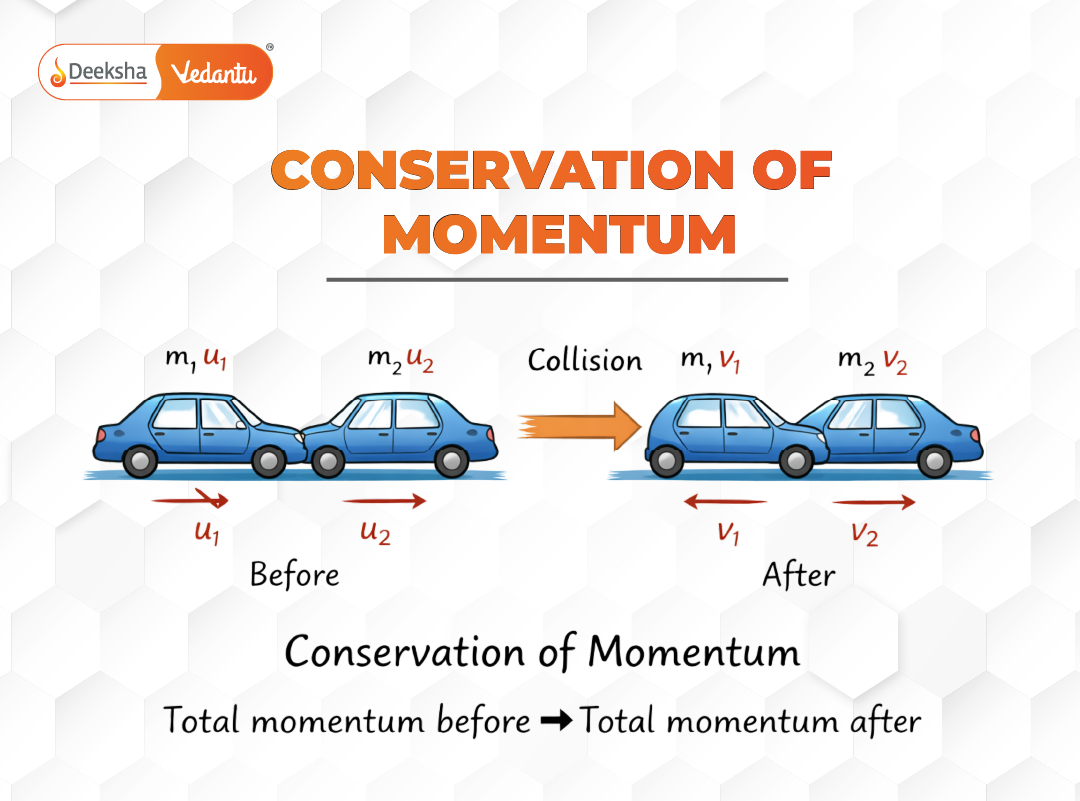
Consider a system of two bodies interacting with each other. If no external force acts on the system, then the total momentum before interaction equals the total momentum after interaction.

Here,  and
and  represent the initial velocities of the two bodies, while
  and
and  represent their final velocities after interaction.
This equation forms the foundation for solving a wide variety of problems involving collisions, recoil, and explosions, and is extensively used in JEE-level questions.
Vector Nature of Momentum Conservation
Momentum conservation must always be applied in vector form. This means:
- Directions of velocities must be carefully considered
- Signs must be assigned consistently along chosen axes
- Momentum conservation can be applied independently along each direction
This vector treatment is especially important in two-dimensional collision problems and oblique interactions.
Connection with Newton's Third Law
The Conservation of Momentum arises directly from Newton's Third Law of Motion. During interaction between two bodies, the forces exerted by them on each other are equal in magnitude and opposite in direction.
As a result, the impulses experienced by the two bodies are equal and opposite, leading to equal and opposite changes in momentum. When the changes in momentum of all bodies in the system are added together, the net change becomes zero, ensuring conservation of total momentum.
This connection highlights why momentum conservation is a fundamental consequence of the interaction-based nature of forces.
Isolated and Non-Isolated Systems
An isolated system is one in which no external force acts on the system.
- In isolated systems, total momentum remains conserved
- In non-isolated systems, external forces cause a change in total momentum
Correctly identifying whether a system is isolated is the most crucial step in applying the conservation principle. In many practical situations, external forces such as gravity or friction may be present but can be neglected if their effect during interaction is very small.
Conservation of Momentum in Collisions
Collisions are one of the most important applications of momentum conservation.
During a collision:
- Interaction forces between bodies are very large
- Time of interaction is extremely small
- External forces usually have negligible effect
Therefore, momentum is conserved during collisions even though kinetic energy may or may not be conserved.
Types of Collisions (Conceptual Overview)
- Elastic collisions: Both momentum and kinetic energy are conserved
- Inelastic collisions: Momentum is conserved but kinetic energy is not
- Perfectly inelastic collisions: Bodies stick together after collision and move with a common velocity
Understanding these categories is essential for tackling advanced collision problems in JEE.
Recoil Phenomenon
Recoil is a direct and striking consequence of momentum conservation.
When a gun fires a bullet, the bullet gains forward momentum. To conserve total momentum of the system, the gun gains an equal amount of momentum in the opposite direction, causing it to recoil backward.
Similar reasoning explains rocket propulsion, where gases expelled backward produce forward motion of the rocket. In each case, momentum conservation provides a simple and powerful explanation of motion.
Applications of Conservation of Momentum
The principle of momentum conservation is widely applied in:
- Collision and impact problems
- Explosion phenomena
- Rocket and jet propulsion
- Motion of connected bodies
- Particle interactions in physics
In all these applications, identifying the system correctly and applying vector momentum conservation leads to efficient problem-solving.
Importance of Conservation of Momentum for JEE
The Conservation of Momentum is extremely important for JEE because:
- It simplifies complex interaction problems
- It reduces dependence on force-based calculations
- It is frequently tested in both conceptual and numerical questions
- It forms the basis for analysing collisions and recoil
At Deeksha Vedantu, students are encouraged to always check whether momentum conservation can be applied before moving to Newton's Second Law, as this often leads to faster and more elegant solutions.
Common Conceptual Errors (JEE Perspective)
Students often make mistakes such as:
- Applying momentum conservation even when significant external forces are present
- Ignoring the vector nature of momentum
- Confusing momentum conservation with energy conservation
- Choosing an incorrect or incomplete system
Avoiding these mistakes significantly improves accuracy and confidence in mechanics problems.
FAQs
Q1. What does the Law of Conservation of Momentum state?
It states that the total momentum of an isolated system remains constant if no external force acts on it.
Q2. Is momentum conserved in all collisions?
Yes, momentum is conserved in all collisions provided the system is isolated.
Q3. Is kinetic energy always conserved during collisions?
No, kinetic energy is conserved only in elastic collisions.
Q4. Why is momentum conservation important for JEE?
Because it simplifies interaction, collision, and recoil problems commonly asked in exams.
Q5. How is momentum conservation related to Newton's Third Law?
Momentum conservation arises directly from the equal and opposite interaction forces described by Newton's Third Law.
Conclusion
The Conservation of Momentum is a powerful and universal principle governing interactions in mechanics. By recognising that total momentum remains constant in isolated systems, students can analyse collisions, explosions, and recoil phenomena with clarity and precision. For JEE aspirants, mastering this principle is essential for efficient and accurate problem-solving. A structured, concept-driven approach, as followed at Deeksha Vedantu, ensures strong fundamentals and long-term success in competitive examinations.



Get Social