


Introduction
When a body moves along a circular path with constant speed, its motion differs fundamentally from straight-line motion. Even though the magnitude of velocity remains unchanged, the direction of velocity changes continuously at every point on the circular path. Since velocity is a vector quantity, any change in its direction results in a change in velocity, and hence the body must experience acceleration at all times during circular motion.
Circular motion is a classic and powerful application of Newton's Laws of Motion. It highlights the fact that force is required not only to change the speed of a body but also to continuously change the direction of motion. This idea is central to understanding many real-life phenomena such as vehicles turning on curved roads, motion of planets, and rotating mechanical systems. For JEE aspirants, circular motion is extremely important because it frequently appears in questions involving friction, tension, banking of roads, and free body diagrams. At Deeksha Vedantu, circular motion is always taught as a direct extension of Newton's Second Law, ensuring conceptual clarity and exam readiness.
Circular Motion and Centripetal Acceleration
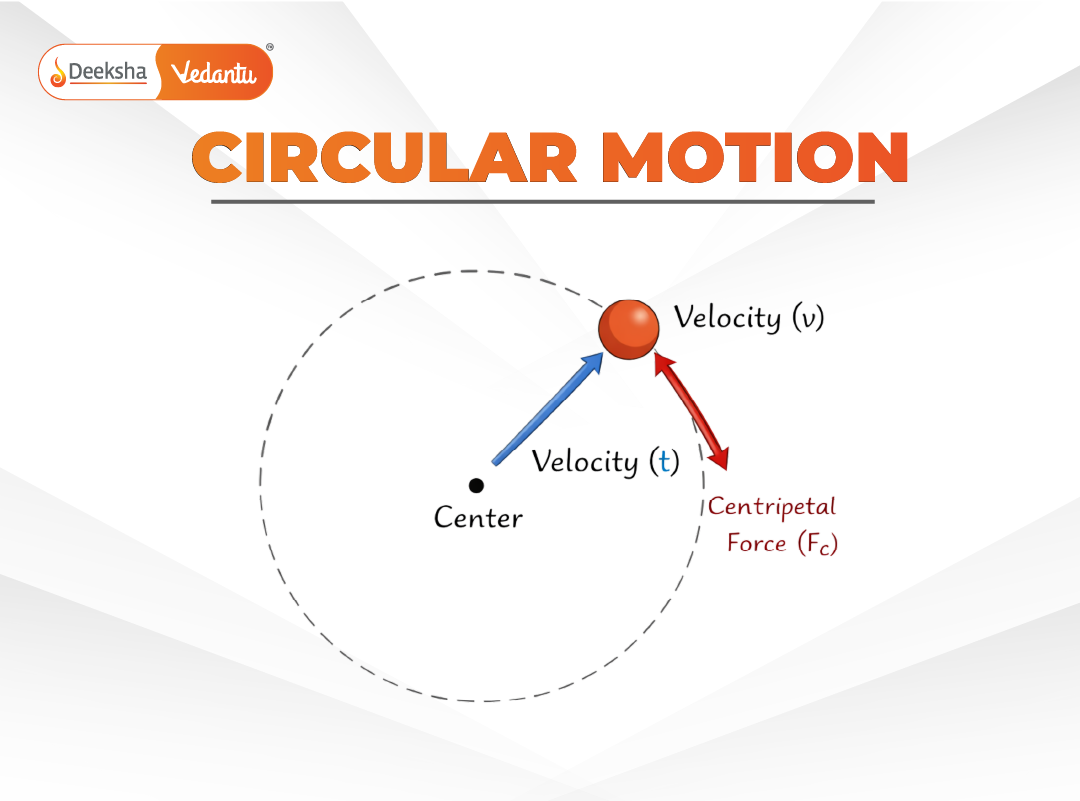
Consider a body of mass  moving with uniform speed
  along a circular path of radius
  . At any instant, the velocity of the body is directed tangentially to the circular path. As the body moves from one point to another, the direction of this tangential velocity changes continuously.
Although the speed remains constant, the continuous change in the direction of velocity produces an acceleration. This acceleration is always directed towards the centre of the circular path and is called centripetal acceleration.
The magnitude of centripetal acceleration is given by:

Centripetal acceleration acts along the radius of the circle, pointing inward towards the centre. It is responsible solely for changing the direction of velocity and does not change the speed of the body.
Centripetal Force
According to Newton's Second Law, acceleration can exist only when a net force acts on a body. Therefore, for centripetal acceleration to exist, a net force must act towards the centre of the circular path. This inward force is known as the centripetal force.
The magnitude of the centripetal force required is:

It is important to note that centripetal force is not a new or separate type of force. It is simply the resultant of real forces acting on the body, directed towards the centre of the circle.
Depending on the physical situation, centripetal force may be provided by:
- Tension in a string (stone tied to a string)
- Friction between surfaces (vehicle on a road)
- Normal reaction (banked roads)
- Gravitational force (planetary motion)
Motion of a Car on a Level Road
When a car takes a circular turn on a horizontal (level) road, it requires a centripetal force to remain in circular motion.
The forces acting on the car are:
- Weight (mg) acting vertically downward
- Normal reaction (N) acting vertically upward
- Frictional force acting horizontally towards the centre of the circular path
Since there is no vertical acceleration of the car, the vertical forces balance each other:

The required centripetal force is provided entirely by static friction between the tyres and the road surface.
Thus,

The maximum possible static friction is:

For the car to take the turn without skidding, the required centripetal force must not exceed the maximum static friction:

This gives the maximum safe speed on a level road as:

This result shows that the maximum safe speed depends on the coefficient of friction and the radius of the road, but is independent of the mass of the vehicle.
Motion of a Car on a Banked Road
To reduce reliance on friction and allow vehicles to negotiate curves safely at higher speeds, roads are often banked. In a banked road, the surface is inclined at an angle θ to the horizontal.
For a car moving on a banked road, the forces acting are:
- Weight (mg) acting vertically downward
- Normal reaction (N) acting perpendicular to the road surface
- Frictional force (if required), acting along the surface
Resolving the forces along the vertical direction:

Resolving the forces along the horizontal direction towards the centre of the circular path:

Ideal Banking (No Friction Required)
If the car moves with a specific speed for which friction is not required, then f = 0.
The equations become:


Dividing these equations gives:

This relation determines the design speed of a banked road, at which vehicles can negotiate the curve without relying on friction.
Banked Road with Friction
If friction is present, the maximum safe speed of the vehicle on a banked road is increased. The expression for the maximum speed becomes:

This expression shows that a banked road allows a vehicle to move with a higher speed compared to a level road for the same coefficient of friction.
Role of Friction in Circular Motion
Static friction plays a vital role in circular motion whenever a vehicle moves along a curved path. It provides the necessary centripetal force and prevents slipping. If friction is insufficient, the vehicle tends to skid outward due to inertia.
Proper banking of roads significantly reduces dependence on friction, leading to reduced tyre wear and improved safety.
Importance of Circular Motion for JEE
Circular motion is extremely important for JEE preparation because:
- It involves direct application of Newton's Second Law in non-linear motion
- It demands accurate free body diagrams and force resolution
- It is frequently combined with friction and inclined plane concepts
- It forms the conceptual basis for vertical circular motion and rotational mechanics
At Deeksha Vedantu, students are trained to systematically resolve forces along radial and vertical directions before writing equations, which greatly improves accuracy in exams.
Common Conceptual Errors (JEE Perspective)
Students often make mistakes such as:
- Treating centripetal force as a separate physical force
- Ignoring the role of static friction on level roads
- Using incorrect directions for forces in free body diagrams
- Forgetting the dependence of centripetal force on speed and radius
Avoiding these mistakes is essential for mastering circular motion.
FAQs
Q1. Why does a body moving in a circle experience acceleration even at constant speed?
Because the direction of velocity changes continuously, resulting in centripetal acceleration.
Q2. What provides centripetal force on a level road?
Static friction between the tyres and the road provides the required centripetal force.
Q3. Is centripetal force always provided by friction?
No. Depending on the situation, it may be provided by tension, gravity, normal reaction, or friction.
Q4. Why are roads banked at curves?
To reduce dependence on friction and allow vehicles to negotiate turns safely at higher speeds.
Q5. Why is circular motion important for JEE?
Because it tests force balance, free body diagrams, and Newton's Laws in curved motion.
Conclusion
Circular motion clearly demonstrates that force is required to change the direction of motion even when speed remains constant. By understanding centripetal acceleration, centripetal force, and the role of friction and normal reaction in both level and banked roads, students can confidently solve a wide range of mechanics problems. Mastery of circular motion, as emphasised at Deeksha Vedantu, builds strong conceptual foundations for advanced mechanics and ensures success in competitive examinations.



Get Social