
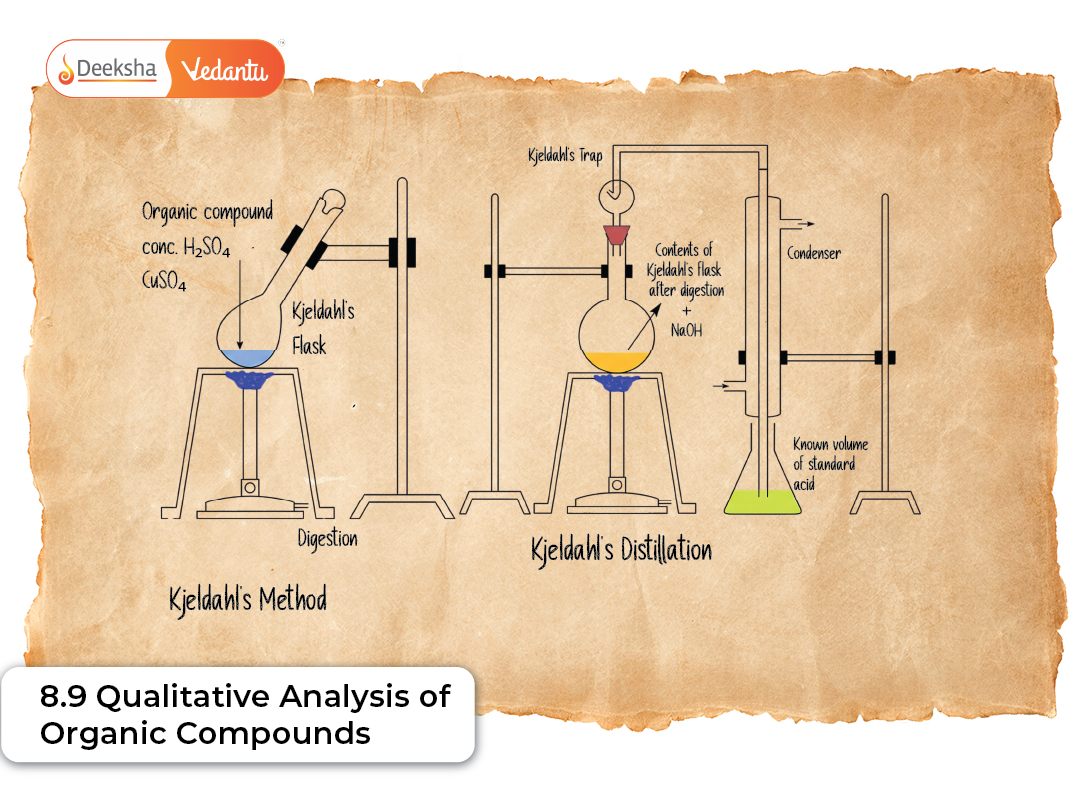


Qualitative analysis is the first and most essential step in determining the identity of an unknown organic compound. Organic molecules may contain one or more heteroatoms such as nitrogen, sulphur, oxygen, halogens, or phosphorus in addition to carbon and hydrogen. Each element or functional group contributes uniquely to the behaviour, reactivity, and physical properties of the compound. Thus, identifying what elements are present becomes crucial before attempting quantitative estimation or structural elucidation.
In this deeply expanded section, we explore all major tests prescribed in NCERT Class 11 in a more elaborate, exam-friendly manner. These explanations reflect Deeksha Vedantu’s student-focused approach-making sure every concept feels intuitive, memorable, and directly applicable in board and competitive exams.
Importance of Qualitative Analysis
Qualitative organic analysis serves several purposes:
- It reveals which heteroatoms and functional groups are present.
- It helps predict reaction pathways and chemical behaviour.
- It forms the basis of further structural determination.
- It is critical in laboratory work, forensic tests, pharmaceuticals, and environmental chemistry.
- It is widely tested in practical exams and competitive exams like NEET and JEE.
Organic compounds are covalent, and therefore their elements cannot be detected directly using tests meant for ionic salts. Because of this, specialised procedures such as Lassaigne’s test are required to convert covalent elements into ionic forms.
Detection of Elements (Lassaigne’s Test)
Lassaigne’s test is the most fundamental part of organic qualitative analysis. Since organic compounds contain covalent bonds, heteroatoms such as nitrogen, sulphur, and halogens cannot be directly detected. By fusing the compound with metallic sodium, these covalent atoms are converted into ionic forms, which are easily testable.
Principle
When an organic compound is fused with sodium metal:
- Nitrogen forms sodium cyanide (NaCN)
- Sulphur forms sodium sulphide (Na₂S)
- Halogens form sodium halides (NaX)
These ionic species dissolve in water to form the Lassaigne’s extract (L.E.), which is then used for individual tests.
Detailed Preparation of Lassaigne’s Extract
- Cut a small piece of sodium and dry it using filter paper (sodium reacts violently with moisture).
- Place sodium in a fusion tube and add the organic sample.
- Heat gently at first, then strongly until the tube becomes red hot. This breaks covalent bonds.
- Immediately plunge the hot tube into distilled water-this step cracks the tube and releases fused contents.
- Boil and filter to remove solid impurities.
The clear filtrate obtained is the Lassaigne’s extract, used for all elemental detection tests.
Detection of Nitrogen
Nitrogen in organic compounds is detected via the formation of sodium cyanide during fusion.
Test A: Prussian Blue Test (Primary Test)
This is the most reliable test for nitrogen.
- Procedure:
- Add freshly prepared FeSO₄ solution to L.E.
- Heat the mixture and then cool.
- Add dilute HCl.
- Observation: A Prussian blue precipitate appears.
- Explanation: Sodium cyanide reacts with Fe²⁺ and Fe³⁺ to form ferric ferrocyanide (Fe₄[Fe(CN)₆]₃), which is Prussian blue.
Test B: Blood-Red Colour (for Nitrogen + Sulphur)
- If both N and S are present, they react to give sodium thiocyanate (NaSCN).
- When ferric ions are added: Fe³⁺ + SCN⁻ → [Fe(SCN)]²⁺ (blood-red complex)
- This confirms the presence of both nitrogen and sulphur.
Detection of Sulphur
Sulphur may be present in amino acids, sulphides, thiols, and thioethers.
Test A: Sodium Nitroprusside Test
- Procedure: Add sodium nitroprusside to L.E.
- Observation: A violet or purple colour develops.
- Reason: Formation of a coloured complex between sulphide ions and nitroprusside ion.
Test B: Lead Acetate Test
- Procedure: Acidify L.E. and then add lead acetate.
- Observation: A black precipitate appears.
- Reason: Lead sulphide (PbS) forms, indicating sulphur.
Additional Note for Exams
If both N and S are present in the compound, NaSCN forms during fusion. In this case, the nitroprusside test may give a weaker colour, but the blood-red test becomes more prominent.
Detection of Halogens
Halogens (Cl, Br, I) form sodium halides during sodium fusion.
Test A: Silver Nitrate Test
- Acidify L.E. with dilute HNO₃ to remove interfering ions.
- Add AgNO₃.
Observations:
- White ppt → AgCl (Chloride)
- Pale yellow ppt → AgBr (Bromide)
- Yellow ppt → AgI (Iodide)
Confirmatory Solubility Test in Ammonia
This distinguishes between the halogens:
- AgCl dissolves in dilute NH₃.
- AgBr dissolves only in concentrated NH₃.
- AgI does not dissolve (very insoluble).
This sequence-white, pale yellow, yellow-is frequently asked in NEET and JEE.
Special Note
If nitrogen or sulphur is present, HNO₃ must be added in excess to destroy NaCN or Na₂S, which otherwise produce false positives.
Detection of Carbon and Hydrogen
These are detected using the classical oxidation method.
Principle
When the compound is heated with copper(II) oxide:
- Carbon forms CO₂
- Hydrogen forms H₂O
Observations
- Water droplets on the cooler parts of the test tube → Hydrogen confirmed.
- Lime water turning milky indicates CO₂ → Carbon confirmed.
This test demonstrates that all organic compounds contain C–H skeletons.
Detection of Oxygen
Oxygen is not detected directly in Lassaigne’s test.
Instead, oxygen is usually inferred when:
- N, S, and halogens are absent
- Functional group tests confirm an oxygen-containing group
Examples include:
- Alcohols
- Phenols
- Aldehydes and ketones
- Carboxylic acids
- Esters
Exam Tip: Oxygen detection is indirect-students often confuse this.
Detection of Unsaturation (Alkenes and Alkynes)
Unsaturated compounds undergo addition reactions that saturated compounds do not.
Test A: Bromine Water Test
- Observation: Brown colour of bromine water disappears.
- Reason: Bromine adds across the C=C or C≡C bond.
Test B: Baeyer’s Test (KMnO₄ Test)
- Observation: Pink colour of dilute KMnO₄ solution gets decolourised.
- This occurs due to oxidation of the double or triple bond.
Additional Exam Insights
- Aromatic compounds do not decolourise bromine water without a catalyst.
- Alkynes also give positive tests but reaction rates vary.
Detection of Functional Groups
Functional group identification is the heart of qualitative analysis. Each group gives a characteristic reaction.
| Functional Group | Test Name | Positive Observation |
| Alcohols | Lucas Test | Tertiary → immediate cloudiness; Secondary → cloudiness within 5 min; Primary → no reaction at room temperature |
| Aldehydes & Ketones | Ceric Ammonium Nitrate Test | Red colour produced due to complex formation |
| Tollen’s Test | Aldehydes form a silver mirror; ketones show no reaction | |
| Fehling’s/Benedict’s Test | Brick‑red precipitate of Cu₂O confirms aldehydes | |
| 2,4‑DNP Test | Yellow/orange precipitate (hydrazones) forms for both aldehydes & ketones | |
| Carboxylic Acids | NaHCO₃ Test | Effervescence due to CO₂ gas formation |
| Phenols | Ferric Chloride Test | Violet, blue, or green colour depending on phenol type |
| Amines | Carbylamine Test | Only primary amines produce foul‑smelling isocyanide |
| Esters | Hydroxamic Acid Test | Formation of coloured complexes |
| Alkenes | Bromine/KMnO₄ Tests | Decolourisation confirms unsaturation |
| Nitro Compounds | Mulliken’s Test | Reduction‑based detection of nitro group |
Summary Table
| Element/Group | Test | Observation |
| Nitrogen | Prussian blue test | Blue colour |
| Sulphur | Lead acetate | Black ppt |
| Halogens | AgNO₃ test | White/Yellow ppt |
| Unsaturation | Bromine water | Decolourisation |
| Alcohols | Lucas test | Cloudiness |
| Aldehydes | Tollen’s test | Silver mirror |
| Phenols | FeCl₃ test | Violet colour |
| Carboxylic acids | NaHCO₃ test | Effervescence |
FAQs
Q1. Why is sodium fusion necessary in Lassaigne’s test?
Because organic compounds are covalent and do not release ions on their own. Sodium fusion converts elements into ionic forms, enabling easy detection.
Q2. What causes false positives in halogen detection?
Cyanide and sulphide ions may interfere unless destroyed by adding excess nitric acid.
Q3. Why don’t ketones give Tollen’s test?
Because ketones cannot be oxidised into carboxylic acids under the mild conditions required for Tollen’s reagent.
Q4. Why do unsaturated compounds decolourise bromine water?
They undergo electrophilic addition reactions, using up bromine molecules.
Q5. How do we distinguish between alcohols and phenols?
Phenols give a characteristic colour with FeCl₃, while alcohols do not.
Conclusion
Qualitative analysis is a gateway to understanding organic chemistry in depth. By learning how to identify elements, functional groups, and unsaturation, students build a strong foundation that supports later chapters such as reaction mechanisms and spectroscopy. At Deeksha Vedantu, we emphasise conceptual clarity, step-by-step procedures, and exam-focused learning-helping students approach laboratory analysis with confidence and precision.



Get Social