
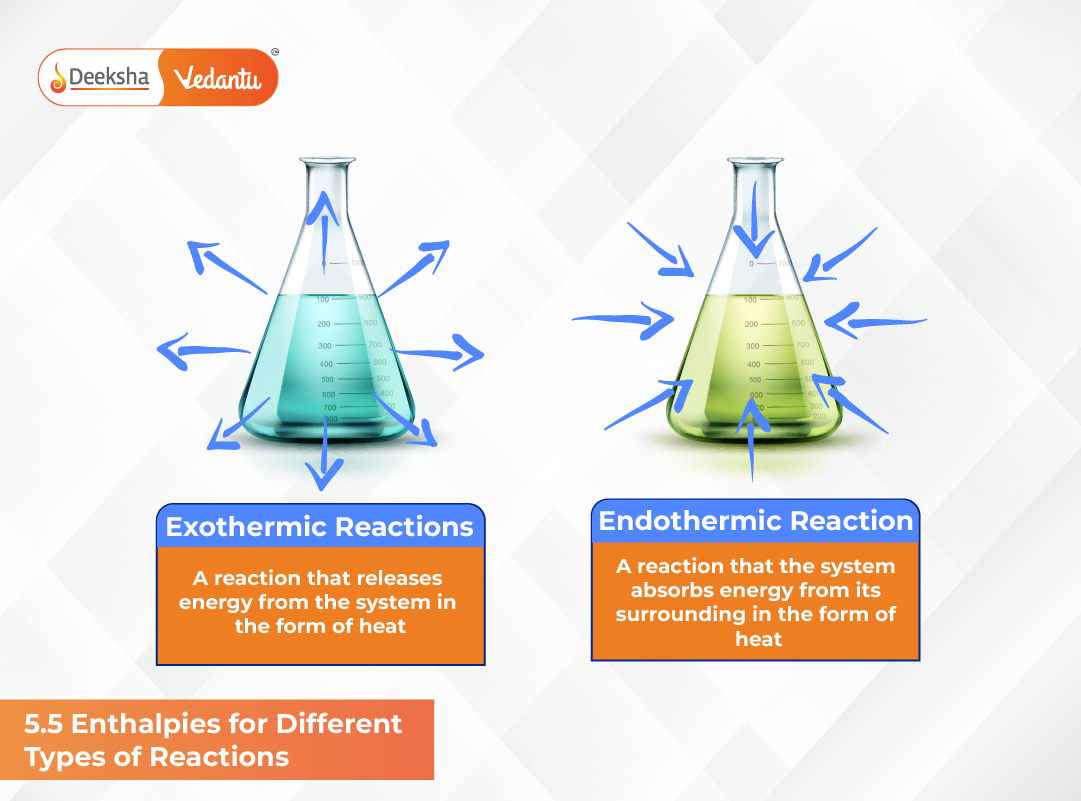


Enthalpy changes occur in almost all chemical reactions and physical processes. Depending on the nature of the process, the enthalpy change (ΔH) can vary greatly. Each type of reaction involves a characteristic energy change that helps chemists quantify and compare different chemical phenomena. Understanding these enthalpy changes is critical in thermochemistry, particularly for competitive exams like NEET and JEE, where thermodynamics questions frequently test both conceptual clarity and mathematical accuracy.
Enthalpy of Combustion (ΔcH°)
The enthalpy of combustion is defined as the amount of heat released when one mole of a substance is completely burned in oxygen under standard conditions (298 K and 1 bar). Combustion reactions are always exothermic, meaning ΔcH° is negative.
Example:
CH₄(g) + 2O₂(g) → CO₂(g) + 2H₂O(l)
ΔcH° = –890.3 kJ mol⁻¹
Enthalpy of combustion values are used extensively in calculating the calorific value of fuels, which indicates the amount of energy produced per unit mass or volume of fuel.
For NEET and JEE, students should remember that the higher the magnitude of ΔcH°, the better the fuel efficiency.
Enthalpy of Formation (ΔfH°)
The enthalpy of formation represents the heat change that occurs when one mole of a compound forms from its constituent elements in their standard states under standard conditions.
Example:
C(graphite) + O₂(g) → CO₂(g); ΔfH° = –393.5 kJ mol⁻¹
This value helps determine reaction enthalpies using Hess’s Law, where reaction enthalpy is calculated by subtracting the sum of enthalpies of reactants from the sum of enthalpies of products.
Enthalpy of Neutralization (ΔneutH)
The enthalpy of neutralization is the heat change that occurs when one mole of water forms during the neutralization of an acid with a base in a dilute aqueous solution.
Example:
HCl(aq) + NaOH(aq) → NaCl(aq) + H₂O(l)
ΔneutH = –57.1 kJ mol⁻¹
This constant value applies to all strong acid-strong base combinations because they completely ionize in water. However, reactions involving weak acids or bases have lower enthalpy values since part of the energy is used for ionization.
For NEET/JEE Tip: Enthalpy of neutralization for weak acid or weak base reactions is smaller than 57.1 kJ mol⁻¹ due to additional ionization enthalpy.
Enthalpy of Solution (ΔsolH°)
The enthalpy of solution is the heat change that occurs when one mole of a substance dissolves in a sufficient quantity of solvent to form an infinitely dilute solution.
Depending on the nature of solute-solvent interactions, ΔHsol can be either positive (endothermic) or negative (exothermic).
Example:
NaCl(s) → Na⁺(aq) + Cl⁻(aq); ΔsolH° = +3.9 kJ mol⁻¹
Dissolution of salts like CaCl₂ releases heat (exothermic), while salts like NH₄NO₃ absorb heat (endothermic), making the solution cool to the touch.
Enthalpy of Atomization (ΔaH°)
The enthalpy of atomization is defined as the heat required to dissociate one mole of a compound or element into its individual atoms in the gaseous state.
Example:
H₂(g) → 2H(g); ΔaH° = +435.9 kJ mol⁻¹
This enthalpy is always positive, as energy must be supplied to break bonds. Atomization enthalpies are used to calculate bond dissociation energies and lattice energies in ionic compounds.
Enthalpy of Sublimation (ΔsubH°)
The enthalpy of sublimation refers to the heat required to convert one mole of a solid directly into a gas without passing through the liquid phase.
Example:
I₂(s) → I₂(g); ΔsubH° = +62.4 kJ mol⁻¹
Sublimation enthalpy is useful in determining phase transition behavior of molecular solids and is important in purification processes like sublimation of camphor or iodine.
Enthalpy of Fusion (ΔfusH°) and Vaporization (ΔvapH°)
Enthalpy of fusion is the heat required to convert one mole of a solid into a liquid at its melting point.
Enthalpy of vaporization is the heat required to convert one mole of a liquid into vapor at its boiling point under constant pressure.
Examples:
H₂O(s) → H₂O(l); ΔfusH° = +6.0 kJ mol⁻¹
H₂O(l) → H₂O(g); ΔvapH° = +40.79 kJ mol⁻¹
These values explain the high energy requirements of phase changes and are crucial in understanding latent heat phenomena.
Enthalpy of Combustion and Thermochemical Applications
Combustion enthalpies are widely used in industrial thermodynamics and bioenergetics. They help in calculating the heat of reaction per mole or per gram of fuel, assisting in designing energy-efficient engines.
Example Problems:
- Calculate the enthalpy of combustion of ethane using ΔHf values.
2C₂H₆(g) + 7O₂(g) → 4CO₂(g) + 6H₂O(l)
ΔHc = [4(–393.5) + 6(–285.8)] – [2(–84.7)] = –1560.0 kJ mol⁻¹.
Additional Reaction Enthalpies
- Enthalpy of Hydration (ΔhydH°): Heat change when 1 mole of gaseous ions dissolve in water to form hydrated ions.
Example: Na⁺(g) + Cl⁻(g) → Na⁺(aq) + Cl⁻(aq) - Enthalpy of Bond Dissociation: Heat required to break one mole of a bond in a gaseous molecule.
Example: Cl₂(g) → 2Cl(g); ΔHdiss = +242.7 kJ mol⁻¹ - Lattice Enthalpy: Energy released when gaseous ions combine to form one mole of an ionic solid.
Example: Na⁺(g) + Cl⁻(g) → NaCl(s); (ΔlatticeH°) = –787 kJ mol⁻¹
Summary Table
| Type of Enthalpy | Definition | Example | Sign of ΔH |
| Enthalpy of Combustion | Heat released when 1 mol of substance burns completely in O₂ | CH₄ + 2O₂ → CO₂ + 2H₂O | Negative |
| Enthalpy of Formation | Heat change when 1 mol of compound forms from elements | C + O₂ → CO₂ | Negative |
| Enthalpy of Neutralization | Heat released when 1 mol of water forms from acid-base reaction | HCl + NaOH → NaCl + H₂O | Negative |
| Enthalpy of Solution | Heat change during dissolution | NaCl → Na⁺ + Cl⁻ | ± depending on solute |
| Enthalpy of Atomization | Heat to form gaseous atoms | H₂ → 2H | Positive |
| Enthalpy of Sublimation | Heat for solid → gas | I₂(s) → I₂(g) | Positive |
| Enthalpy of Fusion | Heat for solid → liquid | H₂O(s) → H₂O(l) | Positive |
| Enthalpy of Vaporization | Heat for liquid → gas | H₂O(l) → H₂O(g) | Positive |
FAQs
Q1. What is enthalpy of combustion?
It is the heat released when one mole of a substance is completely burned in oxygen under standard conditions.
Q2. Why is enthalpy of atomization always positive?
Because energy is required to break chemical bonds and produce free atoms.
Q3. What is the difference between ΔfusH° and ΔvapH°?
ΔfusH° corresponds to melting (solid to liquid), while ΔvapH° refers to boiling (liquid to gas).
Q4. Why does enthalpy of neutralization differ for weak acids and bases?
Because part of the heat is consumed in ionizing the weak acid or base before neutralization.
Q5. What are some industrial applications of enthalpy changes?
Enthalpy data is essential for fuel efficiency calculations, industrial furnace design, and understanding energy transfers in chemical processes.
Conclusion
Different types of enthalpy changes reflect the energetic transformations involved in chemical and physical processes. Mastering these concepts equips students to calculate energy changes accurately and apply them to real-world and exam-based problems. For NEET and JEE aspirants, a clear understanding of enthalpy variations – combustion, formation, and neutralization – is key to tackling both numerical and conceptual questions effectively.



Get Social