


Introduction
Chapter 12 Ecosystem is one of the most important and conceptually demanding chapters in Class 12 Biology under the Ecology unit. This chapter explains how living organisms and the physical environment together form functional systems that sustain life on Earth. Unlike earlier chapters that focus on individual organisms or populations, the ecosystem chapter shifts attention to large-scale processes such as energy flow, nutrient cycling, productivity, stability, and self-regulation.
From a JEE perspective, this chapter requires strong conceptual understanding and the ability to visualise processes rather than memorising definitions. Questions are often framed around energy transfer efficiency, decomposition sequences, ecological pyramids, and reasoning-based scenarios involving ecosystems. At Deeksha Vedantu, ecosystems are taught as dynamic and interconnected systems governed by thermodynamic laws, which helps students confidently handle assertion–reason questions, diagram-based problems, and application-oriented JEE Main questions.
What Is an Ecosystem?
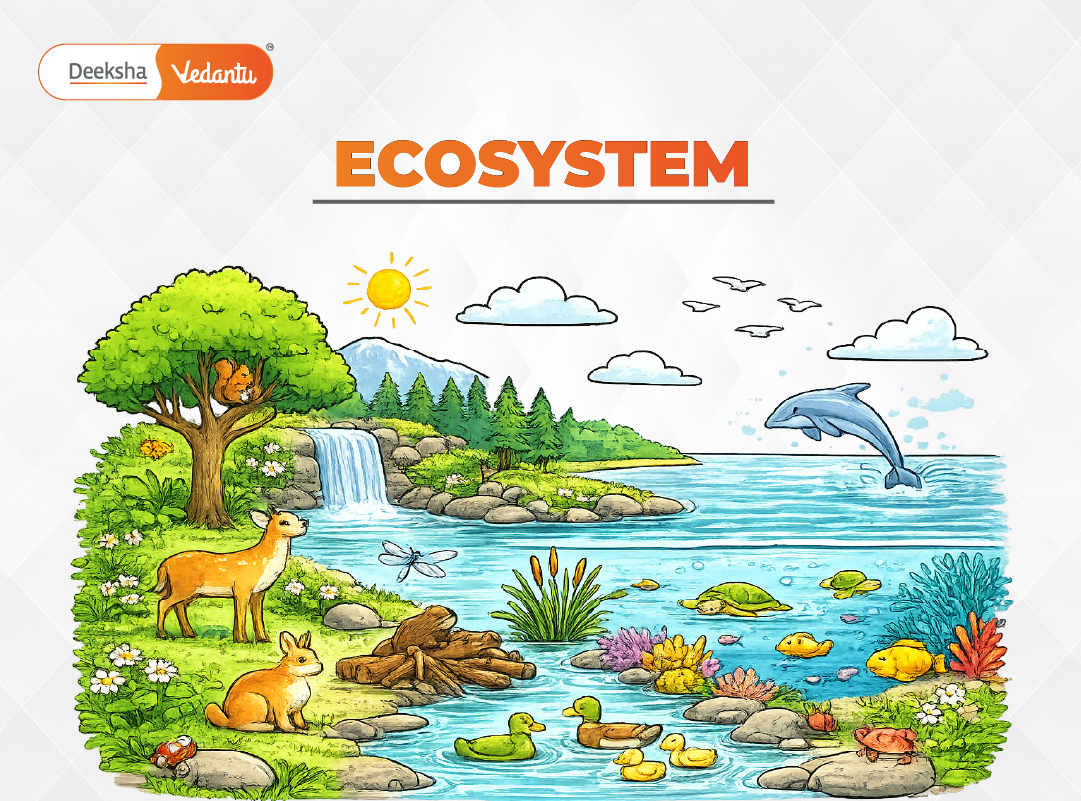
An ecosystem is defined as a functional unit of nature where living organisms interact with one another and with the non-living components of their environment. These interactions are sustained through the flow of energy and the cycling of nutrients, which together maintain ecosystem balance.
An ecosystem can vary greatly in size and complexity, ranging from a small pond or grassland to large forests, deserts, oceans, and even the global biosphere. Despite differences in scale, all ecosystems follow the same basic principles of energy flow and material cycling.
Key characteristics of an ecosystem include:
- Interaction between biotic and abiotic components
- Continuous and unidirectional flow of energy
- Cyclic movement of nutrients between living and non-living components
- Relative stability maintained through feedback and self-regulation
For JEE aspirants, understanding an ecosystem as a system rather than a collection of organisms is crucial for solving conceptual, graphical, and case-based questions.
Structure of an Ecosystem
The structure of an ecosystem refers to the organisation of its living and non-living components and the nature of interactions among them. This structural organisation determines how efficiently an ecosystem functions.
Biotic Components
Biotic components are the living organisms present in an ecosystem and are classified based on their functional roles in energy transfer and nutrient cycling.
They include:
- Producers such as green plants and algae, which synthesise organic food using solar energy through photosynthesis
- Consumers, including herbivores, carnivores, and omnivores, which obtain energy by feeding on producers or other consumers
- Decomposers, mainly bacteria and fungi, which break down dead organic matter and recycle nutrients back into the ecosystem
At Deeksha Vedantu, special emphasis is placed on trophic-level clarity so that students can easily identify producers, primary consumers, secondary consumers, tertiary consumers, and decomposers in JEE questions.
Abiotic Components
Abiotic components are the non-living physical and chemical factors that influence ecosystem functioning and productivity.
They include:
- Light, which drives photosynthesis and determines productivity
- Temperature, which affects enzyme activity and metabolic rates
- Water, which influences species distribution and ecosystem type
- Nutrients and minerals, which support growth, reproduction, and survival
Understanding how abiotic factors regulate ecosystem processes helps students answer ecosystem-based reasoning questions accurately.
Ecosystem Productivity
Productivity refers to the rate at which biomass or organic matter is produced in an ecosystem over a given period. It is a measure of how efficiently energy is converted into biological material.
Primary Productivity
Primary productivity is the rate at which producers convert solar energy into chemical energy through photosynthesis.
It is classified into:
- Gross Primary Productivity (GPP), which represents the total energy fixed by plants
- Net Primary Productivity (NPP), which is the energy remaining after respiratory losses by plants
NPP is ecologically significant because it represents the energy available to consumers at higher trophic levels. JEE questions frequently test the conceptual difference between GPP and NPP, often through reasoning-based or numerical logic.
Secondary Productivity
Secondary productivity refers to the rate of biomass production by consumers. It depends on the quantity and quality of energy transferred from producers and other consumers.
Understanding the relationship between primary and secondary productivity is important for solving conceptual as well as graph-based JEE problems.
Decomposition
Decomposition is the process by which complex organic matter from dead plants and animals is broken down into simpler inorganic substances. This process is essential for nutrient recycling and soil fertility.
The major steps of decomposition include:
- Fragmentation, where detritivores break organic matter into smaller particles
- Leaching, where water-soluble nutrients seep into the soil
- Catabolism, where microbes enzymatically degrade organic matter
- Humification, leading to the formation of humus
- Mineralisation, where inorganic nutrients are released back into the ecosystem
At Deeksha Vedantu, decomposition is taught using flow diagrams and logical sequencing, which helps students avoid common mistakes in sequence-based JEE questions.
Energy Flow in an Ecosystem
Energy flow in an ecosystem follows the laws of thermodynamics and is always unidirectional. Energy enters ecosystems as sunlight and flows through trophic levels before being lost as heat.
Key principles include:
- Energy enters the ecosystem as solar radiation
- Energy flows from producers to consumers and decomposers
- Energy is progressively lost as heat at each trophic level
The ten percent law of energy transfer states that only about ten percent of the energy at one trophic level is transferred to the next. This law explains why food chains are short and is a high-frequency concept in JEE ecology questions.
Ecological Pyramids
Ecological pyramids are graphical representations that show the quantitative relationship between trophic levels in an ecosystem.
The three main types are:
- Pyramid of numbers, representing the number of organisms at each trophic level
- Pyramid of biomass, representing the total biomass at each trophic level
- Pyramid of energy, representing energy flow across trophic levels
Among these, the pyramid of energy is always upright because energy flow is unidirectional and decreases at each successive trophic level. JEE questions often test this concept directly or indirectly through reasoning-based statements.
Ecological Succession
Ecological succession refers to the gradual and predictable change in species composition in an area over time. Succession leads to the development of a stable ecosystem adapted to local environmental conditions.
Types of Succession
- Primary succession occurs in areas devoid of life, such as bare rocks or newly formed land
- Secondary succession occurs in areas where life previously existed but was disturbed
Stages of Succession
- Pioneer stage, where hardy species colonise the area
- Seral stages, which include intermediate communities
- Climax community, which represents a stable and self-sustaining ecosystem
At Deeksha Vedantu, succession is explained using land and forest recovery examples to strengthen conceptual clarity for JEE aspirants.
Nutrient Cycling
Nutrient cycling refers to the movement of essential elements between biotic and abiotic components of ecosystems. These cycles ensure the continuous availability of nutrients for living organisms.
Carbon Cycle
The carbon cycle involves:
- Carbon fixation by producers through photosynthesis
- Transfer of carbon through food chains
- Release of carbon through respiration, decomposition, and combustion
Nitrogen Cycle
The nitrogen cycle includes several microbially mediated processes:
- Nitrogen fixation
- Nitrification
- Assimilation
- Ammonification
- Denitrification
Phosphorus Cycle
The phosphorus cycle is unique because it lacks a significant gaseous phase and primarily occurs through rocks, soil, water, and living organisms.
Understanding nutrient cycles helps students answer assertion–reason and process-based JEE questions accurately.
Ecosystem Services
Ecosystem services are the benefits humans derive from ecosystems, highlighting the importance of ecological balance.
They include:
- Provisioning services such as food, fuel, and water
- Regulating services such as climate regulation and flood control
- Supporting services such as nutrient cycling and soil formation
- Cultural services such as recreation and aesthetic value
At Deeksha Vedantu, ecosystem services are discussed to help students connect ecology concepts with sustainability and environmental responsibility.
Importance of Ecosystem Chapter for JEE Preparation
Conceptual Strength
This chapter integrates energy flow, nutrient cycling, productivity, ecological pyramids, and ecosystem stability, making it ideal for testing integrated conceptual understanding in JEE.
Scoring Potential
With strong conceptual clarity, regular diagram practice, and logical reasoning, the Ecosystem chapter becomes a high-scoring area. The structured and exam-focused learning approach at Deeksha Vedantu helps students avoid conceptual traps and maximise accuracy.
FAQs
Q1. What is an ecosystem?
An ecosystem is a functional unit where living organisms interact with each other and with the physical environment through energy flow and nutrient cycling.
Q2. What is net primary productivity?
Net primary productivity is the energy available to consumers after respiratory losses in producers.
Q3. Why is the pyramid of energy always upright?
Because energy decreases at each trophic level due to unidirectional flow and heat loss.
Q4. What is ecological succession?
Ecological succession is the gradual change in species composition of an area over time, leading to a stable climax community.
Q5. Why is Chapter 12 important for JEE?
It tests system-level ecological reasoning, energy flow, nutrient cycling, and conceptual understanding derived from ecosystem functioning.
Conclusion
Chapter 12 Ecosystem explains how nature functions as an integrated system driven by energy flow and nutrient cycling. For JEE aspirants, a deep understanding of productivity, decomposition, succession, nutrient cycles, and ecosystem services is essential. A concept-driven preparation strategy, as followed at Deeksha Vedantu, helps students develop clarity, confidence, and strong problem-solving ability in ecology-based questions.



Get Social