
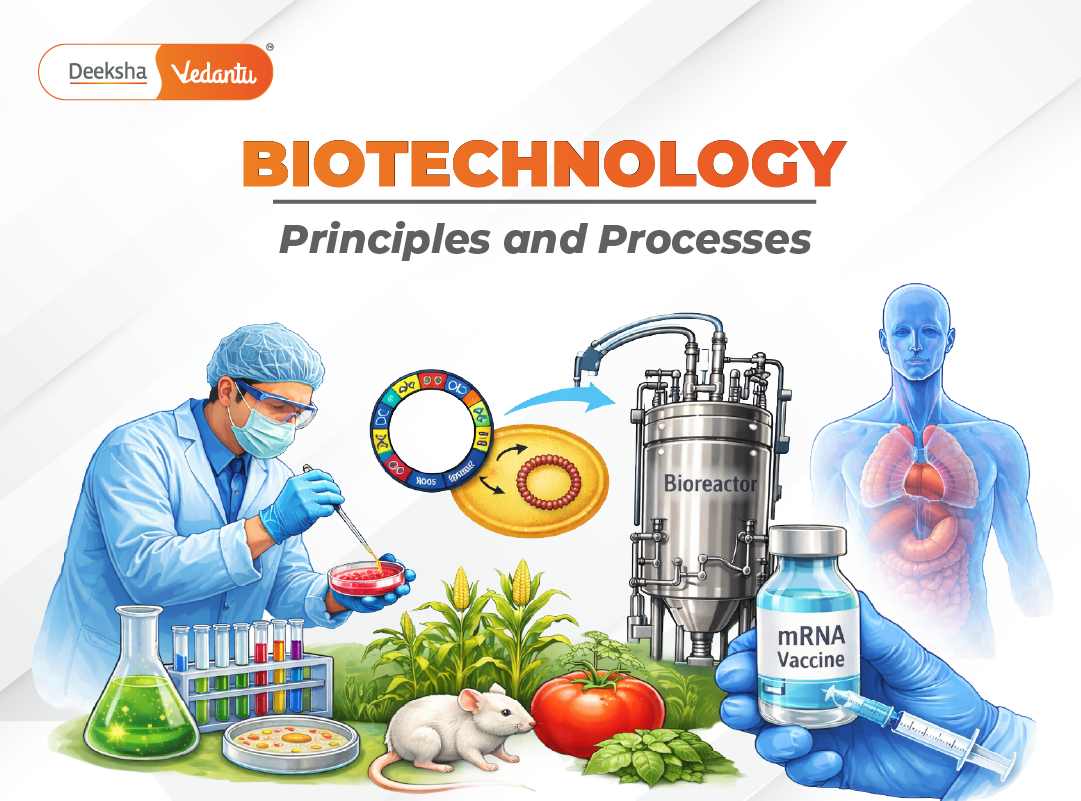


Introduction
Biotechnology is one of the most important and high‑scoring units in Class 12 Biology, especially for students preparing for JEE Main and JEE Advanced. This unit forms a direct bridge between molecular biology, genetics, microbiology, and applied biological sciences. NCERT treats biotechnology as a logical extension of genetic principles, and competitive exams strictly follow NCERT definitions, diagrams, processes, and examples.
From a JEE perspective, Unit IX is concept‑heavy but not calculation‑intensive, making it a reliable scoring area.
Key reasons why Biotechnology is important for JEE include:
- Direct alignment with NCERT definitions and diagrams
- High weightage of application‑based questions
- Frequent use of examples such as insulin production, Bt crops, and gene therapy
- Emphasis on conceptual clarity rather than numerical problem‑solving
Questions are often framed from NCERT statements, flowcharts, and applications such as insulin production, Bt crops, and gene therapy. At Deeksha Vedantu, this unit is approached with strong emphasis on NCERT line‑by‑line clarity, ensuring students are comfortable handling both direct and application‑based JEE questions.
What Is Biotechnology?
Biotechnology refers to the use of living organisms, cells, or their components to develop products and processes that benefit human society. It involves deliberate manipulation of biological systems at the cellular or molecular level to obtain desirable outcomes such as improved crops, therapeutic proteins, vaccines, and industrial enzymes.
According to NCERT, biotechnology is not limited to genetic engineering alone but also includes large‑scale production techniques that allow biological products to be manufactured under controlled conditions.
JEE Focus
In JEE examinations, questions related to biotechnology often test conceptual clarity of definitions, scope, and underlying logic. Students must be careful with wording, as NCERT‑based definitions are frequently tested verbatim, especially in JEE Main. Classroom discussions and structured revision methods followed at Deeksha Vedantu help students internalise these definitions accurately.
Principles of Biotechnology
Modern biotechnology is based on two fundamental principles that together make genetic manipulation and large‑scale biological production possible:
- Genetic engineering for introducing and modifying genes
- Bioprocess engineering for large‑scale production under controlled conditions
Genetic Engineering
Genetic engineering involves altering the genetic material of an organism by introducing foreign DNA. This process allows organisms to express new traits or produce useful biological products that they do not naturally synthesise.
Genetic engineering includes multiple sequential steps:
- Isolation of the genetic material
- Cutting DNA at specific recognition sites
- Amplification of the gene of interest
- Insertion of the gene into a suitable vector and host
- Expression of the desired gene product
Recombinant DNA Technology
Recombinant DNA technology refers to the formation of DNA molecules by combining DNA fragments from different biological sources. The resulting recombinant DNA is then introduced into a suitable host organism where it replicates and expresses the inserted gene.
A classic NCERT example is the production of human insulin using genetically modified bacteria. The insulin gene is inserted into a plasmid vector, which is then introduced into a bacterial host for large‑scale production.
From a JEE perspective, questions may test the sequence of steps involved in recombinant DNA technology or the role of specific enzymes and vectors in the process. Regular diagram‑based practice, as emphasised in Deeksha Vedantu learning modules, strengthens retention of these multi‑step processes.
Bioprocess Engineering
Bioprocess engineering deals with maintaining optimal conditions such as temperature, pH, oxygen supply, and nutrient availability to enable the growth of genetically modified organisms. These processes are carried out in bioreactors, which allow large‑scale production of biological products.
NCERT emphasises that genetic engineering alone is insufficient unless supported by bioprocess engineering. JEE questions may link genetic manipulation with industrial‑scale production.
Tools and Techniques of Biotechnology
Biotechnology relies on a set of specialised tools that allow precise manipulation and amplification of genetic material, including:
- Restriction enzymes
- Polymerase Chain Reaction (PCR)
- Cloning vectors
- Suitable host organisms
Restriction Enzymes
Restriction endonucleases are enzymes that cut DNA at specific recognition sequences. These enzymes act as molecular scissors and are essential for isolating genes of interest.
Each restriction enzyme recognises a specific palindromic DNA sequence. Accurate knowledge of enzyme function is important for JEE, as questions may test recognition site logic or enzyme specificity.
Polymerase Chain Reaction (PCR)
Polymerase Chain Reaction is a technique used to amplify a specific segment of DNA exponentially. PCR involves repeated cycles of denaturation, annealing, and extension, leading to millions of copies of the target DNA.
PCR is widely used in genetic research, medical diagnostics, forensic science, and disease detection. NCERT diagrams and steps of PCR are highly important for JEE Main. Focused visual learning techniques used at Deeksha Vedantu often help students avoid common sequencing errors in PCR‑based questions.
Cloning Vectors
Cloning vectors are DNA molecules used to carry foreign DNA into host cells. Plasmids, bacteriophages, and cosmids are commonly used vectors.
An ideal vector should have an origin of replication, selectable marker, and cloning site. JEE questions frequently test vector characteristics and differences between plasmids and bacteriophages.
Host Organisms
Host organisms such as bacteria, yeast, plant cells, or animal cells provide the cellular machinery needed for replication and expression of recombinant DNA. Escherichia coli is the most commonly used host due to its rapid growth and well‑understood genetics.
Applications of Biotechnology
The applications of biotechnology demonstrate how genetic manipulation and biological production benefit society across multiple sectors:
Applications in Agriculture
Agricultural biotechnology focuses on improving crop characteristics such as:
- Higher yield
- Resistance to pests and diseases
- Tolerance to environmental stress
- Improved nutritional value Genetically modified crops are designed to express traits such as pest resistance, herbicide tolerance, and enhanced nutrient content.
Bt cotton is an important NCERT example where a bacterial gene produces a protein toxic to insect pests. JEE questions often test the mechanism of action rather than memorising crop names.
Applications in Medicine
Biotechnology has revolutionised medicine by enabling:
- Large‑scale production of therapeutic proteins such as insulin and growth hormone
- Development of vaccines using recombinant technology
- Advanced diagnostic techniques like PCR Recombinant insulin production is a classic NCERT‑based example frequently asked in JEE.
Gene therapy and molecular diagnostics are also key medical applications. PCR plays a crucial role in early disease detection, which may appear in application‑based questions.
Transgenic Animals
Transgenic animals are those that carry and express foreign genes. They are used to study gene regulation, disease mechanisms, and drug safety.
NCERT emphasises their role in vaccine testing and biological research. JEE questions may assess understanding of why transgenic animals are created rather than listing examples.
Environmental Applications
Biotechnology contributes to environmental protection through bioremediation, where microorganisms are used to degrade pollutants. This application highlights the ecological importance of biotechnology.
Ethical and Safety Issues in Biotechnology
Biotechnology raises ethical concerns related to:
- Genetic modification of organisms
- Biosafety and accidental gene transfer
- Environmental impact of genetically modified organisms
- Misuse of genetic information Issues such as gene patenting, unintended ecological effects, and misuse of genetic information require strict regulatory oversight.
NCERT‑based ethics questions may appear as statement‑based or assertion‑reason questions in JEE Main.
Importance of Biotechnology for JEE Preparation
Conceptual Integration
Unit IX integrates concepts from genetics, molecular biology, microbiology, and industrial biology. This makes it ideal for testing multi‑concept understanding in competitive exams.
Scoring Potential
Biotechnology is considered a high‑scoring unit because most questions are direct, NCERT‑based, and concept‑driven. Strong conceptual clarity ensures minimal negative marking.
FAQs
Q1. What is recombinant DNA technology?
Recombinant DNA technology involves combining DNA fragments from different organisms to create a new genetic combination that can express desired traits or produce useful proteins.
Q2. Why is PCR important in biotechnology?
PCR allows rapid amplification of specific DNA segments, making it essential for genetic analysis, disease diagnosis, and research applications.
Q3. Are biotechnology questions directly asked in JEE?
Yes, biotechnology questions are frequently asked in JEE Main and are usually based directly on NCERT definitions, processes, and applications.
Q4. What are genetically modified crops?
Genetically modified crops are plants whose DNA has been altered to express beneficial traits such as pest resistance or improved nutritional value.
Q5. Why is biotechnology considered a scoring unit?
Biotechnology is scoring because questions are concept‑based, NCERT‑oriented, and require logical understanding rather than complex calculations.
Conclusion
Unit IX Biotechnology is a crucial component of Class 12 Biology for JEE aspirants. When studied directly from NCERT with emphasis on principles, tools, and applications, it becomes a reliable scoring area. A clear understanding of genetic engineering, PCR, recombinant DNA technology, and real‑world applications strengthens conceptual foundations and enhances performance in competitive examinations. A disciplined, NCERT‑centric preparation strategy-similar to the approach followed at Deeksha Vedantu-can significantly improve accuracy and confidence while attempting biotechnology questions in JEE.



Get Social