
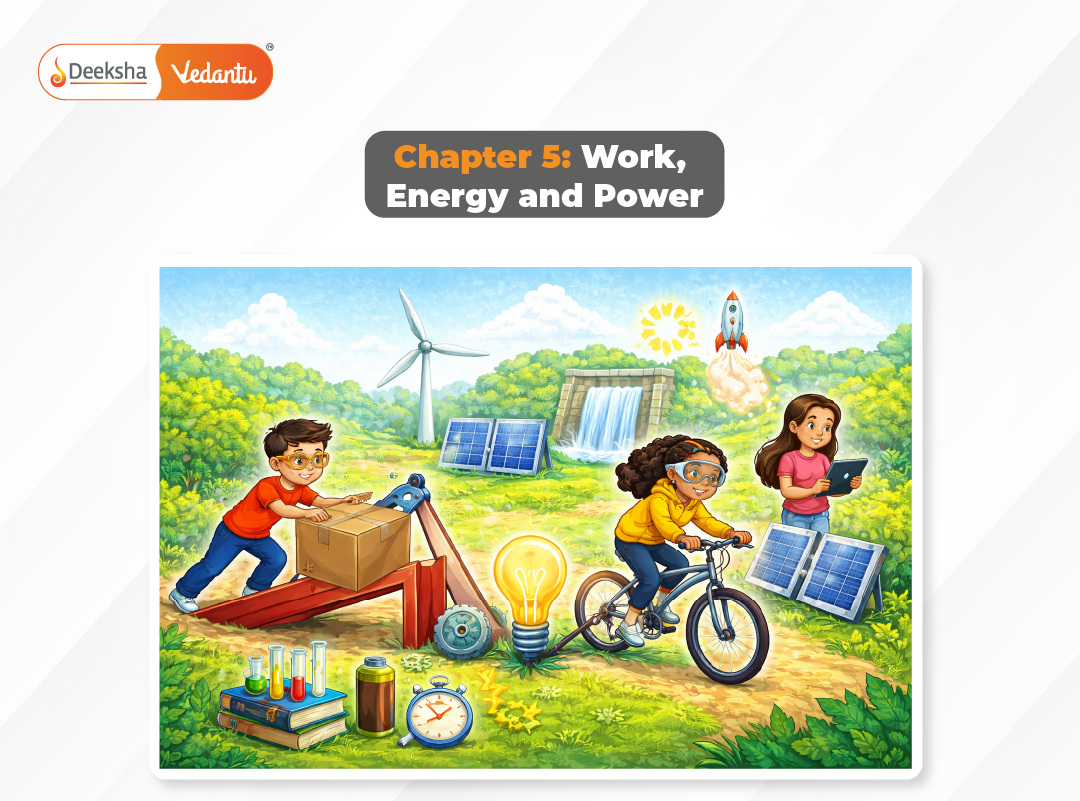


Chapter 5 – Work, Energy and Power is one of the most important and conceptually rich chapters in Class 11 Physics. It forms the backbone of mechanics and establishes the transition from Newton's force-based approach to energy-based analysis. This chapter is crucial not only for CBSE board examinations but also for competitive exams such as JEE, NEET, and KCET.
At Deeksha Vedantu, we emphasize conceptual clarity, mathematical derivation, and application-based learning. Mastery of this chapter significantly strengthens problem-solving ability in later topics such as Rotational Motion, Gravitation, Oscillations, and Fluid Mechanics.
This chapter is structured into subtopics 5.1 to 5.11, progressively building the framework of energy transformation and conservation.
Structure of the Chapter
| Section | Topic |
| 5.1 | Introduction |
| 5.2 | Notion of Work and Kinetic Energy |
| 5.3 | Work |
| 5.4 | Kinetic Energy |
| 5.5 | Work-Energy Theorem |
| 5.6 | Potential Energy |
| 5.7 | Conservative and Non-Conservative Forces |
| 5.8 | Mechanical Energy |
| 5.9 | Power |
| 5.10 | Collisions |
| 5.11 | Summary |
Each section contributes to a deeper understanding of how forces transfer energy and how energy is conserved in physical systems.
1. Concept of Work in Physics
In everyday language, work means effort. However, in physics, work is defined only when a force causes displacement.
The mathematical definition of work is given by the dot product of force and displacement:

If the angle between force and displacement is  , then:

Where:
 = magnitude of force
 = displacement
 = angle between force and displacement
Important Cases
- When
 →
→  (Positive Work)
 - When
 →
→  (Negative Work)
 - When
 →
→  (Zero Work)
 →
→  (Positive Work)
 →
→  (Negative Work)
 →
→  (Zero Work)
For variable forces, work is calculated using integration:

This becomes extremely important in advanced mechanics and JEE-level problems.
2. Kinetic Energy
Kinetic energy is the energy possessed by a body due to its motion.
The expression for kinetic energy is:

Derivation Using Newton's Second Law
Starting from:

And using:

We relate force and displacement to obtain:

Substituting and simplifying leads to:

This directly leads to the Work-Energy Theorem.
3. Work-Energy Theorem
The Work-Energy Theorem states:
Net work done on a particle equals the change in its kinetic energy.

Or,

This theorem simplifies complex force-based problems into simpler energy-based problems. Instead of resolving multiple forces and accelerations, students can directly apply conservation principles.
4. Potential Energy
Potential energy is the energy stored due to position or configuration.
Gravitational Potential Energy (Near Earth Surface)

Where:
 = mass
 = acceleration due to gravity
 = height
Universal Gravitational Potential Energy

This expression becomes important in gravitation and orbital motion.
Elastic Potential Energy
Stored in a spring system:

Where:
 = spring constant
 = displacement
This is foundational for oscillations and SHM.
5. Conservative and Non-Conservative Forces
A force is conservative if work done depends only on initial and final positions.
Mathematically, for a closed path:

Examples:
- Gravitational force
- Spring force
Non-conservative forces (like friction) depend on path and dissipate energy.
6. Mechanical Energy and Conservation
Mechanical energy is the sum of kinetic and potential energy.

Law of Conservation of Mechanical Energy:
If only conservative forces act:

Or,

Applications
- Roller coaster motion
- Motion on inclined plane
- Free fall
- Pendulum motion
7. Power
Power is defined as the rate of doing work.

Instantaneous power:

Unit of power:

Horsepower relation:

Power concepts are important in machine and engine-related numerical problems.
8. Collisions
This section combines conservation of momentum and energy.
Law of Conservation of Momentum

Elastic Collision Condition

Coefficient of Restitution

Collisions are highly important for JEE Advanced problems.
Key Formula Summary Table
| Concept | Formula |
| Work | |
| Variable Force Work | |
| Kinetic Energy | |
| Work-Energy Theorem | |
| Gravitational PE | |
| Elastic PE | |
| Mechanical Energy | |
| Power | |
| Instantaneous Power | |
| Momentum Conservation | |
| Coefficient of Restitution | |
Skills Developed Through This Chapter
- Analytical reasoning
- Application of conservation laws
- Mathematical modelling
- Multi-step numerical solving
- Faster problem-solving using energy methods
Connection to Future Topics
- Rotational Motion
- Gravitation
- Oscillations
- Centre of Mass
- Fluid Mechanics
Competitive Exam Importance
High-weightage areas include:
- Work-Energy Theorem numericals
- Conservation of Mechanical Energy
- Spring-block systems
- Collision-based problems
- Power calculations
FAQs
Q1. Why is Work, Energy and Power important for JEE and NEET?
Because it builds the foundation of mechanics and is repeatedly used in advanced chapters and competitive problems.
Q2. What is the most important equation in this chapter?
and are the most frequently applied relations.
Q3. Is this chapter calculation-heavy?
Yes. However, conceptual clarity reduces unnecessary calculations.
Q4. Does NCERT theory suffice for NEET?
Yes. NCERT examples and conceptual explanations are extremely important for NEET preparation.
Q5. Why is conservation of energy powerful?
Because it simplifies motion problems without directly solving force equations.
Conclusion
Work, Energy and Power is one of the most fundamental and high-impact chapters in Class 11 Physics. It transforms the understanding of motion from a force-centric approach to an energy-based framework. At Deeksha Vedantu, we ensure students master derivations, applications, and exam-oriented problem solving to build a strong foundation for board and competitive examinations.



Get Social