


Introduction
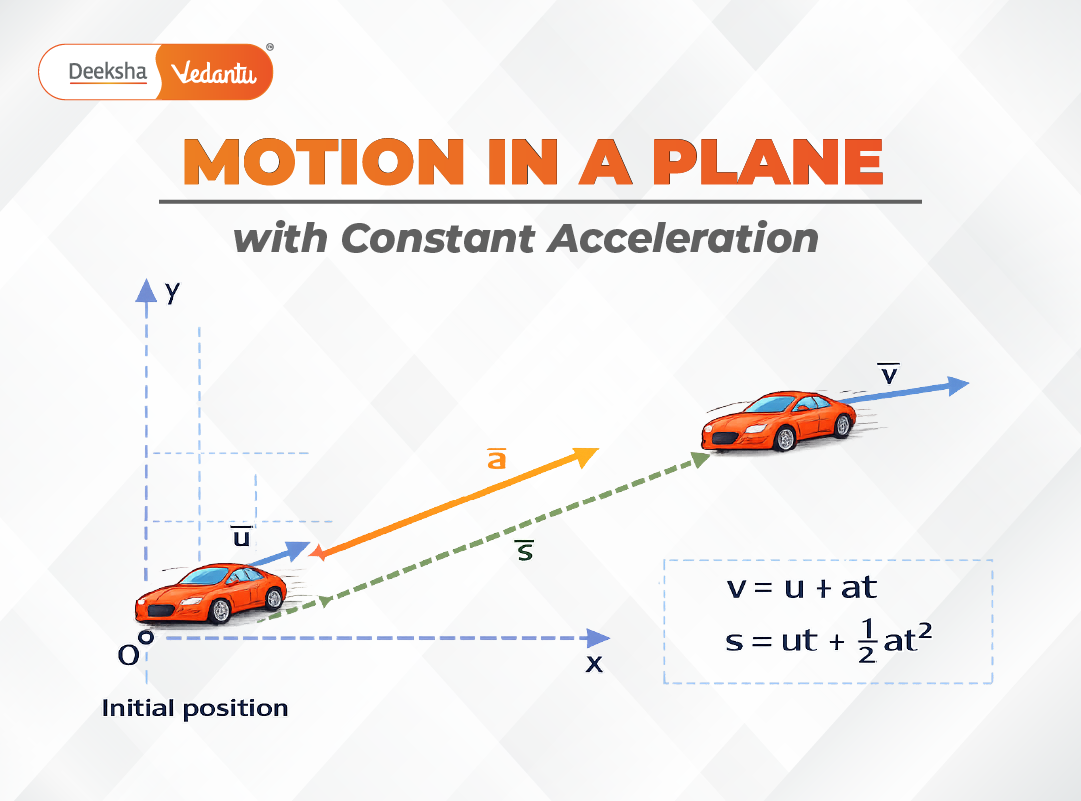
Motion in a plane with constant acceleration deals with two-dimensional motion where the acceleration vector remains unchanged in magnitude and direction throughout the motion. Unlike straight-line motion, both the direction and magnitude of velocity may change continuously in plane motion, making vector analysis essential.
In many real physical situations, acceleration remains constant. A classic example is motion under gravity near the Earth's surface, where acceleration due to gravity acts vertically downward with constant magnitude. Understanding such motion is crucial for analysing projectile motion, relative velocity, and several application-based mechanics problems. At Deeksha Vedantu, this topic is taught as a key transition from basic vector kinematics to advanced motion analysis used in competitive examinations.
Basic Idea of Motion with Constant Acceleration in a Plane
When a particle moves in a plane under constant acceleration, the acceleration vector does not change with time. However, the velocity vector generally changes both in magnitude and direction as the particle moves along its trajectory.
The most important principle used in analysing such motion is that motion along mutually perpendicular directions is independent. Even though the particle follows a single curved path, its motion can be treated as two separate one-dimensional motions along perpendicular axes. This principle allows equations of motion to be applied independently along each axis.
Choice of Coordinate Axes
To analyse motion conveniently, a rectangular coordinate system is chosen.
- One axis is usually taken along the horizontal direction (x-axis)
- The other axis is taken along the vertical direction (y-axis)
The origin is chosen at a convenient point, often the initial position of the particle. All vectors such as displacement, velocity, and acceleration are then resolved into x and y components for systematic analysis.
Position Vector in Motion with Constant Acceleration
At any instant, the position of the particle is described by its position vector.
If the particle has coordinates (x, y) at time t, its position vector is:

As time progresses, both x and y coordinates change according to the equations of motion along each direction. The continuous change of the position vector with time forms the basis for defining velocity and acceleration in two-dimensional motion.
Velocity Vector in Component Form
The velocity vector of the particle at any instant is obtained by differentiating the position vector with respect to time.
It is written as:

Here, v_x and v_y represent the components of velocity along the x and y directions respectively. These components determine both the speed and the direction of motion of the particle.
Acceleration Vector in Component Form
The acceleration vector is obtained by differentiating the velocity vector with respect to time.
It is written as:

In motion with constant acceleration, both a_x and a_y remain constant with time. Acceleration may cause a change in speed, direction of motion, or both.
Equations of Motion in Two Dimensions
When acceleration is constant, the equations of motion used in one-dimensional kinematics can be applied independently along each direction.
Equations Along the x-Direction
If the initial velocity component along x is u_x and acceleration along x is a_x:


Equations Along the y-Direction
If the initial velocity component along y is u_y and acceleration along y is a_y:


These equations together completely describe the motion of the particle in the plane.
Trajectory of the Particle
The trajectory is the path followed by the particle during its motion. In motion with constant acceleration, the shape of the trajectory depends on the initial velocity components and the direction of acceleration.
By eliminating time from the equations of motion along the x and y directions, the equation of the trajectory can be obtained. In many important cases, such as projectile motion, the trajectory turns out to be a parabola. Understanding the nature of the trajectory is essential for conceptual and application-based questions.
Independence of Motions Along Perpendicular Directions
A fundamental result of plane motion analysis is that motion along the x-axis and y-axis are independent of each other.
- Motion along the x-direction is unaffected by acceleration along the y-direction
- Motion along the y-direction is unaffected by velocity along the x-direction
This principle allows complex two-dimensional motion to be analysed using simple one-dimensional equations applied separately along each axis.
Physical Interpretation and Applications
Motion in a plane with constant acceleration appears in many physical situations:
- Projectile motion under gravity
- Motion of a particle thrown at an angle
- Motion of objects moving with constant horizontal velocity and vertical acceleration
In all these cases, resolving vectors and applying equations of motion component-wise gives complete information about position, velocity, and acceleration at any instant. At Deeksha Vedantu, students are trained to first identify acceleration components and then apply equations methodically, which is crucial for accuracy in competitive exams.
Importance for JEE Preparation
This topic is extremely important for JEE because:
- It provides the mathematical framework for projectile motion
- It strengthens understanding of component-wise motion
- It develops confidence in applying equations of motion in two dimensions
- It forms the basis for relative velocity and circular motion analysis
A strong grip on this topic significantly improves performance in mechanics-based questions.
Common Conceptual Errors (JEE Perspective)
Students often make mistakes such as:
- Applying one-dimensional equations directly without resolving vectors
- Mixing x and y components incorrectly
- Using incorrect sign conventions for acceleration
- Forgetting that acceleration may exist even if speed is constant
Careful component-wise analysis and consistent practice help avoid these errors.
FAQs
Q1. What is meant by motion in a plane with constant acceleration?
It refers to two-dimensional motion where the acceleration vector remains constant in magnitude and direction.
Q2. Can equations of motion be applied in two dimensions?
Yes, but they must be applied separately along perpendicular directions.
Q3. Why is projectile motion considered motion with constant acceleration?
Because acceleration due to gravity remains constant and acts vertically downward throughout the motion.
Q4. What is meant by independence of motion along perpendicular directions?
It means motion along one axis does not affect motion along the perpendicular axis.
Q5. Why is this topic important for JEE?
Because it forms the foundation for projectile motion and several advanced mechanics problems.
Conclusion
Motion in a Plane with Constant Acceleration provides a complete and rigorous framework for analysing two-dimensional motion under constant acceleration. For JEE aspirants, mastering this topic is essential because it bridges basic vector concepts with advanced applications such as projectile motion. A systematic, component-based approach, as emphasised at Deeksha Vedantu, ensures clarity, accuracy, and confidence while solving complex mechanics problems.



Get Social