
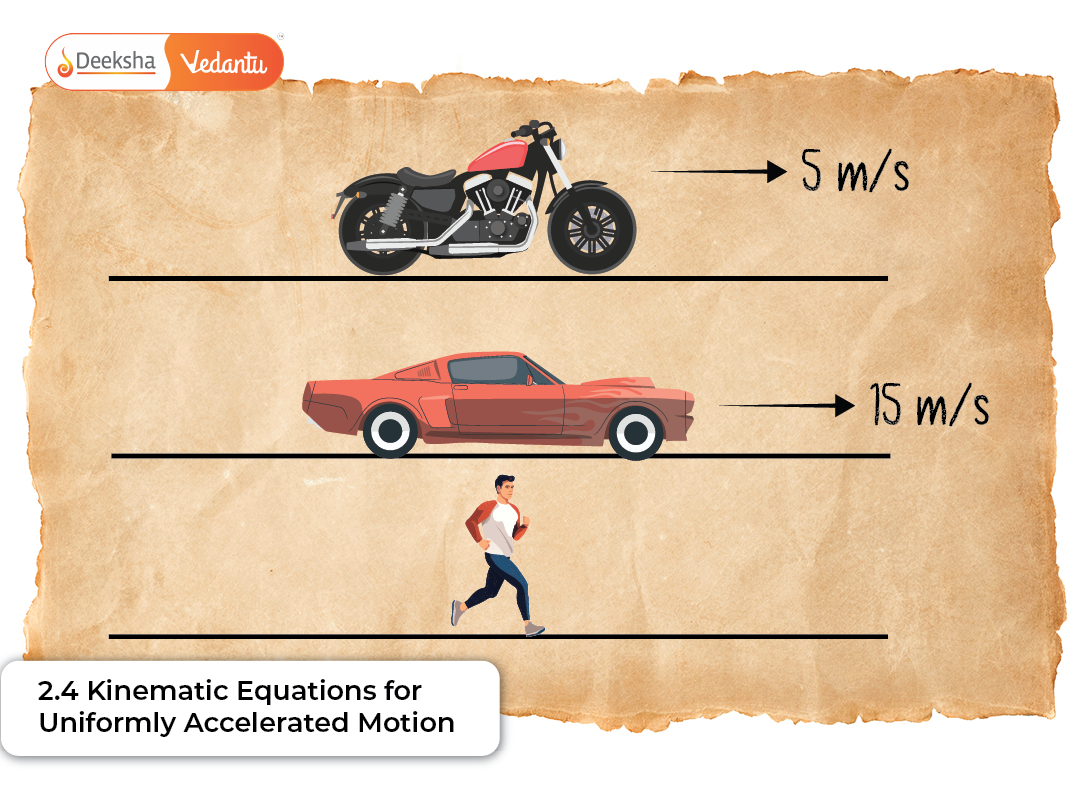


Kinematic equations are among the most powerful tools in physics for analysing motion. They allow us to calculate how objects move when acceleration is constant-whether the object is speeding up, slowing down, or moving under gravity. These equations are essential not only for board exams but also for JEE, NEET, KCET, COMEDK, and other competitive examinations.
At Deeksha Vedantu, our approach goes beyond memorising formulas. We help students understand why these equations work, how they are derived, and when to apply each of them effectively. This deeper understanding builds confidence and accuracy in solving physics problems.
What Is Uniformly Accelerated Motion?
Uniformly accelerated motion occurs when the acceleration of an object remains constant over time. This means that the object’s velocity changes steadily-by equal amounts in equal intervals of time.
Real-life examples include:
- A ball thrown straight upward, slowing down uniformly under gravity.
- A motorbike accelerating steadily along a highway.
- A car decelerating uniformly as the brakes are applied.
- A freely falling object experiencing gravitational acceleration.
When acceleration is constant, the motion becomes predictable, allowing us to derive elegant mathematical relationships that describe it completely.
Variables Used in Kinematic Equations
To mathematically analyse motion, we use the following variables:
- u: Initial velocity at time t = 0
- v: Final velocity at time t
- a: Constant acceleration throughout the motion
- t: Time interval
- s: Displacement during the time interval
These five variables can fully describe any motion under uniform acceleration.
The Three Kinematic Equations of Motion
There are three key equations:
- v = u + at
- s = ut + 1/2 at²
- v² = u² + 2as
These equations relate displacement, velocity, time, and acceleration. Importantly, they only hold when acceleration is constant.
Derivation of the First Equation: v = u + at
Acceleration is defined as the rate of change of velocity with time.
Acceleration = (v – u) / t
Multiply both sides by t:
v – u = at
Rearranging:
v = u + at
This equation shows how velocity changes when an object experiences constant acceleration.
Derivation of the Second Equation: s = ut + 1/2 at²
Under constant acceleration, average velocity is:
Average velocity = (u + v)/2
Displacement = average velocity × time
s = ((u + v) / 2)t
Substitute v = u + at:
s = ut + 1/2 at²
This beautifully captures how displacement depends on both initial velocity and acceleration.
Derivation of the Third Equation: v² = u² + 2as
Use the first two equations:
v = u + at
s = ut + 1/2 at²
Eliminate t to derive:
v² = u² + 2as
This equation is especially useful when time is unknown.
Graphical Interpretation of Kinematic Equations
Understanding graphs helps visualise motion clearly.
Velocity–Time (v–t) Graph
- The slope gives acceleration.
- The area under the graph gives displacement.
- A straight line means acceleration is constant.
Position–Time (x–t) Graph
- A straight line: constant velocity.
- A curve bending upward: positive acceleration.
- A curve bending downward: negative acceleration.
Graphs frequently appear in competitive exams because they test conceptual understanding.
When to Use Each Equation
Choosing the correct equation is crucial. Use:
- v = u + at → when velocity changes with time.
- s = ut + 1/2 at² → when time and displacement are known.
- v² = u² + 2as → when time isn’t given.
This decision-making is a key exam skill.
Real-Life Applications
Kinematic equations help analyse:
- Vehicle braking distance and stopping time.
- Vertical motion of objects under gravity.
- Roller coaster design and safety calculations.
- Sports motion-jumps, sprint starts, long throws.
- Motion of aircraft during landing and takeoff.
These real-world examples improve intuition and understanding.
Numerical Examples
Example 1
A car starts from rest and accelerates at 3 m/s² for 5 seconds. Find final velocity.
v = u + at = 0 + 3 × 5 = 15 m/s.
Example 2
A ball is thrown upward with a velocity of 20 m/s. How high does it go? (g = 10 m/s²)
0 = 400 + 2(–10)s ⇒ s = 20 m
Example 3
A scooter slows from 10 m/s to rest in 4 seconds. Find acceleration and distance.
a = –10/4 = –2.5 m/s² s = 10(4) + 1/2(–2.5)(16) = 20 m
Example 4
A truck moving at 25 m/s comes to rest after covering 100 m under uniform deceleration. Find acceleration.
v² = u² + 2as 0 = 625 + 2a(100) a = –3.125 m/s²
Example 5
A stone falls from rest for 3 seconds. Find distance covered. (g = 9.8 m/s²)
s = 1/2 × 9.8 × 9 = 44.1 m
Practice Question Set (JEE / NEET / KCET / COMEDK)
Q1. A car accelerates from 5 m/s to 25 m/s in 4 seconds. Find acceleration.
Solution: a = (25 – 5)/4 = 5 m/s².
Q2. A ball dropped from rest travels 45 m in t seconds. Find t. (g = 10 m/s²)
Solution: 45 = 1/2(10)t² ⇒ t = 3 s.
Q3. A bike moving at 20 m/s stops in 5 seconds. Find deceleration and stopping distance.
Solution: a = –4 m/s²; s = 20(5) – 1/2(4)(25) = 50 m.
Q4. A particle has u = 15 m/s, v = 5 m/s, a = –2 m/s². Find displacement.
Solution: 25 = 225 + 2(–2)s ⇒ s = 50 m.
Q5. A body accelerates from rest at 6 m/s² for 8 seconds. Find displacement.
Solution: s = 1/2 × 6 × 64 = 192 m.
FAQs – Kinematic Equations
Q1: Why are these equations only valid for constant acceleration?
Because the derivations assume acceleration does not change with time.
Q2: Can these equations be applied to vertical motion?
Yes. For vertical motion, use acceleration = g (positive or negative based on direction).
Q3: What is the biggest mistake students make?
Using kinematic equations when acceleration is not constant.
Q4: How does Deeksha Vedantu help?
We provide derivations, conceptual explanations, shortcut techniques, and structured practice.
Conclusion
The kinematic equations are fundamental tools that help describe and predict motion accurately. Whether solving board exam numericals or advanced JEE/NEET motion problems, a strong understanding of these equations is essential.
At Deeksha Vedantu, we ensure students gain deep conceptual clarity, master derivations, practise diverse question types, and develop the analytical skills needed to excel in physics and competitive exams.


Get Social