| Feature | Average Velocity | Instantaneous Velocity |
| Time Interval | Over a finite interval | At a specific instant |
| Information | Gives general trend | Shows exact motion at a moment |
| Formula | Δs/Δt | ds/dt |
| Usefulness | Useful when motion is uniform | Crucial when speed varies |
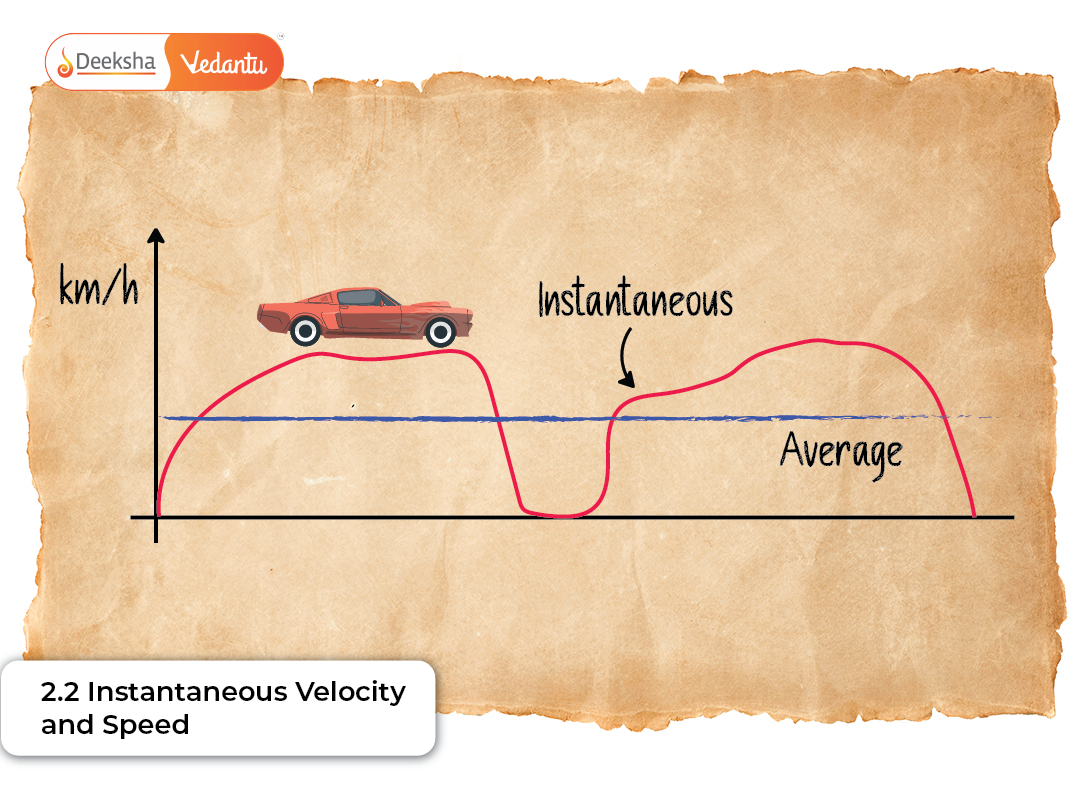
In real motion-cars accelerating, objects falling, rockets taking off-velocity rarely stays constant. Hence instantaneous values provide a far richer understanding.
Formula
Instantaneous velocity is mathematically defined as:
v = ds/dt
This means:
- Take displacement (s)
- Observe how it changes with time (t)
- Compute its derivative
This derivative gives velocity at that exact time. Because of this, instantaneous velocity is considered the slope of the displacement–time graph at a point.
What Is Instantaneous Speed?
Instantaneous speed is the magnitude of instantaneous velocity-it ignores direction and focuses only on “how fast” an object is moving at one instant.
Key Points
- Instantaneous speed is always positive.
- If only magnitude is required → use instantaneous speed.
- If magnitude + direction are required → use instantaneous velocity.
A simple example: the number shown on a car’s speedometer is instantaneous speed. If the same value is given with direction, such as +20 m/s or –20 m/s along a straight line, it becomes instantaneous velocity.
Graphical Interpretation
Graphs offer one of the most intuitive ways to understand instantaneous quantities. Many competitive exam questions directly test graphical interpretations.
1. Displacement–Time Graph
- Instantaneous velocity is represented by the slope of the tangent drawn at a point.
- A steeper tangent indicates higher velocity.
- A horizontal tangent indicates zero instantaneous velocity (momentarily at rest).
- A negative slope means the object is returning or moving in the opposite direction.
This visual understanding helps students solve challenging JEE questions involving curvature and slopes.
2. Velocity–Time Graph
- The height of the graph at any instant gives instantaneous velocity.
- A sudden jump in the graph indicates an abrupt change in velocity.
- The area under the curve over any interval provides displacement.
These interpretations become critical when dealing with non‑uniform motion.
Conceptual Insights for Students
To deepen understanding, we emphasise the following:
- Instantaneous quantities reveal “real‑time” behaviour of motion.
- Rates of change (derivatives) help describe continuously changing motion.
- Graph slopes are powerful tools for identifying instantaneous velocity.
- Many JEE/NEET questions blend calculus + graphs, making this topic essential.
At Deeksha Vedantu, we build these skills gradually-starting from physical intuition, then adding mathematical precision.
Worked Example
A particle’s displacement is given by:
s(t) = 4t² + 2t
Find instantaneous velocity at t = 3 s.
Solution
- Differentiate displacement:
- Substitute t = 3:
Thus, at 3 seconds, the object is moving with a velocity of 26 m/s at that exact instant.
Why This Matters
Students often try to calculate instantaneous values using average formulas. But only derivatives give precise instantaneous behaviour. Solving problems like these strengthens their foundational calculus skills.
Why Students Must Master This Concept
Mastery of instantaneous velocity and speed is essential because:
- Competitive exams test real‑time changes in motion.
- Many kinematics questions involve rates and slopes.
- The ideas extend into higher physics-dynamics, electromagnetism, waves.
- Without understanding instantaneous motion, students struggle with acceleration and force analysis.
At Deeksha Vedantu, our worksheets, concept videos, and guided practice ensure that students learn these ideas thoroughly and visually.
Practice Questions with Detailed Solutions
Below are mixed‑level questions designed for JEE, NEET, KCET and COMEDK with step‑by‑step solutions.
Q1. A particle’s position is x(t) = 5t³ − 3t² + 2t. Find instantaneous velocity at t = 2 s.
Solution:
- v = dx/dt = 15t² − 6t + 2
- At t = 2:
- v = 15(4) − 6(2) + 2 = 60 − 12 + 2 = 50 m/s
Q2. A velocity–time graph shows a line rising uniformly from 2 m/s to 10 m/s in 4 s. What is the instantaneous velocity at t = 3 s?
Solution:
- Acceleration = (10 − 2)/4 = 2 m/s²
- At t = 3:
- v = initial velocity + at = 2 + 2×3 = 8 m/s
Q3. A displacement–time graph has a horizontal tangent at t = 5 s. What does this indicate?
Solution:
- A horizontal tangent → slope = 0
- Therefore, instantaneous velocity = 0 m/s.
Q4. If v(t) = 6t² + 4t, find instantaneous acceleration at t = 1 s.
Solution:
- a = dv/dt = 12t + 4
- At t = 1:
Q5. A particle moves so that x(t) = t² + 3t. Find velocity and speed at t = 4 s.
Solution:
- v = dx/dt = 2t + 3 = 2×4 + 3 = 11 m/s
- Instantaneous speed = magnitude of velocity = 11 m/s
FAQs
Q1. What is the simplest way to understand instantaneous velocity?
Think of it as the speed of the object right now. It is the slope of the displacement–time graph at that exact instant.
Q2. How is instantaneous speed different from instantaneous velocity?
Instantaneous speed is always positive-it ignores direction. Instantaneous velocity includes direction.
Q3. Do we always use derivatives to find instantaneous velocity?
Yes. When displacement is a function of time, only differentiation provides an accurate instantaneous value.
Q4. Why do competitive exams use graphs to test instantaneous velocity?
Graphs test conceptual clarity. They reveal whether students truly understand slopes and instantaneous behaviour.
Q5. How does Deeksha Vedantu help students master this topic?
We teach graph interpretation, slope intuition, derivative shortcuts, and problem‑solving strategies through structured lessons and practice.
Conclusion
Instantaneous velocity and speed allow us to study motion with fine detail and accuracy. These concepts connect intuition with calculus, making them essential for advanced physics in Class 11 and beyond. At Deeksha Vedantu, we ensure students build conceptual strength, mathematical fluency, and exam‑oriented confidence through guided learning and curated practice sets. When mastered well, these ideas open the door to smoothly understanding acceleration, dynamics, and real‑world motion analysis.
Related Topics
[latest_pages_by_parent parent_id="65759" number="10"]
[latest_pages_by_parent parent_id="66155" number="10"]
[latest_pages_by_parent parent_id="66211" number="10"]
[latest_pages_by_parent parent_id="66213" number="10"]
Join Deeksha Vedantu
> PU + Competitive Exam CoachingPreferred Choice For Toppers25+ Years of Academic Excellence70k+ Success Stories
Head Office
Ace Creative Learning Pvt Ltd
Deeksha House,
163/B, 6th Main, 3rd Cross,
JP Nagar 3rd Phase, Bengaluru,
Karnataka – 560078






Get Social