
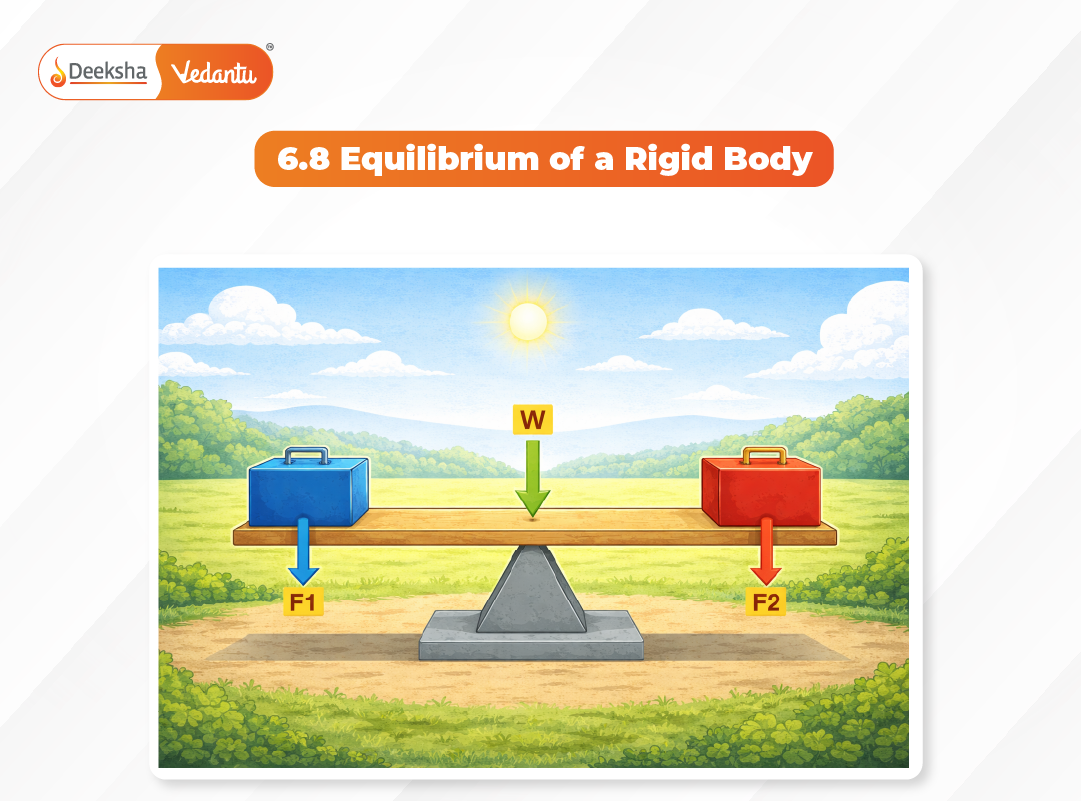


After studying torque and angular momentum, we now explore the conditions under which a rigid body remains at rest or moves with constant velocity without rotating. This state is called equilibrium.
In translational motion, equilibrium simply means that the net force acting on a body is zero. However, for a rigid body, we must consider both translational and rotational effects. Even if the net force is zero, the body may rotate if the net torque is non-zero. Therefore, equilibrium of a rigid body requires satisfying two independent conditions simultaneously.
This topic is extremely important for JEE Main and JEE Advanced because many problems involve beams, ladders, rods, pulleys, supports, hinges, friction, and extended bodies under multiple forces.
1. Meaning of a Rigid Body
A rigid body is an idealized body in which the distance between any two particles remains constant regardless of external forces applied.
In reality, all materials deform slightly. However, for most mechanical problems, the deformation is negligible, and we treat bodies as rigid. This assumption allows us to analyze rotational motion without considering internal structural changes.
Examples of rigid bodies in problems:
- Uniform rods
- Beams
- Discs
- Ladders
- Rectangular plates
2. Conditions for Equilibrium of a Rigid Body
For a rigid body to be in complete equilibrium, two independent conditions must be satisfied.
2.1 Translational Equilibrium
The net external force acting on the body must be zero:

From Newton's second law for a system:

If

Then

Thus, the centre of mass either remains at rest or moves with constant velocity.
In two dimensions, translational equilibrium implies:


These two scalar equations are used extensively in JEE problems.
2.2 Rotational Equilibrium
The net external torque about any point must be zero:

Using the rotational analogue of Newton's second law:

If
Then

Thus angular momentum remains constant. For a body initially at rest, angular momentum remains zero.
Rotational equilibrium ensures that angular acceleration is zero.
3. Combined Equilibrium Conditions
For a rigid body to remain completely at rest:
Both must hold simultaneously.
Important cases:
- If
 but
but  → Pure rotation occurs.
 - If but → Pure translation occurs.
 → Pure rotation occurs.
 → Pure translation occurs.
Thus equilibrium requires balance of both translation and rotation.
4. Choice of Axis in Torque Calculations
In equilibrium problems, torque can be calculated about any point. Since
holds for any axis, we strategically choose an axis that simplifies calculations.
Most powerful strategy:
Choose axis through unknown reaction forces so their torque becomes zero.
This eliminates unknowns from the torque equation and reduces algebraic complexity.
This method is heavily used in beam, hinge, and ladder problems in JEE.
5. Detailed Example: Uniform Rod Supported at Two Ends
Consider a uniform rod of length  and weight
  supported horizontally at its ends.
Let reactions at the ends be  and
and  .
.
Step 1: Translational Equilibrium

Step 2: Rotational Equilibrium
Taking torque about left end:

Solving:

Hence:

Thus reactions are equal due to symmetry.
6. Ladder Against a Wall (Advanced JEE Case)
Consider a ladder of length leaning against a smooth wall and rough floor.
For equilibrium:
- Horizontal forces must balance.
- Vertical forces must balance.
- Net torque about any point must be zero.
Let friction at floor be  and normal reaction be
  .
.
Translational equilibrium gives:
→ 
→ 
Taking torque about base eliminates and from the torque equation.
Such multi-step problems are common in JEE Advanced.
7. Types of Equilibrium and Stability Analysis
7.1 Stable Equilibrium
If slightly displaced, the body returns to its original position.
The centre of mass rises when displaced.
Potential energy increases for small displacement.
Mathematically:
Stable equilibrium corresponds to minimum potential energy.
7.2 Unstable Equilibrium
If slightly displaced, body moves further away.
The centre of mass lowers when displaced.
Potential energy decreases.
This corresponds to maximum potential energy.
7.3 Neutral Equilibrium
If displaced, the body remains in a new position.
The centre of mass remains at the same height.
Potential energy remains constant.
Example: Sphere on horizontal surface.
8. Stability and Centre of Mass
Stability depends strongly on the position of the centre of mass.
If the vertical line through the centre of mass lies within the base of support → Stable.
If it lies outside → Toppling occurs.
Lower centre of mass and wider base increase stability.
This explains the design of vehicles and buildings.
9. Equilibrium Under Three Forces
If a rigid body is in equilibrium under three non-parallel coplanar forces:
Their lines of action must intersect at a common point.
If forces are parallel:
Their algebraic sum must be zero and torques must balance.
This principle simplifies many geometry-based problems.
10. Advanced JEE Insights
- Always begin with a free body diagram.
- Resolve forces into components.
- Use
 and
and  .
. - Apply about the strategic axis.
- Check friction limits using
 .
. - Be careful with torque signs (clockwise negative or positive convention consistently).
 about the strategic axis.
 .
.Many high-level problems combine equilibrium with friction and geometry.
11. Practical Applications
Equilibrium principles govern:
- Bridge support systems
- Balancing cranes
- See-saws
- Hinged doors
- Structural beams
Civil and mechanical engineers extensively use these principles in structural analysis.
FAQs
Q1. What are the two conditions for equilibrium of a rigid body?
The conditions are and .
Q2. Why must torque be zero for equilibrium?
Because non-zero torque produces angular acceleration according to .
Q3. Can equilibrium exist if the centre of mass is moving?
Yes. If and , the body may move with constant velocity (dynamic equilibrium).
Q4. Why is axis choice important in torque calculations?
Because taking torque about a suitable point can eliminate unknown forces and simplify equations.
Q5. What determines the stability of a rigid body?
The relative position of the centre of mass with respect to the base of support determines whether the body is stable or unstable.
Conclusion
Equilibrium of a rigid body requires simultaneous balance of translational and rotational effects. The two fundamental conditions
and
ensure that the body neither accelerates linearly nor angularly.
A deep understanding of equilibrium principles, torque balance, and stability analysis is essential for mastering rotational mechanics and solving advanced JEE problems.



Get Social