


Acceleration is one of the most fundamental and insightful quantities in the study of motion. It allows us to describe how and how quickly an object’s velocity changes with time. Whether an object is speeding up, slowing down, or altering the direction of its velocity, acceleration provides a mathematical way to analyse this behaviour.
In this expanded section, we dive deeper into the concept of acceleration, its types, various interpretations, graphical tools, important insights, and practical applications. At Deeksha Vedantu, we make sure students build a deep understanding of acceleration so they can apply it effectively in board exams, JEE, NEET, KCET, and real-world physics scenarios.
What Is Acceleration?
Acceleration is defined as the rate at which the velocity of an object changes with respect to time. If velocity changes in magnitude, direction, or both, the object is said to be accelerating.
In simple terms:
- If an object speeds up → acceleration is positive.
- If an object slows down → acceleration is negative (retardation or deceleration).
- If velocity remains constant → acceleration is zero.
Since velocity is a vector, acceleration is also a vector quantity, meaning it has both magnitude and direction.
Mathematically,
Acceleration = Change in velocity / Time taken
This formula forms the basis of many numerical problems and conceptual insights in Class 11 Physics.
Acceleration helps answer questions like:
- How quickly does a car reach its top speed?
- Why does a ball thrown upward slow down until it stops momentarily?
- Why do roller coasters feel more intense during sharp turns or steep drops?
Understanding these phenomena becomes easier when students clearly grasp how acceleration works.
Average vs Instantaneous Acceleration
Acceleration can be described over an extended interval or at a specific moment, just like velocity.
Average Acceleration
Average acceleration tells us how much velocity has changed over a period of time. It is useful when the change is uniform or when we only need an overall idea of motion.
For example:
- A car speeds up from 20 m/s to 30 m/s in 5 seconds.
- A ball slows down from 15 m/s to 5 m/s over 2 seconds.
In such cases, average acceleration gives a general sense of how motion changes.
Instantaneous Acceleration
Instantaneous acceleration is far more detailed. It represents the acceleration of an object at a specific instant of time. In real-world motion, where velocity often changes continuously, this measure becomes important.
We obtain instantaneous acceleration through:
- Graphical interpretation (slope of v–t graph)
- Calculus (derivative of velocity with respect to time)
Instantaneous values appear frequently in competitive exam questions, making this concept essential.
Uniform and Non-Uniform Acceleration
Acceleration may or may not remain constant during motion.
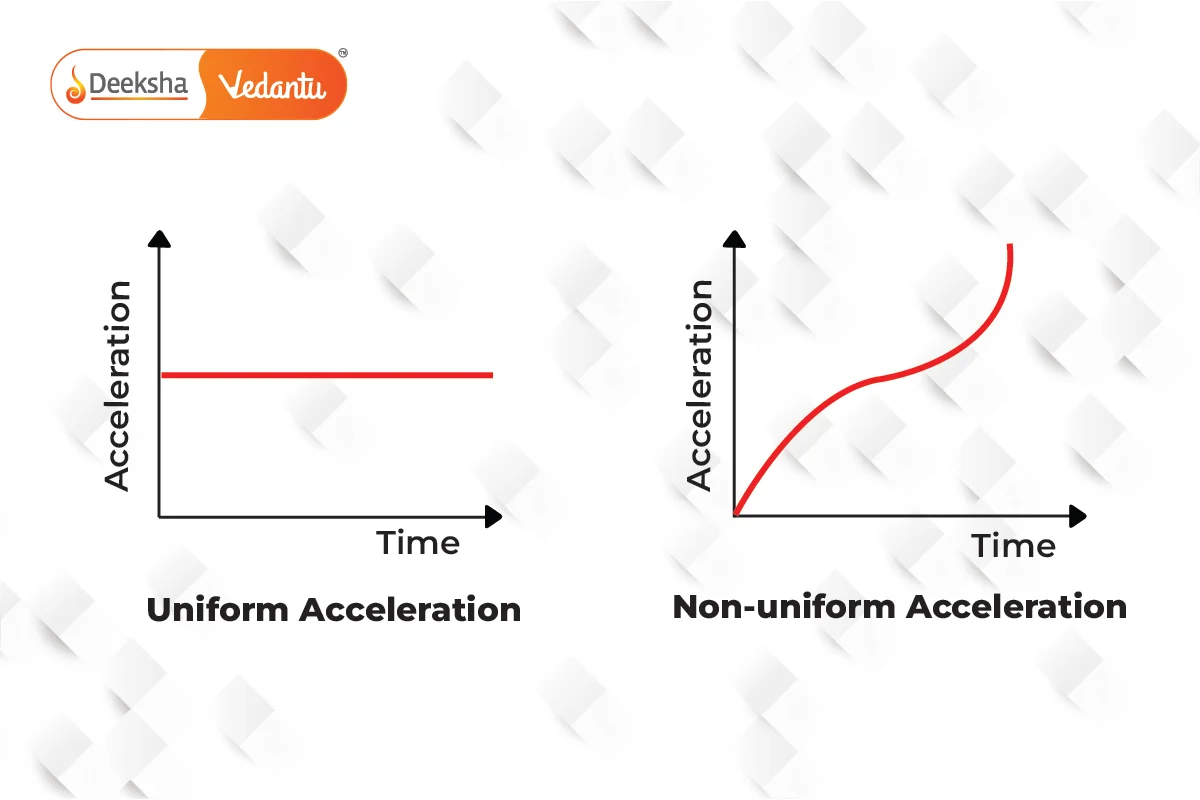
Uniform Acceleration
Here, the velocity changes at a constant rate. This simplifies calculations and allows us to use the kinematic equations.
Examples:
- A freely falling object near the Earth’s surface (g ≈ 9.8 m/s²)
- A vehicle that maintains constant acceleration while speeding up
- A ball rolling down a smooth incline
Uniform acceleration is the basis of many numerical problems in NCERT and competitive exams.
Non-Uniform Acceleration
When the rate of velocity change varies with time, acceleration is non-uniform.
Examples:
- A car driving through city traffic
- A child pedalling a bicycle with varying effort
- A roller coaster where acceleration spikes during steep drops and reduces during turns
Non-uniform acceleration requires deeper analysis, often involving calculus or detailed graph reading.
Graphical Interpretation of Acceleration
Graphs are powerful tools for understanding acceleration visually.
Velocity–Time (v–t) Graph
The slope of the v–t graph represents acceleration.
- A line sloping upward → positive acceleration
- A line sloping downward → negative acceleration
- A horizontal line → zero acceleration
- A curved graph → non-uniform acceleration
The area under the v–t graph represents displacement, making it extremely useful in problem-solving.
Position–Time (x–t) Graph
Although acceleration isn’t directly obtained from this graph, its shape reveals important clues.
- A concave-up curve suggests positive acceleration.
- A concave-down curve indicates negative acceleration.
- A straight line indicates zero acceleration.
Students often encounter conceptual questions where interpreting the curvature correctly becomes essential.
Acceleration–Time (a–t) Graph
This graph shows how acceleration changes over time.
- A horizontal line above the time axis indicates constant positive acceleration.
- A horizontal line below the time axis indicates constant negative acceleration.
- A varying curve indicates changing acceleration.
The area under the a–t graph gives the change in velocity.
Real-Life Examples of Acceleration
Acceleration appears all around us, sometimes subtly and sometimes dramatically.
- When a bike rider twists the throttle, the bike accelerates.
- When brakes are applied, the vehicle experiences negative acceleration.
- A ball thrown vertically upwards slows down until it reaches its highest point.
- An athlete sprinting from the starting block accelerates rapidly at first.
- Roller coasters create thrilling experiences through rapid acceleration changes.
At Deeksha Vedantu, these examples help students connect theoretical learning to real-world physics.
Factors Affecting Acceleration
Several factors influence how much an object accelerates:
- Force applied – Greater force leads to greater acceleration.
- Mass of the object – Heavier objects require more force to accelerate.
- Surface and friction – Rough surfaces resist acceleration.
- Air resistance – Affects motion of fast-moving or lightweight objects.
Understanding these helps students transition smoothly into Newton’s laws of motion.
Importance of Acceleration in Physics
Acceleration is central to the study of mechanics because it:
- Determines how and why motion changes
- Helps in deriving and applying kinematic equations
- Connects directly to Newton’s second law: F = ma
- Forms the basis of analysing circular motion, projectile motion, and oscillations
- Is widely tested in board exams, JEE, NEET, and KCET
Students who thoroughly understand acceleration find it easier to grasp complex physics concepts later.
Practice Question Set (JEE / NEET / KCET / COMEDK)
Q1. A car increases its velocity from 10 m/s to 25 m/s in 3 seconds. Calculate its acceleration.**
Solution: Acceleration = (Final velocity – Initial velocity) / Time = (25 – 10) / 3 = 15/3 = 5 m/s².
Q2. A ball is thrown vertically upward with an initial velocity of 20 m/s. What is its acceleration during the motion? (Take g = 9.8 m/s²)**
Solution: Acceleration during upward motion = –g = –9.8 m/s².
Q3. The velocity–time graph of a body shows a constant negative slope. What does this indicate about the motion?**
Solution: A constant negative slope in a v–t graph indicates uniform negative acceleration (retardation).
Q4. A bike moving at 12 m/s comes to rest in 4 seconds after braking. Find its acceleration.**
Solution: Acceleration = (0 – 12) / 4 = –12/4 = –3 m/s².
Q5. A particle moves such that its velocity changes according to v = 4t. Find its acceleration.**
Solution: Acceleration = dv/dt = derivative of 4t = 4 m/s².
Q6. A body starts from rest and attains a speed of 30 m/s in 6 seconds. Calculate (a) its acceleration and (b) distance traveled.**
Solution: (a) a = (30 – 0)/6 = 5 m/s². (b) s = ut + 1/2 at² = 0 + 1/2 × 5 × 36 = 90 m.
Q7. The acceleration–time graph of a particle is a horizontal line at 3 m/s² from t = 0 to 5 s. What is the change in velocity during this period?**
Solution: Change in velocity = area under a–t graph = a × t = 3 × 5 = 15 m/s.
Q8. A particle moving in a straight line has its velocity given by v = 6 – 2t. Determine when the particle momentarily comes to rest.**
Solution: Set v = 0 → 6 – 2t = 0 → t = 3 s.
Q9. A car travelling at 20 m/s slows down with a uniform acceleration of –2 m/s². How much time will it take to come to rest?**
Solution: 0 = 20 + (–2)t → t = 10 s.
Q10. A particle starts from rest and moves with uniform acceleration. If it travels 100 m in 5 seconds, find its acceleration.**
Solution: Use s = 1/2 at² → 100 = 1/2 a (25) → a = 8 m/s².
FAQs
Q1: What does acceleration measure?
Acceleration measures how quickly an object’s velocity changes with time.
Q2: Can acceleration be negative?
Yes. Negative acceleration, also called retardation or deceleration, occurs when the velocity decreases.
Q3: What is uniform acceleration?
Uniform acceleration occurs when velocity changes at a constant rate.
Q4: How can we find acceleration from a v–t graph?
Acceleration is the slope of the velocity–time graph.
Q5: How does Deeksha Vedantu help students understand acceleration?
We use diagrams, interactive examples, practice worksheets, and guided concept-building to help students master acceleration.
Conclusion
Acceleration plays an essential role in understanding motion. It helps describe whether an object is speeding up, slowing down, or changing direction. With the help of graphical tools, real-life examples, and mathematical analysis, students can develop a strong understanding of how acceleration works.
At Deeksha Vedantu, we focus on strengthening conceptual clarity and problem-solving skills so that students are fully prepared for board examinations and competitive exams. Mastering acceleration becomes the stepping stone to mastering the entire chapter of motion and the broader field of mechanics.



Get Social