
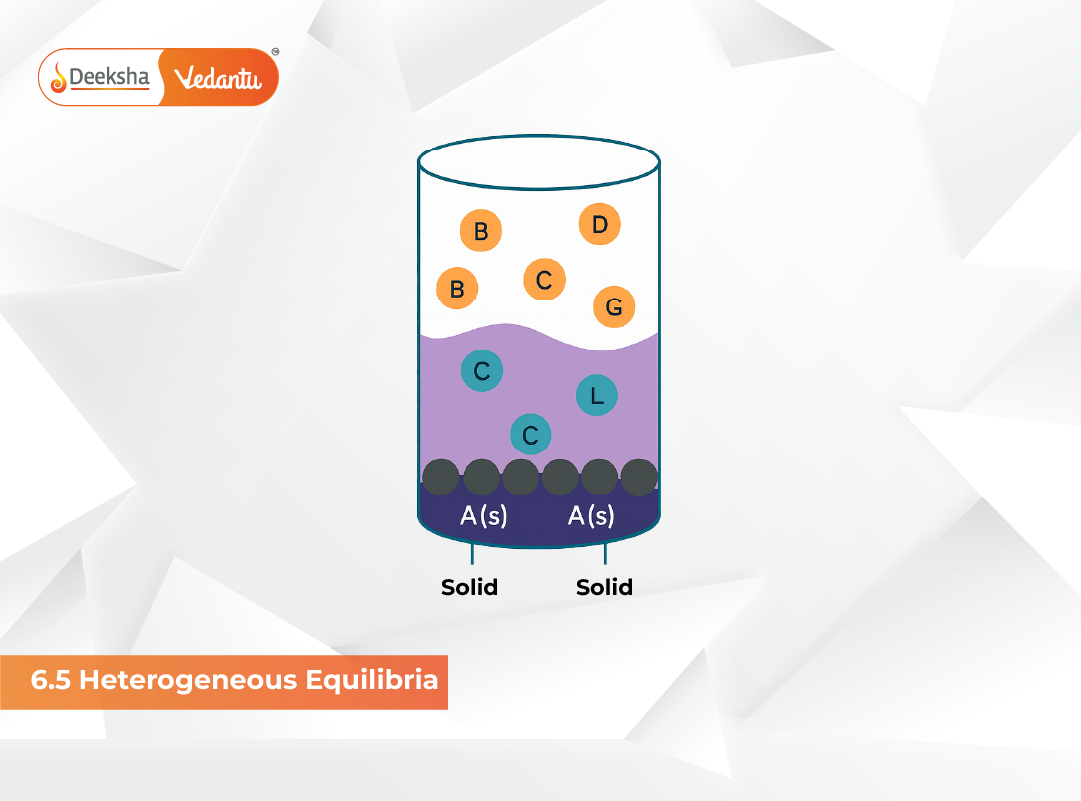


Equilibrium in a system having more than one phase is known as heterogeneous equilibrium. This occurs when the reactants and products are present in different physical states – for instance, a solid and a gas or a liquid and a gas.
A common example is the equilibrium between water vapor and liquid water in a closed container:
H₂O(l) ⇌ H₂O(g)
Here, there are two distinct phases: a liquid phase and a gas phase.
Another example involves the equilibrium between a solid and its saturated aqueous solution:
Ca(OH)₂(s) ⇌ Ca²⁺(aq) + 2OH⁻(aq)
This represents a heterogeneous equilibrium since both solid and aqueous phases coexist.
Characteristics of Heterogeneous Equilibria
Heterogeneous equilibria frequently involve pure solids or pure liquids in contact with gases or solutions. These systems are unique because the concentration of a pure solid or liquid remains constant – it is independent of the amount present. Therefore, when writing equilibrium expressions for such systems, we omit the concentration terms of pure solids or liquids.
For instance, if a pure substance X is involved, its concentration [X] remains constant, regardless of the quantity of X. Consequently, in equilibrium constant expressions, the terms for solids and pure liquids are excluded.
Example: Thermal Decomposition of Calcium Carbonate
Consider the decomposition of calcium carbonate:
CaCO₃(s) ⇌ CaO(s) + CO₂(g)
According to the stoichiometric equation, the equilibrium constant is expressed as:
Kc = [CaO][CO₂] / [CaCO₃]
Since [CaO] and [CaCO₃] are constants, the expression simplifies to:
Kc = [CO₂] or Kp = pCO₂
This implies that the equilibrium pressure or concentration of carbon dioxide depends only on temperature and not on the quantities of the solids.
Understanding Units of the Equilibrium Constant
The units of the equilibrium constant depend on the reaction type and how the concentrations or partial pressures are expressed.
- For gaseous equilibria using Kp, the units depend on the change in moles of gases (Δn).
- For concentration-based constants Kc, the units depend on the difference between moles of products and reactants in the balanced equation.
For example:
- H₂(g) + I₂(g) ⇌ 2HI(g)
Here, Δn = 0, hence Kc and Kp are both dimensionless. - N₂O₄(g) ⇌ 2NO₂(g)
Δn = 1, so Kp has units of pressure (e.g., bar or atm) and Kc has units of mol/L.
When Δn ≠ 0, the units of K depend directly on whether the expression is written in concentration or pressure form.
Experimental Evidence of Heterogeneous Equilibria
1. Calcium Carbonate Decomposition
At a specific temperature, the equilibrium pressure of CO₂ above a mixture of CaCO₃ and CaO remains constant. For example, at 1100 K, the equilibrium pressure pCO₂ = 2.0 × 10⁴ Pa, leading to:
Kp = pCO₂ = 2.0 × 10⁴ Pa = 2.00 bar
This demonstrates that the equilibrium constant for this heterogeneous system depends solely on temperature.
2. Nickel and Nickel Carbonyl Equilibrium
Another example involves the formation of nickel carbonyl:
Ni(s) + 4CO(g) ⇌ Ni(CO)₄(g)
For this equilibrium, the expression is:
Kp = [Ni(CO)₄] / [CO]⁴
Here, the concentration of solid nickel is constant and is omitted from the equilibrium expression.
Problem 6.6
For the reaction:
CO(g) + C(s) ⇌ 2CO(g)
Given that the total equilibrium pressure at 1100 K is 0.48 bar, calculate the equilibrium partial pressures and the value of Kp.
Solution
At equilibrium:
pCO₂ = (0.48 − x) bar
pCO = 2x bar
Substituting into the expression for Kp:
Kp = (pCO)² / pCO₂
Kp = (2x)² / (0.48 − x) = 3
Expanding:
4x² = 3(0.48 − x)
4x² + 3x − 1.44 = 0
Using the quadratic formula:
x = [−b ± √(b² − 4ac)] / 2a
x = [−3 ± √(9 + 23.04)] / 8 = 0.33
At equilibrium:
pCO = 2x = 0.66 bar
pCO₂ = 0.48 − x = 0.15 bar
Hence, the equilibrium partial pressures are:
pCO = 0.66 bar, pCO₂ = 0.15 bar.
Important Notes
- The equilibrium constants Kp and Kc depend solely on temperature for a given reaction.
- For heterogeneous equilibria, solids and liquids are not included in the equilibrium expression.
- Only gaseous and aqueous species affect the equilibrium constant value.
NEET & JEE Key Points
- In heterogeneous equilibria, omit pure solids and liquids when writing equilibrium expressions.
- The decomposition of calcium carbonate is a key example often asked in exams.
- Understand that Kp = pCO₂ in CaCO₃ decomposition, a concept directly linked to thermodynamic equilibrium.
- Remember to use appropriate units when solving numerical problems.
FAQs
Q1. What is heterogeneous equilibrium?
It is the equilibrium that exists between reactants and products in different physical states, such as solid–gas or liquid–gas systems.
Q2. Why are solids and liquids not included in equilibrium expressions?
Because their concentrations remain constant, their effect on equilibrium is negligible.
Q3. What determines the value of Kp or Kc in heterogeneous equilibria?
The temperature alone determines the equilibrium constant value for a specific reaction.
Q4. Give one common example of heterogeneous equilibrium.
The decomposition of calcium carbonate: CaCO₃(s) ⇌ CaO(s) + CO₂(g).
Q5. What are the equilibrium partial pressures in the reaction CO(g) + C(s) ⇌ 2CO(g)?
At 1100 K, pCO = 0.66 bar and pCO₂ = 0.15 bar.
Conclusion
Heterogeneous equilibria illustrate how chemical equilibrium operates across multiple phases. These systems help us understand thermodynamic stability and reaction feasibility under varied conditions. Mastering these concepts, especially their mathematical expressions and simplifications, is essential for NEET and JEE aspirants to solve equilibrium problems with confidence.



Get Social