
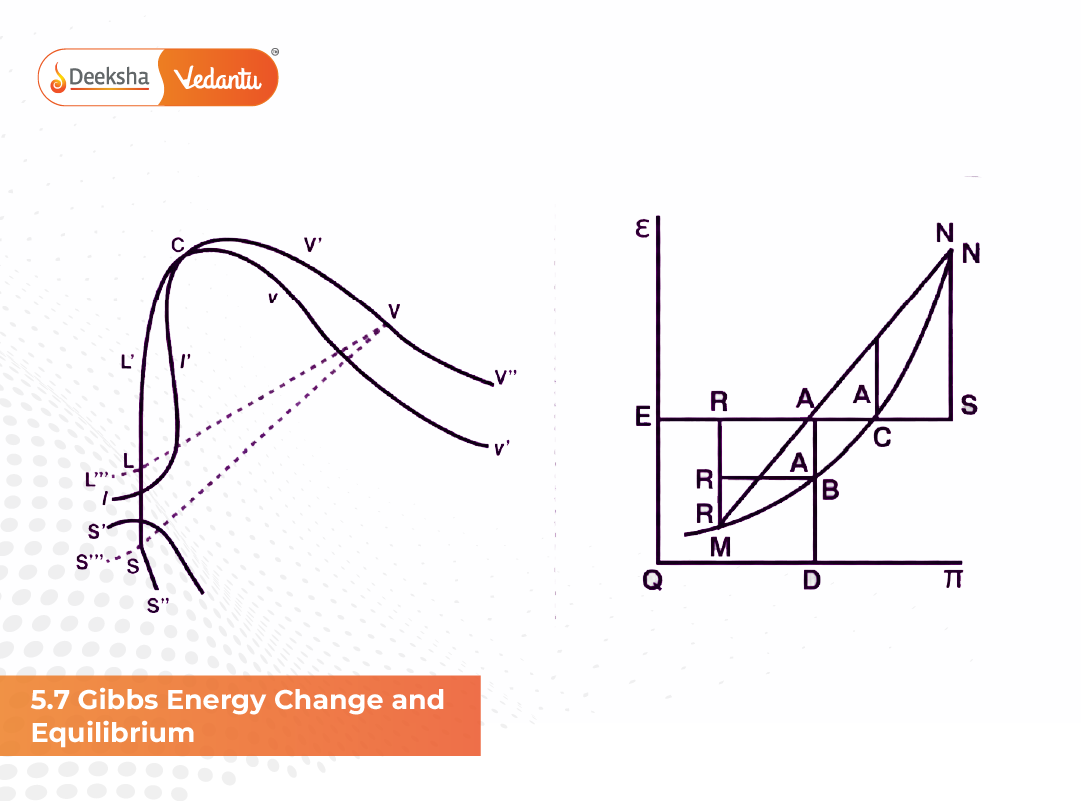


The relationship between Gibbs free energy (ΔG) and chemical equilibrium provides deep insights into the feasibility and direction of chemical reactions. By understanding how Gibbs energy changes with reaction progress, we can predict both spontaneity and equilibrium constants under different conditions.
Concept of Gibbs Energy and Equilibrium
The change in Gibbs energy during a chemical reaction helps determine whether a process will proceed spontaneously, reach equilibrium, or be non-spontaneous. In reversible reactions, Gibbs free energy plays a central role in defining equilibrium conditions.
Gibbs Energy for a Reaction
For a general reaction:
A + B ⇌ C + D
ΔG = ΔG° + RT ln Q
Where:
- ΔG° = standard Gibbs free energy change,
- R = gas constant (8.314 J mol⁻¹ K⁻¹),
- T = temperature (in Kelvin),
- Q = reaction quotient.
At equilibrium, ΔG = 0 and Q = K (equilibrium constant). Therefore,
ΔG° = –RT ln K
or equivalently,
ΔG° = –2.303 RT log K
This equation links Gibbs free energy directly to the equilibrium constant, a key thermodynamic parameter.
Relationship Between Gibbs Energy, Enthalpy, and Entropy
According to the Gibbs equation:
ΔG° = ΔH° – TΔS°
This relationship shows that both enthalpy (ΔH°) and entropy (ΔS°) influence Gibbs free energy. The balance between these two terms determines the spontaneity and equilibrium position of a reaction.
- For endothermic reactions (ΔH° > 0), spontaneity increases with temperature if ΔS° is positive.
- For exothermic reactions (ΔH° < 0), spontaneity decreases at high temperatures if ΔS° is negative.
Effect of Temperature on Spontaneity
The table below summarizes the combined effect of enthalpy and entropy changes on spontaneity and temperature dependence:
| ΔH° | ΔS° | ΔG° | Description |
| – | + | – | Reaction spontaneous at all temperatures |
| – | – | + (at high T), – (at low T) | Reaction spontaneous at low temperature |
| + | + | – (at high T), + (at low T) | Reaction spontaneous at high temperature |
| + | – | + | Reaction non-spontaneous at all temperatures |
Thus, temperature can shift reactions between spontaneous and non-spontaneous states depending on the signs of ΔH° and ΔS°.
Gibbs Energy and Equilibrium Constant (ΔG° and K)
The equilibrium constant (K) for a reaction is related to the standard Gibbs free energy change by:
ΔG° = –RT ln K
This relationship implies:
- If ΔG° < 0 → K > 1 → Reaction favors products.
- If ΔG° > 0 → K < 1 → Reaction favors reactants.
- If ΔG° = 0 → K = 1 → System at equilibrium.
Hence, the Gibbs energy change gives a direct thermodynamic measure of the equilibrium position.
Example:
For the reaction
2NH₃(g) ⇌ N₂(g) + 3H₂(g)
If ΔG° = +33.0 kJ mol⁻¹ at 298 K, the reaction is non-spontaneous under standard conditions, and K < 1.
Numerical Applications of Gibbs Energy and Equilibrium
Example 1 (From NCERT Problem 5.12)
Calculate ΔG° for conversion of oxygen to ozone, 3/2 O₂(g) → O₃(g), at 298 K. Given Kₚ = 2.47 × 10⁻²⁹.
Solution:
ΔG° = –2.303 RT log Kₚ
= –2.303 × (8.314 J mol⁻¹ K⁻¹) × (298 K) × log(2.47 × 10⁻²⁹)
ΔG° = +163,000 J mol⁻¹ = +163 kJ mol⁻¹
Hence, the process is non-spontaneous since ΔG° > 0.
Example 2 (From NCERT Problem 5.13)
Find the value of K for the reaction:
2NH₃(aq) + CO₂(aq) ⇌ NH₂CONH₂(aq) + H₂O(l)
Given: ΔG° = –13.6 kJ mol⁻¹
Solution:
log K = –ΔG° / (2.303 RT)
= 13,600 / (2.303 × 8.314 × 298)
= 2.38
K = antilog(2.38) = 2.4 × 10²
Hence, the reaction is spontaneous with a significant equilibrium constant.
Example 3 (From NCERT Problem 5.14)
At 60°C, N₂O₄(g) ⇌ 2NO₂(g)
If N₂O₄ is 50% dissociated, determine ΔG°.
Given: Kₚ = 1.33 atm.
ΔG° = –RT ln Kₚ
= –(8.314 J mol⁻¹ K⁻¹)(333 K) ln(1.33)
= –763.8 J mol⁻¹ = –0.76 kJ mol⁻¹
Thus, ΔG° is negative, indicating the reaction proceeds spontaneously at 60°C.
Determining ΔG° Experimentally
The standard Gibbs energy change can be experimentally determined in two ways:
- From equilibrium constant (K): Using the relation ΔG° = –RT ln K.
- From ΔH° and ΔS° data: Using ΔG° = ΔH° – TΔS°.
If ΔH° and ΔS° are measured at one temperature, ΔG° can be estimated for any other temperature.
Key Points Summary
- ΔG = 0 indicates equilibrium.
- Negative ΔG implies a spontaneous process.
- Gibbs energy links thermodynamics with chemical equilibrium.
- Both ΔH° and ΔS° determine temperature-dependent spontaneity.
- The equilibrium constant K exponentially depends on –ΔG°/RT.
FAQs
Q1. What does ΔG° = 0 signify?
It signifies that the system is at equilibrium and no net reaction occurs.
Q2. How is Gibbs energy related to equilibrium constant?
They are related by the equation ΔG° = –RT ln K.
Q3. Can a reaction with positive ΔH° still be spontaneous?
Yes, if ΔS° is positive and T is sufficiently high such that TΔS° > ΔH°.
Q4. What happens to ΔG° with temperature change?
For reactions with positive ΔS°, increasing temperature decreases ΔG°, enhancing spontaneity.
Q5. Why is Gibbs energy important in chemistry?
It predicts reaction feasibility, direction, and equilibrium composition — essential for industrial and biological processes.
Conclusion
The concept of Gibbs free energy change bridges thermodynamics and equilibrium. It provides a quantitative link between energy, entropy, and the equilibrium constant, allowing chemists to predict reaction direction and extent. Mastery of ΔG°, ΔH°, and ΔS° relationships equips students to solve advanced NEET and JEE thermodynamics problems confidently.



Get Social