
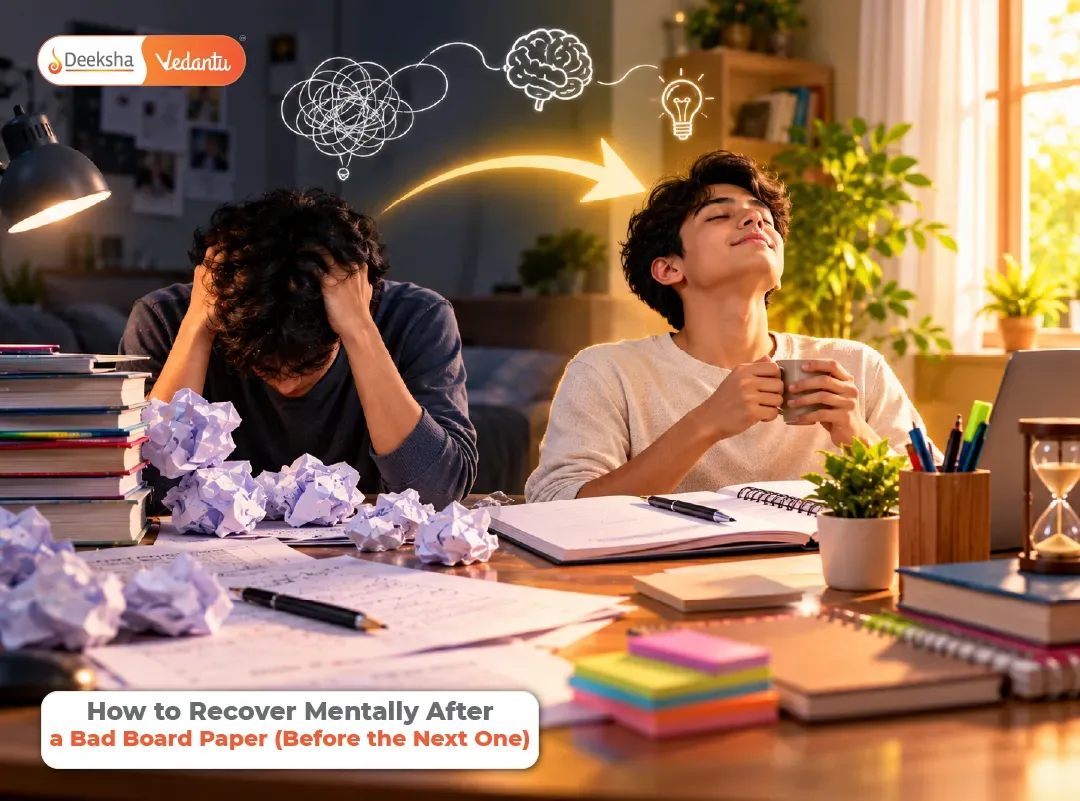
You walk out of the hall and you know it did not go well. Perhaps you blanked on a question you knew, ran out of time, or misread a section. The next paper is in a day or two, and your mind keeps replaying the last three hours. This is a very common experience in board season, and it is also a moment where what you do next can matter more than the paper you just wrote.
This guide explains what to do after a bad paper so that the damage stays inside that one paper. It is written for students, and also for parents who want to help. It is general advice on study habits and stress, not medical advice. If you feel overwhelmed for days, or find it hard to eat, sleep or function, please talk to a trusted adult, a school counsellor or a doctor.
First, Understand What a Bad Paper Really Is
Students usually judge a paper within minutes of leaving the hall, and that judgement is unreliable. A few reasons:
- Memory focuses on the misses. You remember the three questions you struggled with and forget the twenty you answered well.
- You are comparing with friends. Hearing someone else’s answer to a question makes your own answer feel wrong, even when it may be right or may earn partial marks.
- Marks are not all-or-nothing. A question you think you failed may still earn marks for the method, the formula or part of the answer.
- Papers are marked as a whole. One weak section can be balanced by strong ones elsewhere.
None of this means the paper went well. It means that your feeling right after the exam is a poor measure of your final marks. You will not know the real result for weeks, and the next paper cannot wait that long.
The First Hour: Stop the Replay
The urge to replay the paper is strongest right after it. Your goal in the first hour is to calm the body before you try to think.
- Leave the exam area quickly and avoid standing in a group dissecting the answers. Group post-mortems feed worry and rarely help.
- Eat and drink something, because tiredness and hunger make everything feel worse.
- Take a short walk or a few slow breaths. The aim is to bring your heart rate down.
- Say it plainly. “That paper was hard for me. It is over. I cannot change it.” Saying it, even silently, helps the mind accept it.
Avoid checking answer keys on the same day, if you can. Answer keys posted online can be wrong, can differ from the marking scheme and often arrive when you are least able to take the news calmly. Our article on the board exam mistakes that look like good habits lists comparing answers right after an exam as one of them.
The Next Few Hours: A Short, Structured Review
You can learn something from a bad paper without living in it. Give yourself a fixed, short window, such as fifteen to twenty minutes, to write down what happened. Then close the notebook.
Ask three questions and answer them in a line or two each:
- What went wrong? For example, time management, a topic I had not revised, nerves, or misreading questions.
- Is it fixable before the next paper? Some causes are, such as a time-management plan, and some are not, such as a chapter you cannot learn in a night.
- What will I do differently in the next paper? One or two concrete actions, such as reading all the questions first, or starting with the sure marks.
This turns a vague feeling of failure into a small plan. If the problem was time, our guide to time management tips for CBSE exams may help you plan the next paper, although the exam format has changed since it was written. Keep the review short, because the point is to move forward.
Protect Sleep and Routine
When a bad paper shakes you, the first thing to go is usually sleep. That is a problem, because tired students make more mistakes and feel more anxious.
- Keep a regular bedtime and wake time.
- Switch off screens and social media an hour before sleep, since this is where comparison and rumours live.
- Do something ordinary in the evening: a meal with family, a short walk, music.
- Avoid an all-nighter to make up for the lost paper. It rarely helps and often hurts.
A reasonable plan is to study less after a bad paper than you think you should, and to study better. Our piece on why six focused hours beat ten distracted ones explains why more hours do not always mean more marks.
Refocus on the Next Paper
Once you have calmed down and done your short review, turn your attention fully to the next subject.
- Make a short list for the next paper: the topics you will revise, in order of importance.
- Revise in short blocks with breaks, rather than one long session.
- Practise a little in exam form, such as one set of questions with a timer.
- Keep a one-page summary to read the morning of the exam.
If you have only a few days left, the triage approach in our guide on what to do when you have one week left can help you decide what to cover first.
What a Good Recovery Looks Like in Practice
Imagine a student who wrote a Maths paper badly on Monday and has Science on Wednesday. On Monday afternoon she eats, takes a short walk and spends twenty minutes writing down that she ran out of time in the last section and skipped checking. She decides to read the whole Science paper first and mark the sure questions. On Monday evening she revises two Science chapters in short blocks, packs her bag, and sleeps on time. On Tuesday she revises two more chapters and does one timed set of questions. On Wednesday morning she reads her one-page summary and goes in calm. Nothing here is dramatic, and that is the point. Recovery is mostly a set of small, ordinary steps repeated.
Thoughts That Make Things Worse, and What to Say Instead
Certain thoughts tend to grow after a bad paper. Here are a few, with calmer alternatives.
- “I have ruined everything.” A single paper is one part of a larger result. You still have other papers to write well.
- “Everyone else did better.” You do not know that. People rarely announce their own bad moments.
- “I should have studied more.” Maybe, but the paper is over. The useful question is what you can do now.
- “There is no point in studying for the next one.” The next paper is a fresh opportunity, and your effort there still counts fully.
If you notice these thoughts looping, try writing them down and answering them as you would answer a friend.
For Parents: How to Help
Parents can make a bad day better or worse with a few words.
- Listen first. Let your child describe the paper without interrupting or correcting.
- Avoid blame or comparison. Comments such as “your cousin did better” or “I told you to revise” add pressure when the next paper is close.
- Focus on the next step. Ask what would help tomorrow, such as food, quiet or a short walk.
- Keep the home calm. Ordinary routines are comforting.
- Watch for signs of serious distress, such as not eating or sleeping for days, withdrawal or talk of hopelessness. If you see these, seek professional help promptly.
Frequently Asked Questions
Q1. How Do I Stop Thinking About a Bad Paper?
Calm your body first with food, water and slow breathing, do a short written review, then give your attention to the next subject. A fixed review window helps stop endless replay.
Q2. Should I Check the Answer Key After the Exam?
It is usually better to wait until the exams are over. Answer keys can be unofficial or wrong, and checking them mid-season often raises anxiety without helping.
Q3. Can One Bad Paper Ruin My Result?
A single paper is only one part of the overall result, and the feeling of having done badly is often more pessimistic than the marks turn out to be.
Q4. How Much Should I Study After a Bad Paper?
Study in focused blocks for the next subject, protect your sleep, and avoid trying to make up for the lost paper with an all-nighter.
Q5. When Should I Ask for Help?
If you cannot eat, sleep or function for several days, or feel hopeless, speak to a trusted adult, a school counsellor or a doctor.
Conclusion
A bad paper feels huge in the hours after it, but its effect on the rest of the season depends mostly on what you do next. Calm your body, do a short written review, protect your sleep, and give your full attention to the next subject. Treat the paper that went badly as finished, and the one in front of you as unwritten. If the stress feels too heavy, reach out to someone you trust.



Get Social