
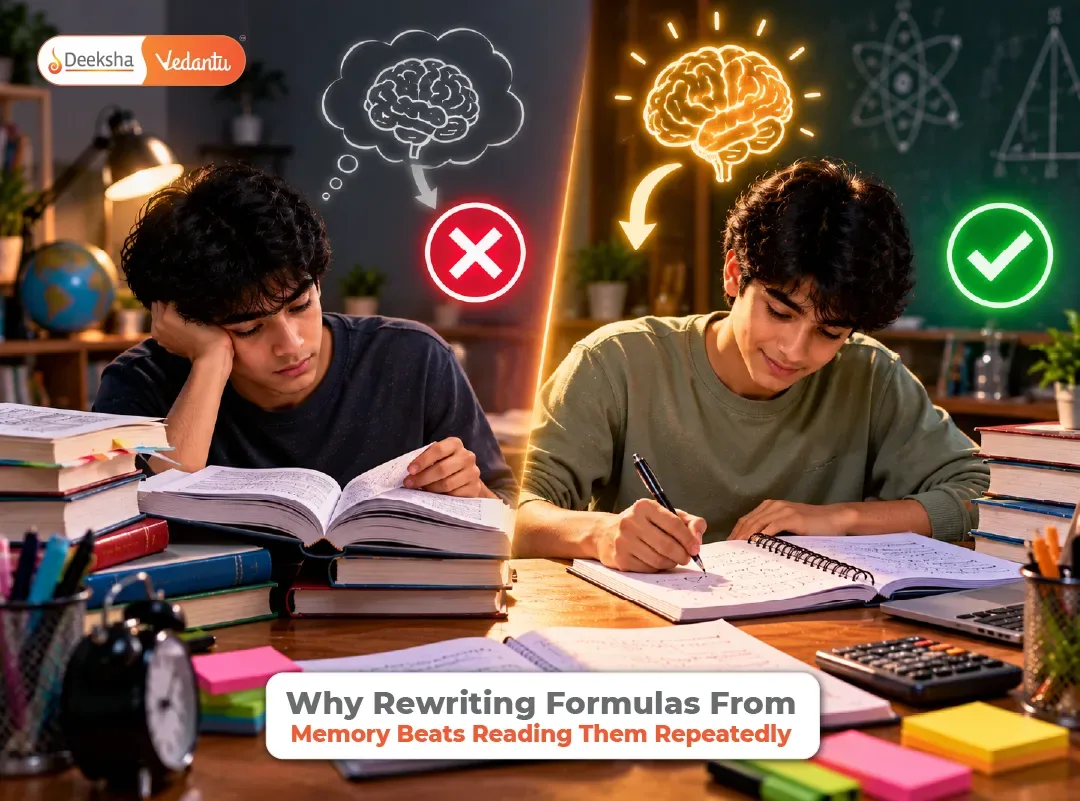
Many students prepare for a formula-heavy exam by reading their formula sheet again and again. It feels productive. The page looks familiar, the formulas seem obvious, and each pass is quick. Then, in the exam, a formula that looked easy on the sheet refuses to come to mind, or comes with a missing term or a wrong sign.
This guide explains why rewriting formulas from memory works better than reading them repeatedly, and how to turn that into a daily routine. If you are looking for how to memorize formulas for exams, the short answer is to stop treating memorizing as reading and start treating it as recall. The ideas here come from well-known findings about how memory works, summarised in plain language. They are general study advice that works for any subject with formulas.
The Illusion of Knowing
When you read a formula you have seen many times, your brain says “I know this”. That feeling is called familiarity, and it is not the same as being able to produce the formula yourself. Recognition is much easier than recall. In an exam, you do not recognise a formula from a list. You have to produce it from a blank page.
Rereading builds recognition. Rewriting from memory builds recall. That is the main reason the second method works better for exams, and why students who reread can feel confident at night and blank in the hall.
Why Retrieval Beats Rereading
Research on learning has repeatedly found that trying to retrieve information from memory strengthens it more than looking at it again. A few reasons help explain this in simple terms.
- Effort makes memory stick. The small struggle of trying to remember a formula is exactly what strengthens the memory. Reading removes the struggle, and so removes much of the benefit.
- Retrieval shows your gaps. When you try to write a formula and cannot, you find out right away what you do not know. Rereading hides gaps behind familiarity.
- Practice matches the exam. In the exam you will have to produce formulas from nothing. Practising that exact act trains the exact skill.
- Writing slows you down in a useful way. Writing makes you notice each term, sign and exponent, which are the details that cost marks.
None of this says that reading is useless. Reading is how you meet a formula for the first time. The point is that after the first meeting, recall practice should take over.
How to Rewrite Formulas From Memory
Here is a simple method you can start today.
- Pick a small set. Five to ten formulas from one chapter, not the whole book.
- Read them once, with the meaning of each symbol.
- Cover the sheet and write them on a blank page from memory.
- Check against the sheet. Mark each one right, nearly right or wrong. A missing term or wrong sign counts as wrong.
- Rewrite the wrong ones straight away, then try again from memory a few minutes later.
- Repeat the next day, and again after a few days.
For Maths, the Class 10 chapters that carry many formulas, such as Arithmetic Progressions, Trigonometry and Coordinate Geometry, are good places to start. Our Class 10 Maths notes and trigonometry notes let you check your answers quickly.
Add Meaning, Not Just Memory
A formula you understand is easier to recall than one you have only memorised as symbols. When you rewrite a formula, add a short note on what it means or where it comes from.
- Say what each symbol stands for. “n is the number of terms.”
- Note the units in Physics, such as ohm, volt or watt.
- Give one tiny example, such as the first three terms of an AP.
- Link related formulas. The two forms of the sum of an AP, for instance, give the same result when the last term is known.
This turns the page from a list of symbols into something you can reason about. If you forget a formula, understanding may let you rebuild it.
Use It Together With Practice Questions
Recall is only half the job. After you can write a formula, use it. After each rewriting session, solve two or three problems that need it. Our Class 10 Maths MCQs are a quick way to apply formulas, and previous-year Maths papers show how they appear in real questions.
When you get a question wrong, ask whether the problem was recall, application or arithmetic. If it was recall, rewrite the formula. If it was application, note when to use it. If it was arithmetic, practise the calculation.
A Worked Example With Arithmetic Progressions
Suppose you are learning the formulas of Arithmetic Progressions. You read the nth term, a plus (n minus 1) times d, and the sum of n terms, and they look easy. Now cover the page and write both. Many students find they write the sum formula with n over 2 correctly but forget the (n minus 1) in the bracket, or write d where a should be. That slip would have stayed hidden under rereading. After you fix it, add a note: the sum has two forms, one using the last term and one using the common difference. Then solve two problems, one asking for the 20th term and one asking for the sum of the first 15 terms. The formulas are now tied to a use, which is what makes them stay.
The same pattern works in Physics. Write Ohm’s law and its rearrangements, the formulas for resistances in series and parallel, and the power formula, each with units. Check, correct, and apply them in a short numerical.
A Simple Weekly Schedule
You do not need long sessions. Short, regular ones work better.
- Day 1: Learn and rewrite a small set of formulas.
- Day 2: Rewrite them from memory, then add a new set.
- Day 4: Rewrite the first set again, with the second set.
- Day 7: Rewrite everything from the week, and mark which ones still fail.
Ten to fifteen minutes a day is enough. The spacing matters: recalling after a gap, when you have partly forgotten, strengthens memory more than recalling again immediately. Our article on why six focused hours beat ten distracted ones makes a similar point about quality over quantity.
What to Do in the Last Week
In the last week before the exam, change how you use this method.
- Focus on the formulas you still get wrong. The ones you always get right can rest.
- Rewrite them in one sheet at the start of each day, from memory.
- Time yourself. Try to write your key formulas in a few minutes, as a final check.
- Put the sheet away the night before, after one last attempt.
If time is short, our guide on what to do with one week left can help you decide what to prioritise.
A final tip: keep your rewriting sheet in the same notebook every time, so you can see your own progress. Watching the list of wrong formulas shrink from week to week is motivating, and it tells you exactly when you are ready to move on to a new set.
Mistakes to Avoid
- Copying instead of recalling. If you write a formula while looking at it, you are copying. Cover the sheet first.
- Memorising too many at once. Large sets overwhelm you. Build up in small groups.
- Skipping the check. Without checking, you can rehearse a wrong formula and make it stick.
- Ignoring meaning. A formula with no meaning is fragile under stress.
- Doing it only the night before. Spaced practice over days works better than a single long session.
A Note on Rewriting Versus Other Methods
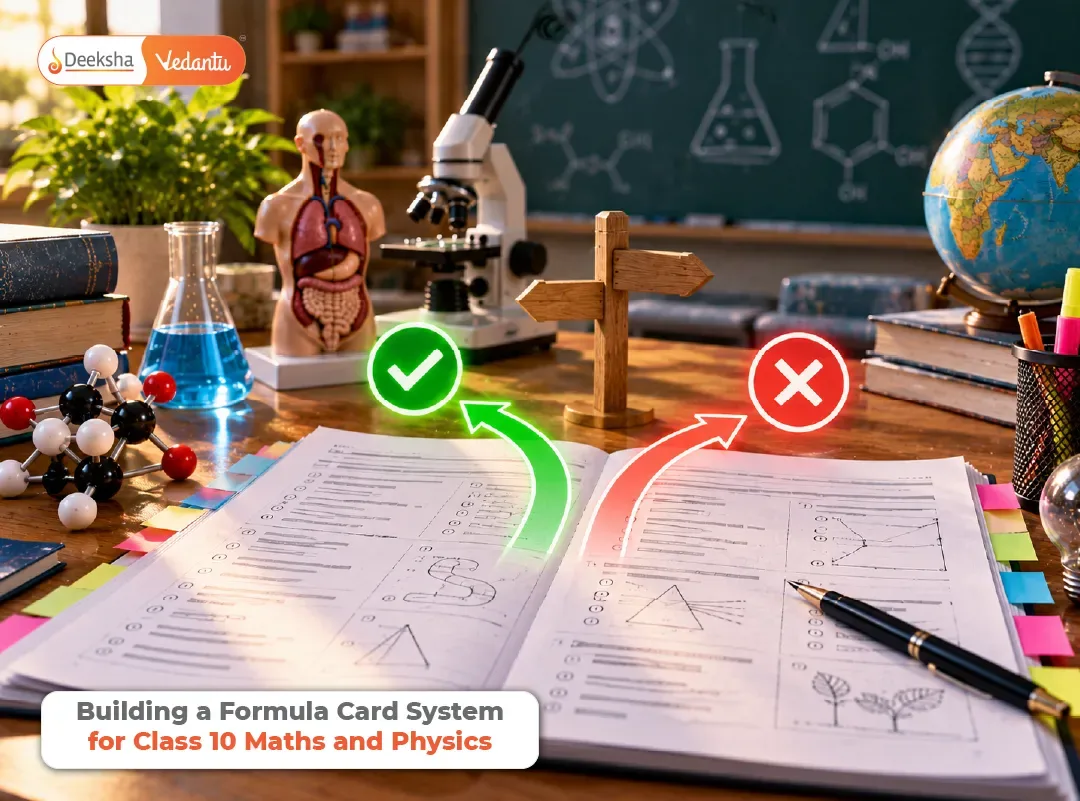
Rewriting is not the only way to practise recall. Flashcards, saying formulas aloud, and teaching a friend all use the same principle. Pick the one that fits you. What matters is that each method asks you to produce the formula before checking it. If you like cards, you can organise your set as a small card system.
Frequently Asked Questions
Q1. Why Is Rewriting Formulas Better Than Rereading?
Rewriting forces you to recall the formula, which strengthens memory and shows your gaps. Rereading builds familiarity, which can feel like knowing without being the same thing.
Q2. How Many Formulas Should I Practise at a Time?
A small set of five to ten, from one chapter. Build up gradually.
Q3. How Often Should I Rewrite Them?
Short sessions across several days work better than one long session. A simple pattern is day one, day two, day four and day seven.
Q4. Should I Understand the Formula as Well as Memorise It?
Yes. Understanding what each symbol means and when to use the formula makes it easier to recall and apply.
Q5. Can I Use This Method for Subjects Other Than Maths?
Yes. It works for Physics and Chemistry formulas, equations, definitions and dates.
Conclusion
Reading a formula sheet again and again feels safe, but it trains recognition, and the exam asks for recall. Rewrite your formulas from memory, check them honestly, repeat the wrong ones and space your practice across days. Add meaning to each formula and apply it to a few problems. A short daily routine, kept up for a few weeks, will do more for your marks than hours of rereading.








Get Social