
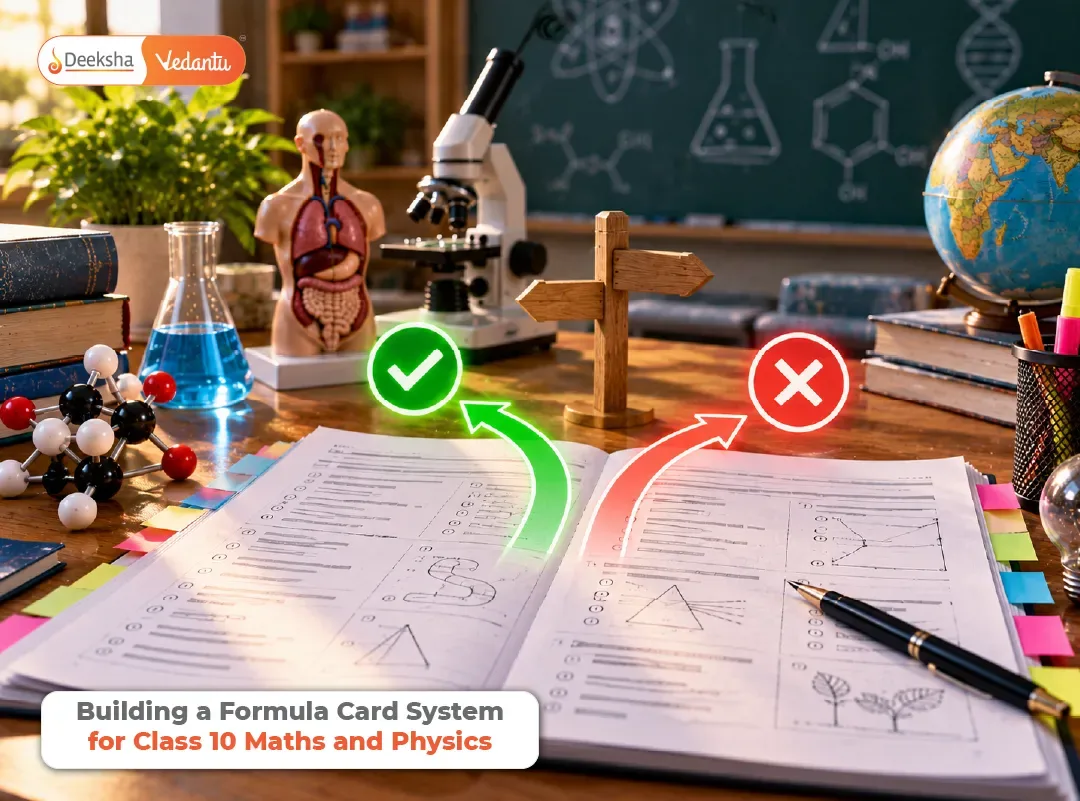
Formulae are the shortest route to marks in Class 10 Maths and Physics, and also the easiest to forget under pressure. Most students keep formulae in notes, a chapter-end list or a textbook box. That works for reading but not for recall. A formula card system turns passive reading into active practice, and it fits into small gaps in a busy day.
This guide shows how to build and use a card system for Class 10 Maths and Physics. If you are searching for class 10 maths formulas, the point here is less the list itself and more the method of making formulae stay in memory. Build your cards from the chapters in your textbook.
Why Cards Work Better Than a Long List
A long list of formulae feels productive to read, yet it hides two problems. First, you recognise the formula when you see it, which is different from recalling it when you do not. Second, a list gives no information on which formulae you know and which you do not.
Cards fix both. A card asks a question on one side and you answer from memory. You can then sort cards into “know” and “not yet”, and spend time only on the second pile. This is retrieval practice, and it is more effective for memory than re-reading.
What to Put on a Card
Keep each card to one idea. A good card has three parts.
- Front: A prompt, such as “Sum of first n terms of an AP” or “Relation between voltage, current and resistance.”
- Back: The formula, the meaning of each symbol, and the unit where relevant.
- Small note: One line on when to use it, or one common trap.
For example, for the formula for the nth term of an AP, the back could show the formula, say what a, d and n stand for, and add the note “n must be a positive whole number.” For the power formula in Physics, the back could show three equivalent forms and a note on units, such as watts and kilowatt-hours.
Avoid putting a full derivation on the card. Derivations belong in your notes. The card is for recall.
How to Organise the Cards
You have two options, and you can use both.
- By chapter. Good for the first pass, because it matches your textbook and revision plan. Use one colour of card or one rubber band per chapter.
- By type. Good for later, when you mix cards. Types might be: algebra identities, mensuration, coordinate geometry, trigonometric ratios, circuits, optics, and so on.
For Maths, the heavy chapters for formulae are usually Arithmetic Progressions, Quadratic Equations, Coordinate Geometry, Trigonometry, Surface Areas and Volumes, and Statistics. Our Class 10 Maths notes and the notes for trigonometry are a good source to check against while making cards.
For Physics, the cards typically come from Electricity, Light, and Magnetic Effects of Electric Current. Use the Class 10 Science notes to confirm what is in scope.
Building Your First Set in a Weekend
You do not need to make hundreds of cards. A realistic first set is 60 to 100 cards.
- Pick the chapters with the most formulae.
- Go through the textbook and your notes and write one card per formula or relation.
- Mark the ones you already know with a small tick so you do not spend time on them.
- Write cards by hand. The act of writing helps memory, and your handwriting is easier to recall than printed text.
- Add a “trap” line wherever you have lost marks before, such as a sign error or a missed unit.
If time is short, make cards only for formulae you cannot recall in 10 seconds. That is the smartest set for you.
How to Test Yourself
The system only works if you recall before you flip.
- The three-pile method. Draw a card, answer aloud or on paper, then flip. Put it in “know”, “unsure” or “no” piles.
- Review the “no” pile first, then “unsure”. Do not review the “know” pile every day.
- Shuffle between sessions so you do not learn by position.
- Write, don’t just think. For longer formulae, write from memory, then compare.
- Use spaced repetition. A simple schedule: review a new card the same day, then after a day, a few days later, then a week later. Cards you miss go back to the start.
Ten minutes in the morning and ten in the evening is enough to keep a set of 80 cards alive.
A Sample Card Set for One Chapter
To make this concrete, here is how Arithmetic Progressions might become four cards. Card one: the general form of an AP and the meaning of first term and common difference. Card two: the nth term, with a note that n is a positive whole number. Card three: the sum of the first n terms, written in both common forms, with a note on when each is easier (use the first form when the last term is known, the second when it is not). Card four: a trap card for the usual slip of using the wrong sign for the common difference when the terms are decreasing.
Four cards, five minutes to write, and the chapter’s core is covered. Repeat this for each chapter and your set builds itself without feeling like a project.
Link Formulae to Problems
Recall alone is not enough. A formula you can recite but cannot apply is only half learned. After each review session, solve two or three problems that use the cards you just practised.
- Use the Class 10 Maths MCQs for quick application.
- For longer practice, use sample papers and previous-year papers.
When you get a question wrong, check whether the cause was formula recall, formula application or arithmetic. Only the first needs a card change. If you used the right formula in the wrong place, add a “when to use” line to the card.
Physics Cards: Special Points
Physics formulae come with units and symbols, and many mistakes are about those, not the formula.
- Always write the unit on the back of the card.
- Group related formulae. For instance, one card for Ohm’s law and its rearrangements, another for series and parallel combinations.
- Add a sign convention note for the Light chapter, where distances are measured with signs. Your textbook’s convention should be on the card, so it is fixed in your mind.
- Add a tiny diagram where it helps, such as a circuit or a ray path.
Our guide on what not to study in the last 30 days explains how to decide what to leave out in the final month, which also applies to what goes on your cards.
One caution about shortcuts: do not copy a ready-made formula sheet and call it a system. A sheet someone else made shows you what they found hard, not what you do. Even if you start from a printed list, rewrite the cards that matter to you, and add your own trap lines. The effort of choosing and writing is part of the learning.
Using the Cards in the Last Weeks
In the final weeks, change how you use them.
- Carry the “no” and “unsure” piles only. The “know” pile can rest.
- Mix Maths and Physics cards to practise switching.
- The night before the exam, go through the “unsure” pile once, then stop. Sleep is more useful than a late extra pass.
- On exam day, if the board allows time to jot down formulae at the start, do it only if it is permitted and part of your own routine. Do not rely on this.
For a triage approach when time is short, see one week left: a triage plan.
Frequently Asked Questions
Q1. How Many Formula Cards Should I Make?
A first set of 60 to 100 cards is realistic. Focus on formulae you cannot recall quickly.
Q2. Should Cards Be Handwritten or Digital?
Handwritten cards help many students remember, but digital flashcards also work if you test yourself honestly before flipping.
Q3. Do I Need the Derivation on the Card?
No. Keep derivations in your notes. The card is for recall and a short note on use.
Q4. How Often Should I Review?
Ten minutes in the morning and evening is enough. Review cards you miss more often than cards you know.
Q5. Will the Same Formulae Be Needed in Every Board?
Yes, the method works for any board. Build the cards from the chapters in your own textbook.
Conclusion
A formula card system is simple: one idea per card, a prompt on the front, the formula, units and a trap note on the back, and a daily habit of testing yourself. Build a first set over a weekend, sort cards into piles, review the weak ones more often, and link every session to a few problems. Keep the system small enough that you actually use it.








Get Social