
The last hour before a board exam is not a study session. It is a preparation for performing, and the two are different. Students who treat it like one more revision round often arrive tired, anxious and mixing up facts they knew well the night before. Students who treat it as a short routine arrive steady.
This guide gives you a practical list of things to do before board exam day arrives and in the hour before you walk into the hall. Your admit card lists what you may carry into the exam hall, so read it the day before.
First, Decide What the Last Hour Is For
Before the checklist, one principle: the last hour has three jobs.
- Be ready: Everything you need is with you.
- Be calm: Your body and mind are settled.
- Be warmed up: You have done a little light recall so your memory feels active.
It does not have a fourth job of learning new content. Anything you do not know by now will not be learned in sixty minutes, and trying creates panic.
The Night Before: Do the Heavy Lifting Early
A calm last hour starts the evening before, because most of the checklist is easier when it is already done.
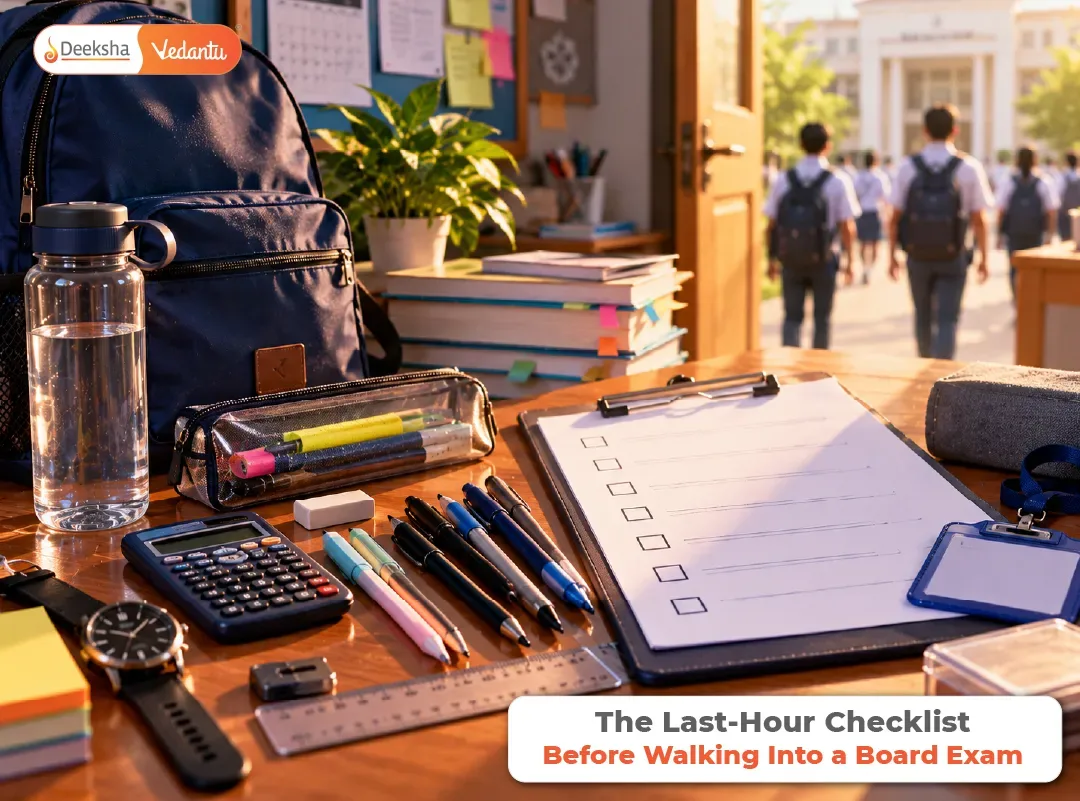
- Pack the bag. Admit card, pens, pencils, eraser, sharpener, ruler, geometry box if needed, water bottle and a simple wristwatch if watches are allowed. Carry only the items allowed for your exam.
- Keep spares. Two or three working pens of the same type, and a spare pencil.
- Lay out your clothes. Comfortable, simple, with no fuss. If the hall is likely to be cold or warm, a light layer helps.
- Check the route and the time. Know how you will reach the centre and how long it takes, with a margin for traffic.
- Sleep. A full night’s sleep helps your memory more than a late revision session.
If you have a few minutes at night, glance at your short notes or formula list. Our guide on the last 30 days and what not to study helps you decide what to leave alone.
The Morning of the Exam: The First Two Hours
By the time the last hour begins, a few things should already be in place.
- Wake up with enough time, so you are not rushing.
- Eat a light, familiar breakfast. Avoid trying new food on exam day. A heavy or oily meal can make you sleepy, and an empty stomach can make you distracted.
- Drink water, but not so much that you are uncomfortable in a three-hour paper.
- Do a short, light revision. Read your one-page summary, not the whole book.
The Checklist for the Final Hour
Here is a sequence you can follow, with approximate timings. Adjust it to your travel time.
60 to 45 minutes before: Check the essentials.
Open your bag one last time. Admit card, stationery, water, any permitted items. Put the admit card somewhere you can reach without opening the bag fully.
45 to 30 minutes before: Arrive and settle.
Reach the centre early. Find your room and seat number if displayed. Use the washroom. Take a moment to breathe slowly.
30 to 15 minutes before: Light recall only.
Look at a short sheet with the things you tend to forget: formulae, key dates, definitions, chemical equations. Read it once. If you notice you have forgotten something, note it and move on. Do not start a long chapter.
15 to 5 minutes before: Put the notes away.
This is the point where most students should stop reading. Last-minute reading raises anxiety, and anxious students recall less. Put your notes in the bag. If friends are comparing answers to possible questions, step away politely.
5 minutes before: Calm your body.
Take slow breaths: in for four counts, out for six, a few times. Relax your shoulders and unclench your hands. Remind yourself of your plan for the paper.
What to Revise Lightly, and What to Leave Alone
The question students ask most is what to read in the last half hour. The answer is: the small, high-recall items.
- Formulae and units, if the subject is Maths or Science.
- Chemical equations and symbols, if you tend to mix them up.
- Dates, names and definitions, for subjects such as Social Science.
- Your own list of past mistakes, such as a sign error or a missed unit.
What to leave alone:
- New topics you have never studied.
- Long chapters, which you cannot finish and which only increase worry.
- Other people’s predictions of what will come.
- Social media and group chats, which bring noise and rumours.
For a deeper look at the habits that feel useful but are not, see our article on board exam mistakes that look like good habits.
Subject-Specific Touches for the Last Hour
Different papers call for slightly different warm-ups. For Maths, glance at the formulae you tend to mix up, and remind yourself of your plan for the paper, such as solving the sure marks first. For Science, run through the diagrams you most often forget to label and the equations you must balance. For Social Science, look at a short list of dates, terms and map items. For languages, recall the format of a letter or notice and the common structure of a long answer. In every case the principle is the same: a very small set of items, read once, then put away.
It also helps to decide in advance what you will do if you blank out on a question. A simple plan is to skip it, move to the next one, and return later. Having this plan ready takes away much of the fear, because you know in advance what the response will be.
Your Plan for Entering the Hall
Once you are inside, a few steps help you start well.
- Check the question paper details. Confirm the subject, the code if applicable and the instructions on the first page.
- Fill in your details carefully. Roll number and other details are easy to get wrong in a hurry.
- Use the reading time. If the paper allows reading time before writing, use it to scan the sections and mark the questions you can answer fastest.
- Start with confidence. Begin with a question you know well. A good first answer sets your pace.
Read the instructions printed on your paper before you begin. For ideas on managing the three hours, see our guide on time management for the CBSE exam.
Managing Nerves in the Last Hour
Some nervousness is normal and can even help. The aim is not to remove it but to keep it from taking over.
- Name it. Saying to yourself, “I am nervous, and that is normal,” lowers the pressure.
- Move a little. A short walk or stretching releases tension.
- Keep conversations light. Talk about something other than the exam.
- Trust your preparation. You have studied for months. The last hour cannot add much, but it can subtract a lot if you let panic in.
If you only have a week left and want a plan, our guide on what to do when one week is left covers triage across subjects.
A Note for Parents
If you are a parent, the best help in the last hour is quiet reliability. Make sure the bag is packed and the transport is arranged. Offer a light breakfast. Avoid last-minute quizzes, comparisons or reminders of what is at stake. A calm, ordinary morning tells your child that things are under control.
Frequently Asked Questions
Q1. What Should I Do in the Last Hour Before a Board Exam?
Check your bag, reach the centre early, do a short, light recall of formulae or key facts, put your notes away about fifteen minutes before and calm your breathing.
Q2. Should I Study New Topics Just Before the Exam?
No. New topics rarely stick in an hour and can raise anxiety. Stick to small, familiar items.
Q3. What Should I Eat Before a Board Exam?
A light, familiar meal. Avoid heavy, oily or unfamiliar food.
Q4. What Can I Carry Into the Exam Hall?
Your admit card and your school’s instructions list the permitted items.
Q5. How Do I Calm My Nerves Before the Paper?
Slow breathing, a short walk, light conversation and a reminder that your preparation is done.
Conclusion
The last hour before a board exam works best as a routine: pack and check, arrive early, do a short, light recall, put the notes away and breathe. Prepare the practical items the night before so that the morning is calm, and keep your attention on starting the paper well. Let the last hour be about readiness, not cramming.





Get Social