
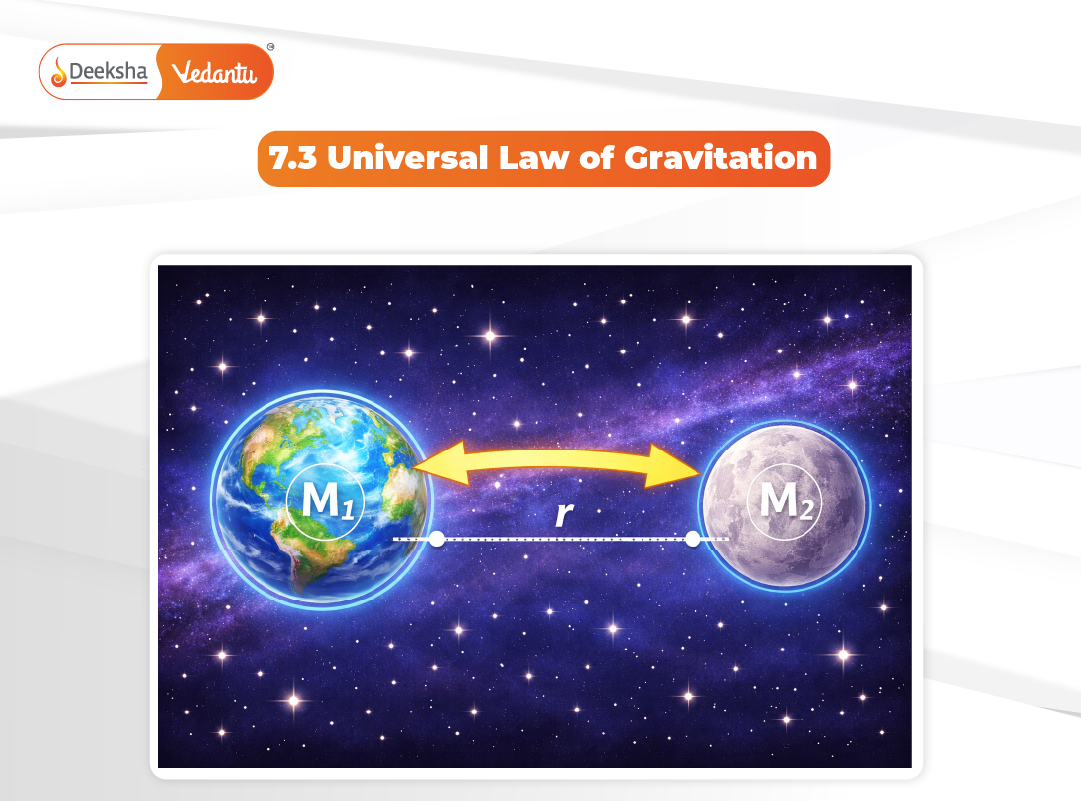


The Universal Law of Gravitation is one of the most profound discoveries in the history of science. With a single equation, Sir Isaac Newton unified terrestrial mechanics (falling objects) and celestial mechanics (planetary motion). The same force that pulls an apple toward Earth also governs the motion of the Moon, planets, stars, and galaxies.
Newton realized that gravity is not just an Earth-bound phenomenon but a universal interaction acting between every pair of masses in the universe. This bold generalization transformed physics and laid the foundation for classical mechanics.
In this section, we will develop the Universal Law of Gravitation in depth, explore its mathematical structure, examine its physical implications, and connect it to orbital motion and competitive exam applications.
1. Statement of Universal Law of Gravitation
Newton's law states:
Every two point masses in the universe attract each other with a force that is directly proportional to the product of their masses and inversely proportional to the square of the distance between them.
Mathematically,

Where:
 are the interacting masses
 is the separation between their centers
 is the universal gravitational constant
 are the interacting masses
This equation applies to point masses. For extended bodies, we treat them as collections of point masses and apply superposition.
Important observation:
- Force is proportional to mass product.
- Force decreases rapidly with distance.
- Force is always attractive.
2. Vector Form of Gravitational Force
Since gravitational force has direction, we express it in vector form.
Let  be the position vector from
  to
to  . Then the force on due to is:

The negative sign indicates that the force is attractive and directed toward .
By Newton's Third Law:

Thus gravitational interaction satisfies action–reaction symmetry.
This central-force nature means the force always acts along the line joining the two masses.
3. Why Inverse Square?
Gravitational force follows an inverse square dependence:

Physical reasoning:
If gravitational influence spreads uniformly in space, it spreads over the surface of an imaginary sphere centered at the source mass. The area of a sphere is:

As distance increases, the same influence spreads over a larger area, so intensity decreases as  .
.
Consequences:
If  ,
,

If  ,
,

This rapid decrease explains why gravitational attraction between small laboratory objects is extremely weak.
4. Gravitational Constant (G)
The proportionality constant in Newton's law is the universal gravitational constant:

It was measured by Henry Cavendish using a torsion balance experiment. The experiment effectively measured the tiny gravitational force between known masses.
Significance of measuring  :
:
Using

we can determine Earth's mass:

Thus Cavendish's experiment allowed scientists to "weigh the Earth."
5. Superposition Principle
Gravitational force obeys the principle of superposition.
If several masses act on a particle, the net force is the vector sum of individual forces:

Each force is calculated independently using Newton's law.
Example conceptual application:
If three equal masses are placed at vertices of an equilateral triangle, the net force at the centroid may cancel due to symmetry.
Superposition is crucial for solving JEE problems involving multiple masses, rings, rods, and spherical bodies.
6. Gravitational Field Concept
The gravitational field due to mass  at distance
  is defined as force per unit mass:

Thus,

Vector form:

This field representation simplifies many advanced problems.
7. Force Due to Spherical Mass Distribution (Shell Theorem Results)
Two extremely important results:
- A uniform spherical shell attracts an external particle as if its entire mass were concentrated at its center.
- Gravitational force inside a hollow spherical shell is zero.
Implications:
- Planets can be treated as point masses for external motion.
- No gravitational shielding exists.
- Inside a planet, only enclosed mass contributes.
For a solid sphere of uniform density, mass enclosed within radius is:

Thus inside the sphere:


Hence force is proportional to .
This explains why acceleration due to gravity decreases linearly inside Earth.
8. Connection with Circular Motion
Consider a planet of mass  orbiting a star of mass in circular orbit.
Gravitational force provides centripetal force:

Simplifying:

Time period:

This directly leads to Kepler's Third Law.
Thus the Universal Law of Gravitation naturally explains planetary motion.
9. Energy in Gravitational Interaction
Since gravity is conservative, we define potential energy:

Total mechanical energy:

For circular orbit:

Important relation:

Negative total energy indicates a bound system.
10. Comparison with Electrostatic Force
Gravitational force:
Electrostatic force:

Similarities:
- Both follow inverse-square law.
- Both are central forces.
Differences:
- Gravity is always attractive.
- Electrostatic force can be attractive or repulsive.
- Gravity is much weaker.
For example, electrostatic force between electron and proton is vastly stronger than gravitational attraction between them.
11. Advanced JEE Insights
- Central forces conserve angular momentum.
- Inverse-square law leads to elliptical orbits.
- Escape speed can be derived using energy conservation.
- Field inside the spherical shell is zero.
- Force inside a solid sphere varies linearly with radius.
Understanding proportional reasoning saves significant time in objective exams.
FAQs
Q1. Why is gravitational force always attractive?
Because mass is always positive and the force depends on the product of masses.
Q2. Why is gravitational force so weak compared to electric force?
Because the gravitational constant is extremely small.
Q3. Does gravitational force require a medium?
No. It acts through vacuum and has infinite range.
Q4. Why does gravitational force follow inverse square law?
Because gravitational influence spreads over a spherical surface whose area increases as  .
.
Q5. Is gravitational force conservative?
Yes. Work done depends only on initial and final positions, allowing potential energy to be defined.
Conclusion
Newton's Universal Law of Gravitation unifies terrestrial and celestial mechanics under one elegant inverse-square law. It explains falling bodies, planetary motion, satellite dynamics, and gravitational binding of massive systems.
The law's mathematical simplicity hides its profound power – from determining planetary orbits to calculating escape velocities and satellite periods. A deep conceptual understanding of this law is essential for mastering gravitational mechanic



Get Social