


Introduction
Newton’s First Law of Motion is the formal scientific principle that clearly defines the conditions under which a body remains at rest or continues to move uniformly. While earlier ideas introduced the concept of inertia as a natural resistance to change, Newton’s First Law provides a precise and testable physical statement that governs motion in the absence of unbalanced forces.
This law plays a crucial role in mechanics because it establishes the baseline condition of motion. Before analysing acceleration or force-induced changes, one must first determine whether the body is already in equilibrium. For JEE aspirants, Newton’s First Law is applied repeatedly in identifying equilibrium situations, analysing constrained motion, and simplifying complex systems. At Deeksha Vedantu, this law is emphasised as the starting checkpoint for every mechanics problem.
Statement of Newton’s First Law
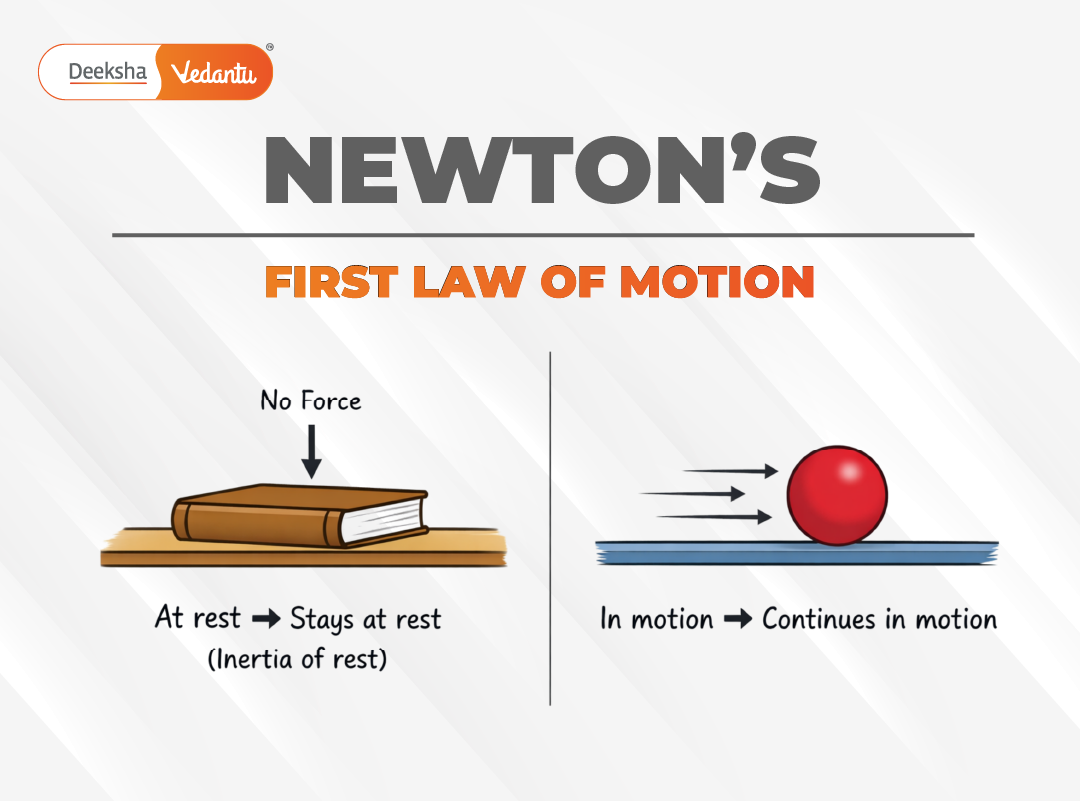
Newton’s First Law states that a body remains at rest or continues to move with uniform velocity in a straight line unless acted upon by a net external unbalanced force.
This statement highlights two fundamental ideas:
- Uniform motion does not require any force
- Only a net external force can change the state of motion
The law applies equally to bodies at rest and bodies moving with constant velocity, establishing a symmetry between rest and uniform motion.
Physical Meaning of the Law
The deeper meaning of Newton’s First Law is that motion is not self-terminating. Once a body is set into motion, it will continue indefinitely unless some external influence intervenes. Similarly, a body at rest will remain at rest unless compelled to move.
This idea directly contradicts intuitive everyday observations influenced by friction and resistance, making it essential for students to separate real-world conditions from ideal physical principles.
Meaning of Net External Force
The term net external force refers to the vector sum of all forces acting on a body from outside the chosen system.
- If the net external force acting on a body is zero, the body does not accelerate
- If the net external force is non-zero, the body’s velocity changes in magnitude, direction, or both
This concept is fundamental in mechanics and is the first condition checked while solving JEE problems involving motion and force analysis.
Newton’s First Law and Equilibrium
A body is said to be in equilibrium when the net external force acting on it is zero.
There are two types of equilibrium:
- Static equilibrium, where the body remains at rest
- Dynamic equilibrium, where the body moves with constant velocity
Newton’s First Law provides the necessary condition for both types of equilibrium and helps distinguish equilibrium situations from accelerated motion.
Inertial Frames of Reference
Newton’s First Law is strictly valid only in inertial frames of reference.
An inertial frame is a reference frame in which a body not subjected to any net external force moves with constant velocity. Such frames are either at rest or moving with uniform velocity relative to one another.
Examples of inertial frames include:
- A train moving in a straight line with constant speed
- A laboratory fixed to the Earth, which can be treated as approximately inertial for most problems
Understanding inertial frames is essential for correctly applying Newton’s laws in JEE-level questions.
Newton’s First Law vs Law of Inertia
The Law of Inertia describes inertia as a property of matter, while Newton’s First Law provides the physical rule governing motion.
- Inertia explains why bodies resist changes in motion
- Newton’s First Law explains when and under what conditions motion changes
Together, these ideas form the conceptual foundation of classical mechanics.
Real-Life Applications of Newton’s First Law
Newton’s First Law can be observed in numerous everyday situations:
- Passengers lurch forward when a moving vehicle stops suddenly due to inertia of motion
- Loose objects fall backward when a bus accelerates forward
- Seat belts protect passengers by opposing inertia during sudden braking
- Objects placed on the dashboard of a car slide forward when the car stops abruptly
These examples help connect abstract principles with observable experiences.
Importance of Newton’s First Law for JEE
Newton’s First Law is extremely important for JEE preparation because:
- It defines the condition of zero net force
- It helps identify equilibrium and non-equilibrium situations
- It forms the basis for drawing accurate free body diagrams
- It prepares students conceptually for Newton’s Second Law
At Deeksha Vedantu, students are trained to always check force balance before applying equations of motion, reducing errors in complex problems.
Common Conceptual Errors (JEE Perspective)
Students often make mistakes such as:
- Assuming a force is needed to maintain uniform motion
- Ignoring the concept of net force and focusing only on individual forces
- Applying Newton’s laws in accelerating or non-inertial frames without correction
Being aware of these errors helps students develop strong analytical skills.
FAQs
Q1. What does Newton’s First Law of Motion state?
It states that a body remains at rest or in uniform straight-line motion unless acted upon by a net external unbalanced force.
Q2. Is force required to keep an object moving with constant velocity?
No, force is required only to change the motion, not to maintain uniform motion.
Q3. What is meant by an inertial frame of reference?
It is a frame of reference in which Newton’s First Law holds true.
Q4. How is equilibrium explained using Newton’s First Law?
Equilibrium occurs when the net external force acting on a body is zero, resulting in rest or uniform motion.
Q5. Why is Newton’s First Law important for JEE preparation?
Because it forms the foundation for analysing force balance, equilibrium, and motion in mechanics problems.
Conclusion
Newton’s First Law of Motion establishes the most fundamental condition governing motion-whether motion changes or remains the same depends entirely on the presence or absence of a net external force. For JEE aspirants, mastering this law is essential for understanding equilibrium, force balance, and advanced mechanics topics. A structured and concept-driven approach, as emphasised at Deeksha Vedantu, ensures clarity, accuracy, and confidence in solving physics problems.



Get Social