
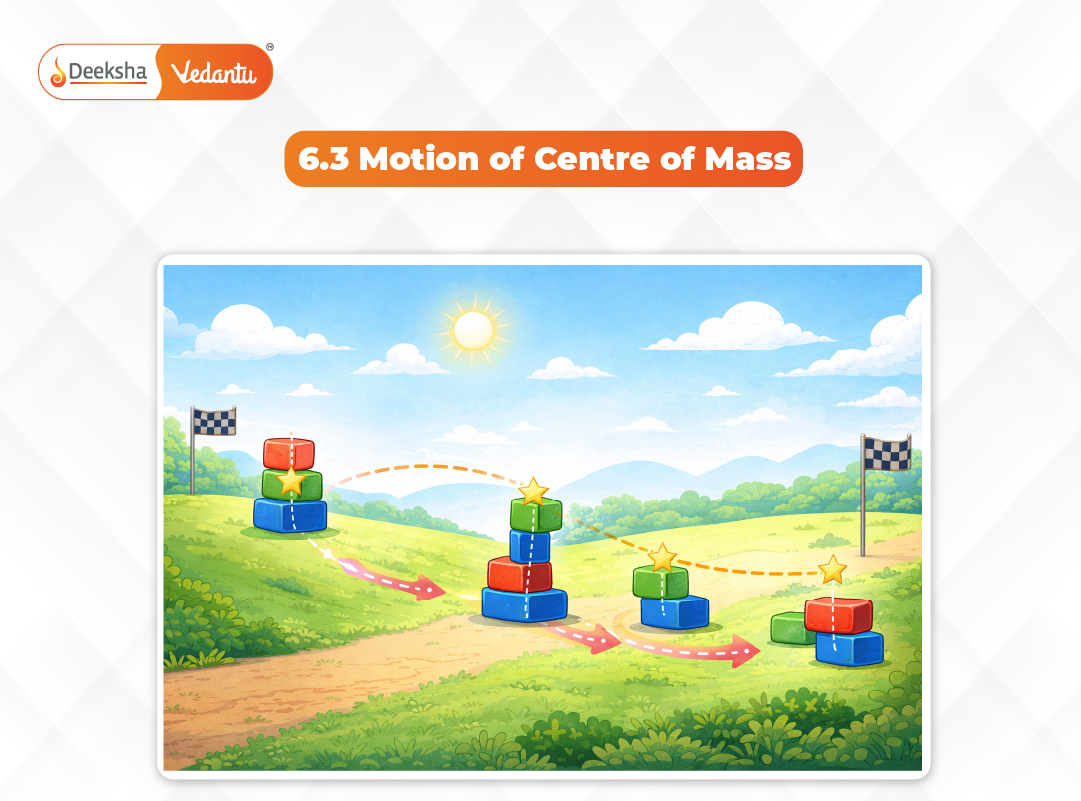


The true power of the centre of mass concept emerges when we analyze its motion. While Section 6.2 defined how to locate the centre of mass, this section explains how it moves under the action of forces. The central result we derive here is one of the most important equations in classical mechanics:

This equation states that the centre of mass of a system behaves exactly like a single particle of mass  subjected to the net external force acting on the system.
This result dramatically simplifies the analysis of multi-particle systems and is frequently tested in JEE Main, JEE Advanced, and NEET examinations.
1. Linear Momentum of a System of Particles
Consider a system consisting of  particles with masses
  and velocities
  .
.
The total linear momentum of the system is defined as:

Let the total mass of the system be:

The velocity of the centre of mass is given by:

Multiplying both sides by gives:

Thus,

This relation shows that the total momentum of a system equals the momentum of a single particle of mass moving with velocity  .
.
2. Derivation of the Equation of Motion of Centre of Mass
Differentiating total momentum with respect to time:

Applying Newton's Second Law to each particle:

Where:
 is the external force on particle
  .
. is the internal force due to other particles.
 is the external force on particle
  .
. is the internal force due to other particles.
Summing over all particles:

By Newton's Third Law, internal forces occur in equal and opposite pairs. Therefore,

Hence,

Since , we get:

If the total mass is constant:
This is the fundamental equation governing the motion of centre of mass.
3. Physical Interpretation and Significance
The equation
implies the following:
- Internal forces cannot change the motion of the centre of mass.
- Only the net external force determines the acceleration of CM.
- Complex internal interactions do not affect translational motion of the system.
This principle allows us to treat an entire system as a single particle for translational analysis.
4. Special and Important Cases
4.1 Absence of External Force
If

then

Therefore,

This is the mathematical expression of conservation of linear momentum.
4.2 System in Uniform Gravitational Field
If the system is in a uniform gravitational field,

Thus,

Hence, the centre of mass of any system in uniform gravity behaves like a projectile, regardless of internal rearrangements.
4.3 Variable Internal Motion with Fixed CM
If two particles initially at rest push apart due to internal forces,
Therefore,

Even though particles move in opposite directions, the centre of mass remains stationary.
5. Applications in Competitive Examinations
5.1 Explosion in Mid-Air
A projectile explodes into fragments at its highest point. Although fragments move in different directions, gravity remains the only external force.
Therefore,
Thus the centre of mass continues along the original projectile path.
5.2 Recoil of Gun
If a gun of mass fires a bullet of mass  with velocity
  and the system was initially at rest:

Hence recoil velocity is:

The centre of mass remains at rest if initially at rest.
5.3 Two-Body Interaction on Smooth Surface
If two masses connected by a spring are placed on a frictionless surface and released,
Hence,
If initially zero, CM remains fixed.
5.4 Moving System with Internal Energy Change
Even if internal potential energy converts into kinetic energy during explosion or separation,
remains valid.
Thus, redistribution of energy does not affect CM motion.
6. Conceptual Insights for JEE Advanced
- CM motion simplifies multi-body systems.
- Conservation of momentum is a direct consequence of the CM motion equation.
- Projectile explosion problems rely entirely on CM trajectory reasoning.
- CM motion remains independent of rotational motion of the system.
Understanding these principles allows students to solve otherwise complex problems using short and elegant reasoning.
FAQs
Q1. Why do internal forces not affect centre of mass motion?
Because internal forces cancel pairwise due to Newton's Third Law.
Q2. What happens to the centre of mass during an explosion?
If , then remains constant.
Q3. How is conservation of momentum related to CM motion?
When ,  remains constant, implying uniform motion of CM.
Q4. Does CM always follow projectile motion in gravity?
Yes, in a uniform gravitational field, .
Q5. Can CM remain at rest even if particles move relative to each other?
Yes. If total momentum is zero, CM remains at rest while internal motion occurs.
Conclusion
The motion of the centre of mass is governed by the elegant and powerful equation:
This result allows us to analyze multi-particle systems using the laws of motion for a single effective particle. From recoil and explosions to constrained systems and projectile breakup, the concept of CM motion is a high-yield and conceptually rich topic in mechanics.
Mastery of this principle forms a strong foundation for understanding angular momentum, rotational dynamics, and advanced mechanics in the upcoming sections of Chapter 6.



Get Social