
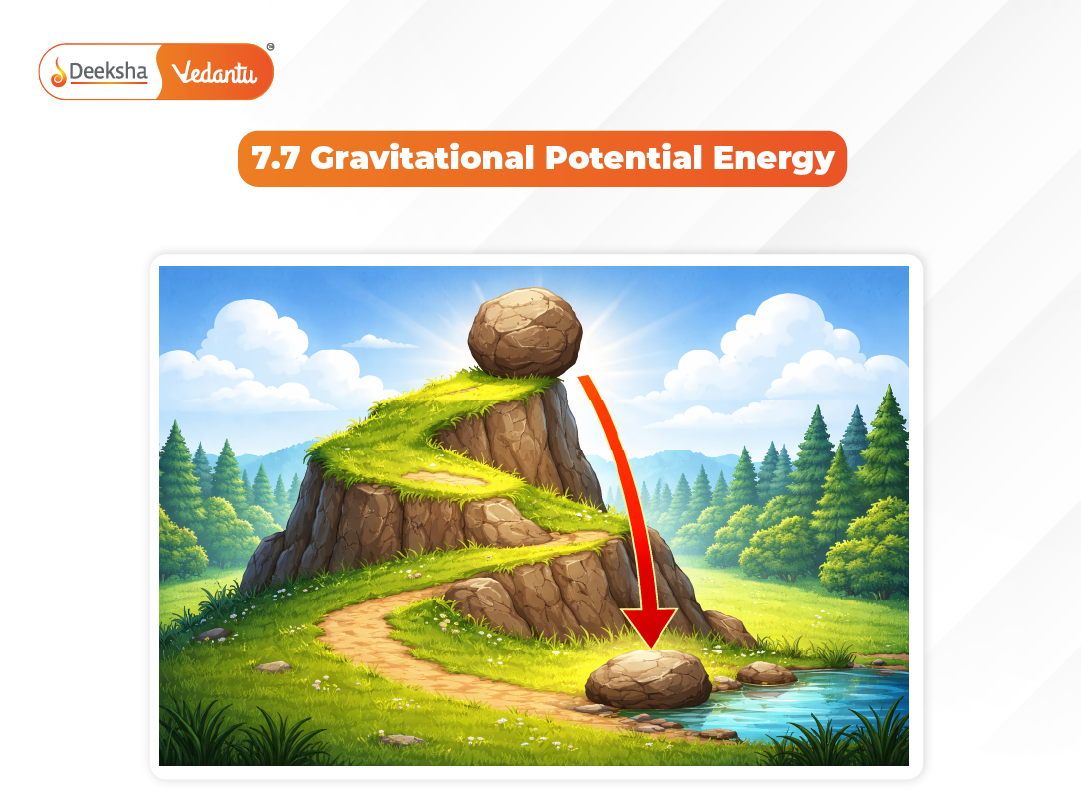


Gravitational potential energy is one of the most powerful concepts in gravitational physics. It arises because gravitational force is conservative in nature. Whenever a force is conservative, we can define a scalar quantity called potential energy whose change depends only on initial and final positions.
In near-Earth mechanics, we often use the simplified expression  . However, this is only a special approximation. The universal expression for gravitational potential energy depends on the inverse-square law and plays a crucial role in satellite motion, escape velocity, orbital binding energy, and planetary dynamics.
For JEE Main and JEE Advanced, this topic is extremely important because many multi-step problems are solved more efficiently using energy methods rather than force methods.
In this section, we will:
- Derive gravitational potential energy using work done
- Understand the physical meaning of negative energy
- Distinguish between gravitational potential and potential energy
- Derive the near-surface approximation

- Study orbital energy relations
- Analyze gravitational potential energy graphs
- Connect energy with escape velocity and binding energy
- Develop advanced JEE-level conceptual clarity
1. Conservative Nature of Gravitational Force
A force is called conservative if the work done by it between two points depends only on the initial and final positions and not on the path followed.
Gravitational force between two masses  and
and  separated by distance
  is:
is:

Since this force depends only on separation , it is conservative. Therefore, gravitational potential energy can be defined.
A key property of conservative forces is:

which means work done over any closed path is zero.
2. Derivation of Gravitational Potential Energy
Consider bringing a mass from infinity to a distance from a mass .
We define gravitational potential energy such that:

The work done by gravitational force in moving from infinity to is:

Substituting force expression:


Evaluating integral:
![\boldsymbol{W = - GMm \left[- \frac{1} \right]_{\infty}^}](https://deekshalearning.com/wp-content/ql-cache/quicklatex.com-ccdc36b1561c4cbcb35faf96393b0a0a_l3.png "Rendered by QuickLaTeX.com")

Thus gravitational potential energy is:

This is the universal expression valid at any distance from the central mass.
3. Physical Meaning of Negative Potential Energy
The negative sign has deep physical meaning.
- At infinity,

- At finite distance,


This indicates that gravitational systems are bound systems.
To separate the masses to infinity, energy equal to:

must be supplied.
The more negative the energy, the more tightly bound the system.
This concept is fundamental in orbital mechanics and astrophysics.
4. Gravitational Potential vs Potential Energy
Gravitational potential  is defined as potential energy per unit mass.

Thus:

Important distinction:
- Potential depends only on source mass
 .
. - Potential energy depends on both and
 .
.
Gravitational field is related to potential by:

For radial case:

Differentiating:

This confirms consistency between force and potential formulations.
5. Near-Earth Approximation: Derivation of mgh
Universal expression:

Using binomial approximation for  :
:

Thus:

Since:

Change in potential energy becomes:

Thus  is only a local approximation valid for small heights.
6. Total Mechanical Energy in Gravitational Field
Total mechanical energy is:

For circular orbit:

Thus:

Kinetic energy:

Potential energy:

Total energy:

Important relations:


Total energy negative implies bound orbit.
7. Energy in Elliptical Orbit
For elliptical orbit, total energy depends only on semi-major axis  :
:

This remarkable result means total energy does not depend on instantaneous position.
Thus a planet moves faster at perihelion and slower at aphelion, but total energy remains constant.
This concept is frequently used in JEE Advanced problems.
8. Escape Energy and Escape Velocity
To remove a mass from distance to infinity, required energy equals magnitude of potential energy:

Equating kinetic energy with required escape energy:

Thus escape velocity:

This shows a direct connection between potential energy and escape speed.
9. Binding Energy Concept
Binding energy of a gravitational system is the energy required to separate it to infinity.
For Earth–satellite system in circular orbit:
Thus binding energy equals magnitude of total energy.
More negative energy means stronger gravitational binding.
This idea extends to stars and galaxies.
10. Graph of Gravitational Potential Energy
Expression:
Graph features:
- At
 ,
, 
- As
 decreases,
  becomes more negative
 - Curve asymptotically approaches negative infinity as

 ,
, 
 becomes more negative
Slope of graph gives force:

Graph interpretation is frequently tested in JEE Advanced.
11. Multi-Particle System
For system of particles:

Each pair contributes to total potential energy.
This is important in advanced problems involving three-body systems.
12. Important JEE Insights
- is a local approximation of the universal formula.
- Negative total energy implies a bound system.
- Total orbital energy depends only on the semi-major axis.
- Escape energy equals magnitude of potential energy.
- Force equals negative gradient of potential.
Energy methods simplify many multi-step gravitational problems.
FAQs
Q1. Why is gravitational potential energy negative?
Because zero energy is chosen at infinity and energy must be supplied to separate the masses.
Q2. What is the difference between gravitational potential and potential energy?
Potential is energy per unit mass, while potential energy depends on both interacting masses.
Q3. Why is only approximate?
Because it assumes constant gravity and small height compared to Earth's radius.
Q4. What does negative total energy indicate?
It indicates a gravitationally bound system.
Q5. On what does the total energy of orbit depend?
It depends only on the semi-major axis of the orbit.
Conclusion
Gravitational potential energy arises from the conservative nature of gravitational force. Its universal expression governs planetary motion, satellite dynamics, orbital binding, and escape velocity.
Understanding its derivation, negative sign, connection to orbital motion, and approximation to near Earth's surface is essential for mastering gravitational mechanics.
A strong command of energy-based reasoning provides a powerful toolset for solving advanced JEE Main and JEE Advanced problems efficiently.



Get Social