
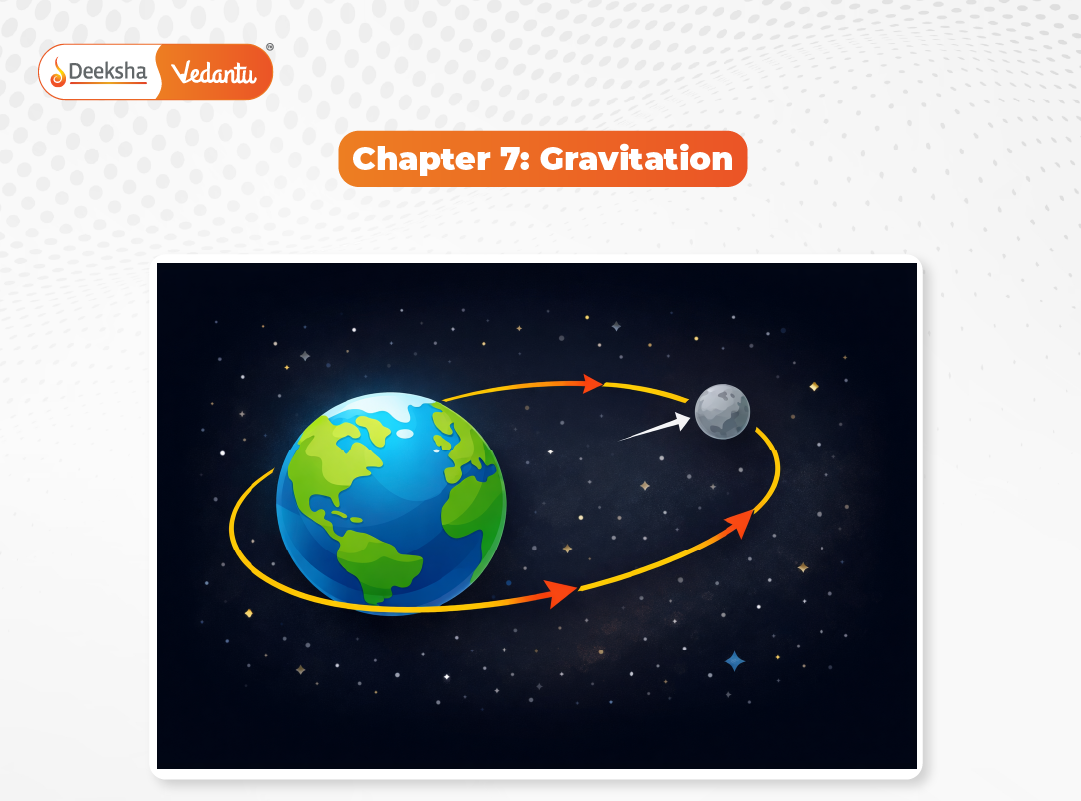


Gravitation is one of the four fundamental forces of nature and the most far-reaching interaction known in physics. It governs the motion of planets around the Sun, the motion of the Moon around Earth, the formation of stars and galaxies, ocean tides, and even the large-scale structure of the universe. In this chapter, we move from terrestrial mechanics to celestial mechanics and uncover the universal principles that connect a falling apple to orbiting planets.
This chapter is extremely important for JEE Main, JEE Advanced, and NEET because it blends concepts from mechanics, energy, circular motion, and conservation laws into one unified framework.
In this chapter, we systematically develop:
- Kepler's Laws of Planetary Motion
- Newton's Universal Law of Gravitation
- Gravitational Constant
- Acceleration Due to Gravity
- Variation of g with Height and Depth
- Gravitational Potential and Potential Energy
- Escape Speed
- Motion of Earth Satellites
- Energy of Orbiting Satellites
Each section includes derivations, conceptual explanations, and exam-oriented insights.
7.1 Introduction
Every particle in the universe attracts every other particle with a force called gravitational force. This universal attraction explains:
- Why objects fall toward Earth
- Why the Moon revolves around Earth
- Why planets orbit the Sun
- Why tides occur in oceans
- Why satellites remain in orbit
Historically, Galileo studied falling bodies, Kepler analyzed planetary motion using astronomical data, and Newton unified these ideas through the universal law of gravitation.
Gravitational force has the following characteristics:
- It is always attractive.
- It acts between all masses.
- It is a long-range force.
- It follows an inverse-square law.
Understanding gravitation allows us to link terrestrial and celestial phenomena using one mathematical law.
7.2 Kepler's Laws of Planetary Motion
Johannes Kepler, using Tycho Brahe's observational data, formulated three empirical laws describing planetary motion.
First Law – Law of Orbits
Planets move in elliptical orbits with the Sun at one focus.
An ellipse is defined by:
- Semi-major axis: a
- Semi-minor axis: b
- Distance between foci: 2c
Eccentricity is given by:

If  , the orbit becomes circular.
This law replaced the earlier belief that planetary motion was perfectly circular.
Second Law – Law of Areas
The line joining the Sun and the planet sweeps out equal areas in equal intervals of time.
Mathematically, areal velocity is constant.
This implies:
- Planet moves fastest at perihelion.
- Planet moves slowest at aphelion.
This law reflects conservation of angular momentum.
Third Law – Law of Periods
The square of the time period of revolution is proportional to the cube of the semi-major axis:

For circular orbits around mass  :
:

This relation will be derived using Newton's law of gravitation.
7.3 Universal Law of Gravitation
Newton proposed that every pair of point masses attracts each other with force:

Where:
 is the universal gravitational constant
 is separation between masses
 is separation between masses
Vector form:

Key properties:
- Always attractive
- Follows inverse square dependence
- Central force
- Conservative force
Because it is conservative, gravitational potential energy can be defined.
7.4 The Gravitational Constant
The value of  was measured by Henry Cavendish using a torsion balance experiment.

This experiment also allowed calculation of Earth's mass.
Using:

Earth's mass can be determined.
7.5 Acceleration Due to Gravity
Force on mass m at Earth's surface:

Using  :
:

Numerically:

Acceleration due to gravity depends on Earth's mass and radius.
7.6 Variation of g with Height and Depth
At Height h Above Surface

For  :
:

Thus g decreases with height.
At Depth d Below Surface
Assuming uniform density:

Thus g decreases linearly with depth and becomes zero at Earth's center.
These variations are important in advanced problems.
7.7 Gravitational Potential and Potential Energy
Gravitational potential at distance r:

Potential energy of mass m:

Total mechanical energy:

Negative potential energy indicates a bound system.
For system of particles:

7.8 Escape Speed
Escape speed is the minimum speed required to escape Earth's gravitational field.
Using energy conservation:

Thus:

Using :

Numerical value:

Escape speed is independent of direction and mass of projectile.
7.9 Motion of Earth Satellites
For circular orbit radius r:

Orbital speed:

Time period:

For low Earth orbit:

Satellites are in continuous free fall.
7.10 Energy of an Orbiting Satellite
Kinetic energy:

Potential energy:

Total energy:

Important relationships:

- Total energy is negative for bound orbit
- Larger orbital radius means higher (less negative) total energy

These relations are heavily used in JEE Advanced problems.
7.11 Important JEE Concepts
- Comparison between gravitational and electrostatic force
- Energy of circular vs elliptical orbit
- Gravitational field intensity
- Change in orbital velocity with altitude
- Stability of satellite motion
Understanding derivations and energy relations is critical for solving multi-step questions.
FAQs
Q1. Why is gravitational potential energy negative?
Because zero potential is taken at infinity and work must be done against gravity to separate masses.
Q2. Does escape speed depend on direction?
No. It depends only on the magnitude of speed.
Q3. Why do astronauts feel weightless in orbit?
Because they are in continuous free fall along with the spacecraft.
Q4. Why is total energy negative for satellites?
Because they are gravitationally bound systems.
Q5. Why does g decrease inside Earth?
Only the mass enclosed within radius contributes to gravitational force.
Conclusion
Gravitation unifies terrestrial and celestial mechanics under one elegant inverse-square law. From Kepler's observational laws to Newton's universal gravitation, this chapter builds the mathematical framework that explains orbital motion, satellite dynamics, escape velocity, and gravitational energy.
A strong conceptual grasp of gravitation is essential for mastering orbital mechanics and solving high-level JEE problems involving energy methods, conservation laws, and circular motion. This chapter forms a bridge between classical mechanics and astrophysics, revealing the universal nature of gravitational interaction.



Get Social