


Introduction
The concept of Equilibrium of a Particle is a direct and crucial application of Newton's Laws of Motion, especially the First and Second Laws. It deals with physical situations in which a particle does not undergo any acceleration, meaning that its velocity remains constant in magnitude and direction. Such situations include both rest and uniform motion.
Although equilibrium problems may appear straightforward at first glance, they demand a deep understanding of force balance, vector resolution, and free body diagrams. For this reason, equilibrium of a particle forms a vital part of JEE mechanics and often acts as a foundation for more complex topics such as friction, constrained motion, circular motion, and rigid body dynamics. At Deeksha Vedantu, this topic is emphasised as a core skill that trains students to analyse forces logically rather than relying on memorised formulas.
What Is Meant by Equilibrium?
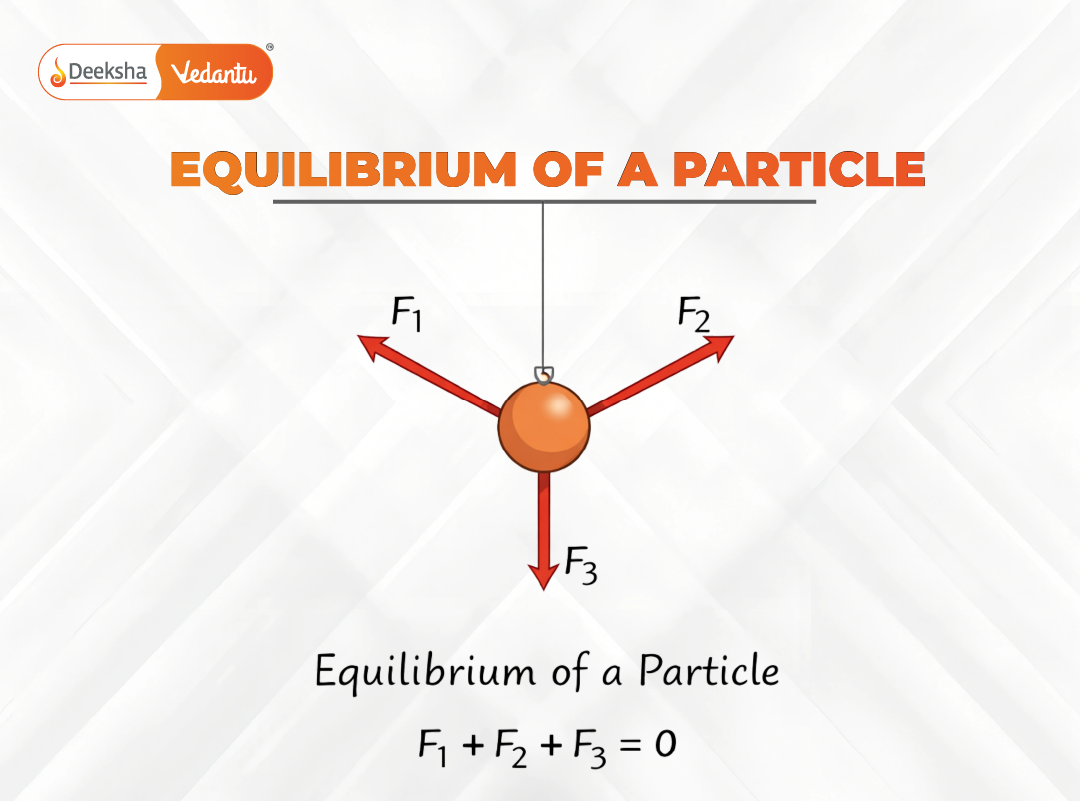
A particle is said to be in equilibrium when the net external force acting on it is zero.
Mathematically, the condition for equilibrium is expressed as:

This condition implies that the acceleration of the particle is zero. Depending on its initial state, the particle may either remain at rest or continue moving with uniform velocity. Thus, equilibrium does not necessarily imply rest; it simply implies the absence of acceleration.
Physical Interpretation of Equilibrium
The idea of equilibrium highlights that forces acting on a particle can be present yet perfectly balanced. When forces cancel each other vectorially, their combined effect on motion becomes zero. This balanced condition is the key to understanding many real-life systems that appear motionless or move steadily despite multiple forces acting simultaneously.
Understanding this physical interpretation helps students distinguish between the presence of forces and the effect of forces, a distinction that is frequently tested in JEE problems.
Types of Equilibrium
Equilibrium of a particle can be broadly classified into two main types based on the state of motion of the particle.
Static Equilibrium
In static equilibrium, the particle remains at rest under the action of balanced forces.
Examples include:
- A book resting on a horizontal table
- A lamp hanging motionless from the ceiling
- A signboard suspended by cables
In each case, forces such as weight, tension, and normal reaction balance each other exactly.
Dynamic Equilibrium
In dynamic equilibrium, the particle moves with constant velocity even though forces are acting on it.
An example is a car moving on a straight, level road with constant speed, where the driving force balances friction and air resistance. Despite the presence of multiple forces, the net force remains zero.
Relation Between Equilibrium and Newton's Laws
Equilibrium is a direct consequence of Newton's First Law, which states that a body remains at rest or in uniform motion unless acted upon by a net external force.
From Newton's Second Law:

For equilibrium, acceleration  , which immediately leads to:
Thus, equilibrium represents a special but extremely important case of Newton's Laws where forces are present but acceleration is absent.
Role of Free Body Diagrams in Equilibrium Problems
Free Body Diagrams (FBDs) are the most important analytical tool for solving equilibrium problems. An FBD represents all the external forces acting on a particle after isolating it from its surroundings.
Steps for solving equilibrium problems using FBDs include:
- Isolating the particle from the system
- Identifying and drawing all forces acting on it
- Choosing convenient and mutually perpendicular coordinate axes
- Resolving all forces into components along chosen axes
- Applying equilibrium conditions along each axis
At Deeksha Vedantu, strong emphasis is placed on mastering FBDs because the majority of equilibrium-related errors in JEE arise from missing forces or incorrect force directions rather than mathematical mistakes.
Conditions of Equilibrium in One Dimension
For a particle in equilibrium along a straight line, the algebraic sum of forces along that line must be zero.

This condition is commonly applied in vertical equilibrium problems involving weight, tension, and normal reaction, such as objects hanging from strings or resting on horizontal surfaces.
Example (One-Dimensional Equilibrium):
A mass hanging from a vertical string remains at rest when the upward tension in the string balances the downward gravitational force.
Conditions of Equilibrium in Two Dimensions
In two-dimensional equilibrium problems, forces act along different directions in a plane.
The conditions for equilibrium are:

Resolving forces along perpendicular directions simplifies analysis and is essential for solving JEE-level problems involving inclined planes, strings, and pulley systems.
Example (Two-Dimensional Equilibrium):
A particle suspended by two strings at different angles is in equilibrium when the horizontal components of the tensions cancel each other and the vertical components together balance the weight of the particle.
Conditions of Equilibrium in Three Dimensions
In three-dimensional equilibrium, forces act along all three mutually perpendicular directions in space. Such cases arise when a particle is supported by three non-coplanar forces.
The conditions of equilibrium are:

All three conditions must be satisfied simultaneously.
Example (Three-Dimensional Equilibrium):
A particle suspended by three non-coplanar strings attached to a ceiling remains in equilibrium when the vector sum of the three tension forces exactly balances the particle's weight.
Common Forces in Equilibrium Problems
Some forces frequently encountered in equilibrium of a particle problems include:
- Weight of the particle due to gravity
- Normal reaction from surfaces
- Tension in strings, ropes, or cables
- Frictional force between surfaces in contact
- Applied external forces
Correct identification and representation of these forces are critical for satisfying equilibrium conditions accurately.
Special Cases of Equilibrium
Equilibrium of a Hanging Particle
A particle hanging by a string is in equilibrium when the upward tension in the string balances the downward weight of the particle.
Equilibrium on an Inclined Plane
For a particle on an inclined plane, equilibrium depends on the balance between the component of gravitational force along the plane, the normal reaction, and friction.
Equilibrium with Multiple Strings
When a particle is connected to multiple strings, equilibrium requires that the vector sum of all tensions and other forces acting on the particle is zero. Such problems demand careful vector resolution.
Importance of Equilibrium of a Particle for JEE
The concept of equilibrium of a particle is extremely important for JEE because:
- It strengthens the understanding of force balance
- It forms the basis for friction and constrained motion problems
- It is frequently tested in both conceptual and numerical questions
- It develops skill in drawing and analysing free body diagrams
At Deeksha Vedantu, students are encouraged to approach equilibrium problems as force-balancing exercises rather than equation-based shortcuts, leading to better conceptual clarity.
Common Conceptual Errors (JEE Perspective)
Students often make mistakes such as:
- Assuming equilibrium implies absence of forces
- Ignoring the vector nature of forces
- Forgetting to resolve forces into components
- Drawing incomplete or incorrect free body diagrams
Recognising and avoiding these errors is essential for scoring well in mechanics.
FAQs
Q1. What is the equilibrium of a particle?
A particle is in equilibrium when the net external force acting on it is zero.
Q2. Can a particle in equilibrium be moving?
Yes, a particle in dynamic equilibrium can move with constant velocity.
Q3. Which Newton's Law explains equilibrium?
Newton's First Law explains the condition of equilibrium.
Q4. Why are free body diagrams important in equilibrium problems?
They help identify all forces acting on the particle and apply equilibrium conditions correctly.
Q5. Why is equilibrium of a particle important for JEE?
Because it forms the foundation for friction, constraints, and advanced mechanics problems.
Conclusion
The Equilibrium of a Particle is a foundational concept that reinforces the idea of force balance in mechanics. By understanding that equilibrium corresponds to zero net force and zero acceleration, students can confidently analyse a wide range of physical systems involving multiple forces. For JEE aspirants, mastering this topic is essential for tackling friction, tension, and constraint problems effectively. A structured, concept-driven approach, as emphasised at Deeksha Vedantu, ensures clarity, accuracy, and strong performance in competitive examinations.



Get Social